
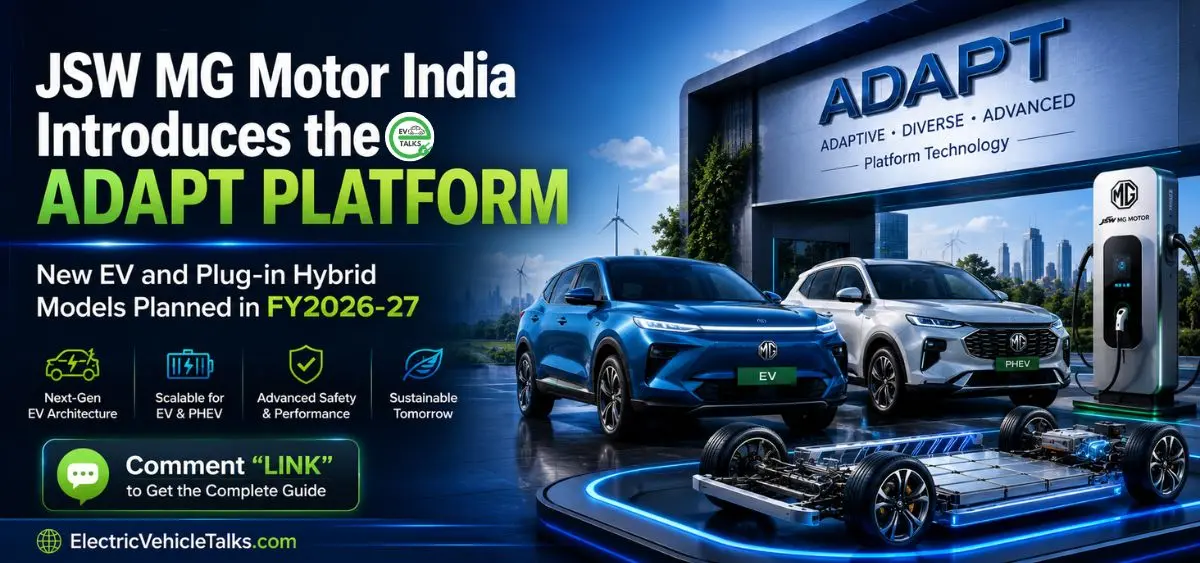

India’s electric mobility landscape is entering a new phase of innovation as JSW MG Unveils the ADAPT Platform, a next-generation modular architecture designed to support multiple New Energy Vehicle (NEV) technologies. Unlike conventional vehicle platforms that are limited to a single powertrain, the new Advance Drive Architecture Platform Technology (ADAPT) is engineered to accommodate Battery Electric Vehicles (EVs), Hybrid Electric Vehicles (HEVs), Plug-in Hybrid Electric Vehicles (PHEVs), and Range Extender Electric Vehicles (REEVs) on one intelligent platform.
The company has also confirmed that the first EV and PHEV based on ADAPT will arrive in India during FY2026–27, signaling the beginning of a new chapter in its electrification journey.
The announcement comes at a time when India’s automotive industry is rapidly embracing cleaner transportation. While battery electric vehicles continue to gain popularity, many customers still seek greater flexibility due to varying charging infrastructure, long-distance travel needs, and ownership costs. MG’s multi-energy strategy addresses these real-world challenges by offering different electrified powertrains on a common architecture instead of relying on a single technology.
As global automakers increasingly move toward software-defined and modular vehicle platforms, the ADAPT platform positions JSW MG Motor India among manufacturers preparing for the next generation of sustainable mobility. More importantly, it gives Indian consumers the freedom to choose the technology that best suits their driving habits without compromising on efficiency, performance, or convenience.
Key Highlights
- JSW MG Unveils the ADAPT Platform, India’s first Multi-New Energy Vehicle (NEV) architecture.
- Supports EV, HEV, PHEV, and REEV technologies using a single modular platform.
- The first electric vehicle and Plug-in Hybrid Electric Vehicle based on ADAPT are scheduled for launch in FY2026–27.
- Integrates a Dedicated Hybrid Engine, Dedicated Battery System, India’s first 10-in-1 Intelligent Electric Drive Unit, and the world’s first Electromagnetic Dedicated Hybrid Transmission.
- An intelligent energy management system automatically switches between four optimized drive modes.
- Platform designed to improve driving range, charging capability, performance, efficiency, safety, and refinement.
- Expected to become the technological foundation for JSW MG Motor India’s future New Energy Vehicle portfolio.
What is the MG ADAPT Platform?
The Advanced Drive Architecture Platform Technology (ADAPT) is a highly flexible modular vehicle architecture developed to support multiple electrified propulsion systems within a single engineering framework. Rather than creating separate platforms for electric vehicles, hybrids, plug-in hybrids, and range extender vehicles, MG has designed one intelligent architecture capable of accommodating all four technologies.
This approach significantly reduces development complexity while allowing engineers to introduce new vehicles faster, improve manufacturing efficiency, and adapt more quickly to changing customer preferences and government regulations.
According to the company, the platform has been engineered with future mobility in mind. Its modular construction allows greater flexibility in vehicle design while enhancing important performance parameters such as driving range, charging speed, efficiency, cabin refinement, safety, and overall driving dynamics.
Why Did JSW MG Develop the ADAPT Platform?
India’s transition toward electric mobility is progressing steadily, but the market remains highly diverse. Urban buyers are increasingly considering fully electric vehicles as charging infrastructure expands, while customers in smaller cities and highway users often prefer hybrid technologies that offer longer driving range and quicker refueling.
Instead of focusing exclusively on battery electric vehicles, JSW MG Motor India has adopted a multi-energy strategy that acknowledges these varying customer requirements.
The ADAPT platform allows the company to build different powertrain options without redesigning the entire vehicle architecture each time. This not only improves manufacturing efficiency but also gives customers greater freedom to choose the technology that best matches their lifestyle.
Speaking during the unveiling, Anurag Mehrotra, Managing Director, JSW MG Motor India, emphasized that the future of mobility should provide customers with multiple energy choices without compromising on performance, efficiency, or driving experience. He described ADAPT as the technological backbone for the company’s upcoming New Energy Vehicle lineup and a major step toward accelerating sustainable mobility in India.
Why Multi-Energy Platforms Are Becoming the Future of the Automotive Industry
Across the global automotive industry, manufacturers are moving away from designing separate platforms for every type of vehicle. Instead, they are investing billions in flexible architectures capable of supporting multiple propulsion technologies.
This shift offers several advantages:
- Faster product development.
- Lower manufacturing costs.
- Higher production efficiency.
- Easier software integration.
- Better scalability across different vehicle segments.
- Future readiness for evolving technologies.
Brands such as Volkswagen, Hyundai, Toyota, BYD, and Geely have already introduced advanced modular platforms for global markets. With JSW MG unveiling the ADAPT Platform, the company joins this global trend by introducing India’s first modular architecture capable of supporting four different New Energy Vehicle technologies under one roof.
For consumers, this means greater product choice, improved reliability, and access to newer technologies without waiting for entirely new vehicle platforms to be developed.
Why the ADAPT Platform Matters for Indian Buyers
India is one of the world’s fastest-growing automotive markets, but customer expectations vary widely depending on driving patterns, charging availability, and budget. Some buyers want the zero-emission benefits of an electric vehicle, while others need the confidence of a longer driving range offered by hybrid technologies.
The ADAPT platform directly addresses this challenge by allowing MG to introduce multiple electrified vehicles using the same engineering foundation.
Whether a customer prefers an electric SUV for city commuting, a plug-in hybrid for weekend road trips, or a future range extender vehicle that minimizes charging concerns, the platform provides the flexibility to meet those diverse needs.
From a long-term perspective, this strategy could also reduce production costs, improve component localization, and accelerate the introduction of advanced mobility technologies tailored specifically for Indian conditions.
Engineering Intelligence Behind the MG ADAPT Platform
The biggest strength of the JSW MG ADAPT Platform lies in its engineering philosophy. Rather than simply combining an internal combustion engine with an electric motor, MG has developed a fully integrated technology ecosystem where every major component works together to maximize efficiency, performance, and driving comfort.
Unlike conventional hybrid systems that often prioritize either fuel economy or performance, the ADAPT platform has been designed to intelligently balance both. The platform continuously analyzes driving conditions, battery status, vehicle speed, and power demand before selecting the most efficient operating mode automatically.
This intelligent architecture is expected to become the technological backbone of JSW MG Motor India’s future New Energy Vehicle (NEV) portfolio, offering customers a seamless driving experience regardless of the chosen powertrain.
Dedicated Hybrid Engine: Built Specifically for Electrified Mobility
At the heart of the ADAPT platform is a Dedicated Hybrid Engine that has been developed exclusively for hybrid applications rather than adapted from a conventional petrol engine.
Unlike traditional engines designed primarily for standalone operation, a dedicated hybrid engine is optimized to work alongside an electric motor. This allows it to operate within its most efficient RPM range, reducing fuel consumption while delivering higher thermal efficiency.
Key benefits include the following:
- Higher fuel efficiency
- Reduced emissions
- Better thermal efficiency
- Lower engine stress
- Quieter operation
- Improved long-distance cruising
Because the electric motor handles low-speed driving and initial acceleration, the engine can focus on delivering consistent power whenever additional energy is required. This results in smoother driving while minimizing unnecessary fuel consumption.
Dedicated Battery System Enhances Safety and Efficiency
Supporting the hybrid engine is a Dedicated Battery System designed specifically for electrified applications.
Unlike conventional 12V vehicle batteries, this advanced battery pack delivers instant electric power to the drive motor while maintaining high efficiency under varying driving conditions.
According to MG, the battery system provides the following:
- Instant electric acceleration
- Enhanced operational safety
- High charging efficiency
- Better energy utilization
- Reliable power delivery
The battery continuously communicates with the Intelligent Energy Management System, ensuring that charging and discharging occur at the most efficient times to maximize battery life and overall vehicle performance.
India’s First 10-in-1 Intelligent Electric Drive Unit
One of the most significant innovations introduced through the ADAPT platform is India’s first 10-in-1 Intelligent Electric Drive Unit (EDU).
Traditional electric drivetrains often rely on multiple separate components, increasing weight, wiring complexity, and maintenance requirements. MG’s integrated solution combines ten major functions into a single compact unit.
This integrated approach offers several advantages:
- Reduced system complexity
- Lower overall vehicle weight
- Better packaging efficiency
- Improved reliability
- Faster power delivery
- Higher drivetrain efficiency
- Lower maintenance requirements
By reducing the number of individual components, engineers can optimize energy transfer while creating additional cabin and storage space for future vehicle designs.
The compact design also contributes to improved manufacturing efficiency, making future electrified vehicles easier to produce at scale.
World’s First Electromagnetic Dedicated Hybrid Transmission
Perhaps the most technically advanced feature of the ADAPT platform is the world’s first Electromagnetic Dedicated Hybrid Transmission (DHT).
Unlike conventional automatic or continuously variable transmissions (CVTs), this advanced system uses electromagnetic control to seamlessly coordinate power delivery between the petrol engine and electric motor.
The result is:
- Faster power transitions
- Smooth acceleration
- Reduced drivetrain losses
- Improved fuel economy
- Better responsiveness
- Refined driving characteristics
Drivers benefit from near-imperceptible transitions between electric and hybrid operation, creating a driving experience that feels both responsive and effortless.
This innovation also helps maximize the efficiency of the hybrid powertrain by ensuring that engine and motor output are always delivered most effectively.
Intelligent Energy Management System: The Brain Behind ADAPT
While advanced hardware forms the foundation of the ADAPT platform, its real intelligence comes from the Intelligent Energy Management System (IEMS).
This sophisticated control software continuously monitors numerous parameters, including:
- Battery charge level
- Vehicle speed
- Throttle input
- Road conditions
- Driver demand
- Engine efficiency
- Electric motor load
Based on real-time data, the system automatically determines which propulsion source should be used to deliver the best combination of efficiency, performance, and driving comfort.
The transition between operating modes occurs seamlessly without requiring any driver intervention.
This intelligent optimization ensures that energy is always used efficiently, whether driving through congested city traffic or cruising on highways.
Four Intelligent Drive Modes Explained
One of the standout features of the ADAPT platform is its ability to automatically switch between four dedicated driving modes depending on road conditions and driving requirements.
1. Pure Electric Drive
During low-speed city driving, the vehicle operates entirely on electric power.
In this mode:
- Zero tailpipe emissions
- Silent operation
- Instant torque
- Smooth acceleration
- Ideal for urban commuting
This mode maximizes battery usage while minimizing fuel consumption.
2. Series Hybrid Drive
When additional energy is required and the battery charge decreases, the petrol engine starts functioning as a generator.
Importantly, the engine does not directly drive the wheels.
Instead:
- The engine generates electricity.
- An electric motor powers the vehicle.
- The battery receives continuous charging support.
- Driving remains smooth and electric-like.
This operating mode provides an excellent balance between efficiency and driving range.
3. Parallel Hybrid Drive
For situations requiring greater acceleration or climbing steep gradients, both the petrol engine and electric motor work together.
Benefits include:
- Higher combined power
- Better overtaking performance
- Faster acceleration
- Improved efficiency under heavy loads
This mode is particularly useful during highway merging and demanding driving conditions.
4. Engine Direct Drive
During sustained high-speed highway cruising, the system allows the engine to directly drive the wheels.
Since internal combustion engines operate more efficiently at constant highway speeds, this mode helps:
- Improve fuel economy
- Reduce battery usage
- Lower energy losses
- Enhance long-distance efficiency
The transition between all four modes happens automatically, allowing drivers to focus entirely on the road while the platform optimizes energy usage in the background.
REEV Technology: Eliminating Range Anxiety
Another major advantage of the ADAPT platform is its compatibility with Range Extender Electric Vehicle (REEV) technology.
Unlike a conventional hybrid, a REEV is always driven by an electric motor. The petrol engine never powers the wheels directly. Instead, it acts solely as a generator to recharge the battery whenever additional energy is required.
This design delivers the smooth, instant acceleration of an electric vehicle while significantly extending the vehicle’s usable range for long-distance travel.
For Indian buyers who frequently undertake highway journeys or live in areas with limited charging infrastructure, REEV technology offers a practical middle ground between traditional hybrids and fully electric vehicles.
As India’s charging network continues to expand, REEVs can serve as an effective transition technology, combining the benefits of electric driving with the confidence of extended range. According to the official announcement, ADAPT’s modular architecture has been engineered to support this technology as part of MG’s long-term New Energy Vehicle strategy.
How the ADAPT Platform Fits into India’s Rapidly Evolving EV Ecosystem
India’s automotive industry is undergoing one of its biggest transformations in decades. While internal combustion engine (ICE) vehicles continue to dominate overall sales, the adoption of New Energy Vehicles (NEVs) is accelerating rapidly due to supportive government policies, expanding charging infrastructure, rising fuel prices, and growing environmental awareness.
According to industry estimates, India is expected to become one of the world’s largest electric vehicle markets by the end of this decade. Government initiatives such as the PM E-DRIVE Scheme, state-level EV policies, tax incentives, and investments in public charging infrastructure are encouraging both consumers and manufacturers to transition toward cleaner mobility.
However, India’s diverse geography and varying infrastructure mean that a one-size-fits-all approach to electrification is unlikely to succeed. While metropolitan cities are witnessing increasing EV adoption, many customers in Tier-2 and Tier-3 cities still require the flexibility of hybrid or range-extender technologies due to limited charging availability.
This is precisely where JSW MG unveils the ADAPT Platform as a future-ready solution. By supporting EVs, HEVs, PHEVs, and REEVs on a single modular architecture, MG is preparing for multiple customer needs instead of relying solely on one technology.
Why Multi-Energy Platforms Are Becoming a Global Trend
The global automotive industry is moving away from developing separate vehicle architectures for different powertrains. Instead, leading manufacturers are investing heavily in modular platforms that can support multiple propulsion technologies.
This strategy offers several advantages:
- Reduced development costs
- Faster vehicle launches
- Simplified manufacturing
- Higher production efficiency
- Easier software updates
- Better scalability across vehicle segments
- Lower long-term ownership costs
Rather than redesigning an entirely new vehicle for every powertrain, manufacturers can use one common architecture while offering different propulsion options based on regional market demand.
For India, where consumer preferences differ significantly across states and cities, this flexibility becomes even more valuable.
How MG’s Strategy Compares with Other Automakers
The introduction of the ADAPT platform places JSW MG Motor India alongside several global manufacturers that have embraced modular vehicle architectures. However, MG’s approach differs in one important way—its emphasis on multi-energy flexibility rather than on focusing exclusively on battery-electric vehicles.
- Tata Motors: Tata Motors has successfully expanded its electric vehicle portfolio with models such as the Nexon EV, Punch EV, Curvv EV, Tiago EV, and the recently launched Sierra EV. While Tata continues to invest in dedicated EV architectures, its strategy is primarily centered on battery-electric mobility.
- Mahindra: Mahindra has introduced its INGLO platform for future electric SUVs, designed specifically for battery-electric vehicles. It focuses on software-defined architecture, advanced connectivity, and premium EV performance.
- Hyundai: Globally, Hyundai’s Electric-Global Modular Platform (E-GMP) underpins several high-performance EVs, including the IONIQ lineup. It has become one of the industry’s benchmark EV-only platforms but is dedicated exclusively to battery-electric vehicles.
- BYD: Chinese EV giant BYD has developed its highly advanced e-Platform and Blade Battery technology, enabling impressive efficiency, fast charging, and safety. Like Hyundai’s E-GMP, BYD’s architecture is primarily optimized for fully electric vehicles.
- Toyota: Toyota continues to lead hybrid technology worldwide through its TNGA platform and advanced hybrid systems. Its long-term strategy combines hybrids, plug-in hybrids, hydrogen fuel-cell vehicles, and battery-electric vehicles to address different global markets.
Where ADAPT Stands Out
MG’s ADAPT platform takes a broader approach by integrating EV, HEV, PHEV, and REEV technologies into a single intelligent architecture. This flexibility enables the company to respond more effectively to changing market conditions while offering customers multiple electrified options without redesigning the underlying vehicle platform.
Benefits of the ADAPT Platform for Indian Consumers
For buyers, the ADAPT platform is not just another engineering upgrade—it represents greater flexibility in choosing the right vehicle for their lifestyle.
a) Urban Commuters
Drivers who primarily travel within cities can benefit from fully electric vehicles offering the following:
- Zero tailpipe emissions
- Lower running costs
- Silent operation
- Instant acceleration
- Reduced maintenance requirements
b) Highway Users
Customers covering long distances frequently may prefer plug-in hybrid or range extender vehicles that combine electric driving with the reassurance of extended range and quick refueling.
c) First-Time EV Buyers
Many Indian consumers remain hesitant to switch directly to a fully electric vehicle due to concerns about charging infrastructure and range anxiety. Hybrid and REEV technologies available through the ADAPT platform provide a practical transition toward electrification while retaining the convenience of conventional refueling.
d) Fleet Operators
Commercial users, ride-hailing fleets, and corporate mobility providers can also benefit from multiple powertrain choices based on operational requirements, helping reduce fuel costs while improving sustainability.
What the ADAPT Platform Could Mean for MG’s Future Lineup
Although JSW MG Motor India has confirmed that the first Electric Vehicle and Plug-in Hybrid Electric Vehicle based on the ADAPT platform will arrive during FY2026–27, the company has not yet revealed the production models that will debut on the architecture.
Industry observers expect the platform to underpin a wide range of future products, including:
- Next-generation electric SUVs
- Premium plug-in hybrid SUVs
- Intelligent urban crossovers
- Long-range family vehicles
- Future Range Extender Electric Vehicles (REEVs)
Given the modular nature of ADAPT, MG could also introduce vehicles across multiple price segments while sharing common engineering components to improve manufacturing efficiency and localization.
Expert Insight from Electric Vehicle Talks
From an industry perspective, JSW MG Unveils the ADAPT Platform at a pivotal moment for India’s automotive sector. While fully electric vehicles are gaining momentum, the market is still evolving, and consumer needs vary widely based on driving habits, infrastructure, and affordability.
Instead of committing exclusively to battery-electric mobility, MG has chosen a more adaptable strategy that recognizes India’s unique market dynamics. The ability to build EVs, hybrids, plug-in hybrids, and range extender vehicles on one intelligent platform gives the company significant flexibility to respond to future policy changes, technological advancements, and customer preferences.
The integration of advanced technologies such as a Dedicated Hybrid Engine, India’s first 10-in-1 Intelligent Electric Drive Unit, the world’s first Electromagnetic Dedicated Hybrid Transmission, and an Intelligent Energy Management System demonstrates that ADAPT is more than just a new vehicle platform—it is a comprehensive mobility ecosystem designed for the next generation of transportation.

Related Articles:









