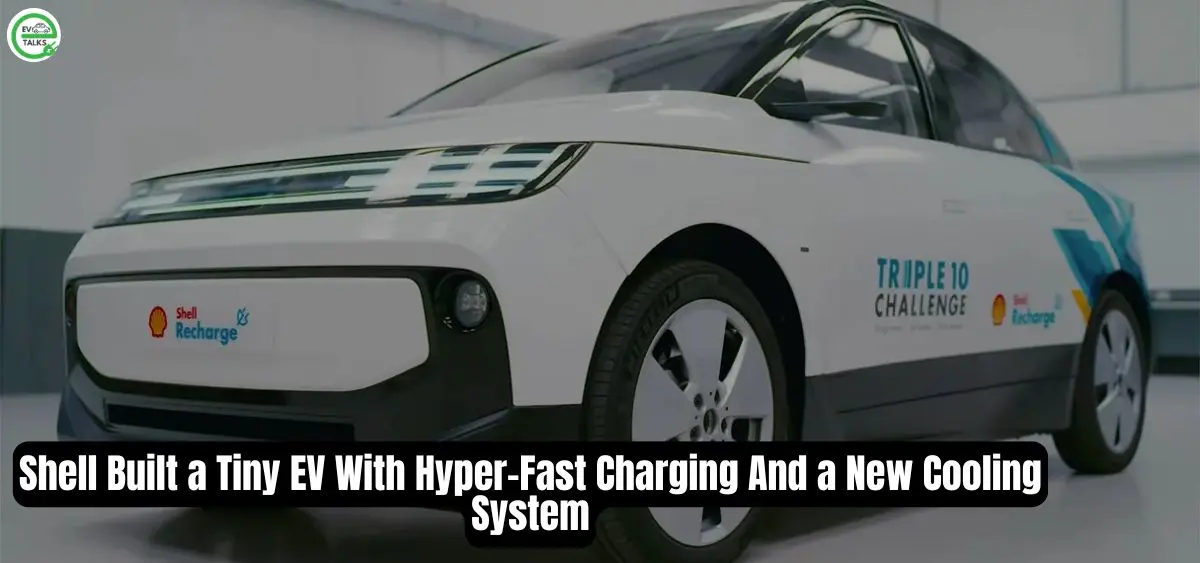

Shell built a Tiny EV With Hyper-Fast Charging and introduced an innovative battery cooling system that could significantly improve the future of electric vehicles. Although Shell has no plans to manufacture passenger EVs, its newly revealed Triple 10 Challenge Concept demonstrates how advanced thermal management can solve some of the biggest problems facing today’s electric cars, including charging speed, efficiency, and battery costs.
Developed with leading British automotive engineering companies, the compact five-door hatchback serves as a technology demonstrator designed to inspire global automakers rather than compete in the EV market.

What Does the Triple 10 Challenge Mean?
The Triple 10 Challenge is built around three ambitious performance goals:
- Charge the battery from 10% to 80% in just 9.54 minutes
- Deliver an impressive 10 km/kWh driving efficiency
- Keep total lifecycle carbon emissions below 10 metric tonnes of CO₂e
Together, these targets aim to prove that smarter engineering can improve EV performance without relying on larger battery packs or next-generation battery chemistry.
Revolutionary Direct Immersion Cooling System
The biggest highlight of the concept is its advanced direct immersion cooling technology.
Unlike conventional EVs that use water-glycol coolant flowing through pipes around battery cells, Shell uses a specially developed dielectric thermal fluid that safely comes into direct contact with battery cells, electric motors, and power electronics.
Since the fluid does not conduct electricity, high-voltage components can be completely immersed, allowing heat to be removed much faster than traditional cooling methods. Better temperature control helps batteries maintain peak performance during demanding situations like rapid charging and high-speed driving.
Faster Charging Without Thermal Throttling
One of the biggest advantages of this system is dramatically improved fast charging.
Shell built a Tiny EV With Hyper-Fast Charging capability that allows the battery to recharge from 10% to 80% in under 10 minutes using a widely available 175 kW DC fast charger.
The concept adds approximately 25 km of driving range every minute, almost double the charging rate achieved by many current electric vehicles using similar charging power. Because heat is removed efficiently, the battery avoids thermal throttling, allowing it to sustain maximum charging speeds throughout most of the charging session.
Simpler Design, Lower Cost, Better Efficiency
The single-circuit immersion cooling system also cools the electric motor and power electronics, eliminating the need for multiple cooling loops and extensive internal plumbing.
This simplified architecture provides several important advantages:
- Around 25% lower battery pack manufacturing costs
- Reduced vehicle weight
- Smaller battery pack footprint
- Improved overall energy efficiency
- Downsized yet highly efficient electric drive units
Shell claims the concept delivers approximately 10 km per kWh, representing nearly a 30% efficiency improvement over many current-generation EVs.
Engineering Collaboration Behind the Concept
Several specialist automotive companies helped bring the Triple 10 Challenge to life.
- RML Group engineered the lightweight, pipe-free battery architecture.
- Empel Systems developed compact, high-efficiency electric drive units.
- HORIBA MIRA completed vehicle integration and validated the cooling system under demanding environmental conditions, confirming it performs reliably even in extreme weather using standard vehicle radiators.
The concept also features a futuristic exterior with digital side mirrors, flush door handles, aerodynamic wheels, and a minimalist interior equipped with a rotary gear selector.
Shell’s Real Business Strategy
While the concept may look production-ready, Shell has no intention of entering the automobile manufacturing business.
Instead, Shell built a Tiny EV with Hyper-Fast Charging to demonstrate the commercial potential of its proprietary Shell Recharge dielectric thermal fluid, produced from an ultra-pure natural gas-derived base oil. The company aims to supply this advanced cooling fluid to automakers developing the next generation of affordable, fast-charging electric vehicles.
By promoting immersion cooling technology, Shell hopes to create a long-term business opportunity in the rapidly expanding electric mobility sector.
Why This Concept Matters
The Triple 10 Challenge shows that improving battery cooling can be just as important as developing larger batteries. More efficient heat management enables faster charging, higher efficiency, lower manufacturing costs, and reduced lifecycle emissions without waiting for breakthrough battery chemistry.
Although the concept will never enter production, Shell built a Tiny EV with Hyper-Fast Charging to demonstrate a practical solution that could influence the design of future electric vehicles worldwide. If adopted by major automakers, immersion cooling technology may help make EVs faster to charge, more efficient to operate, and more affordable for consumers.

Related Articles: