
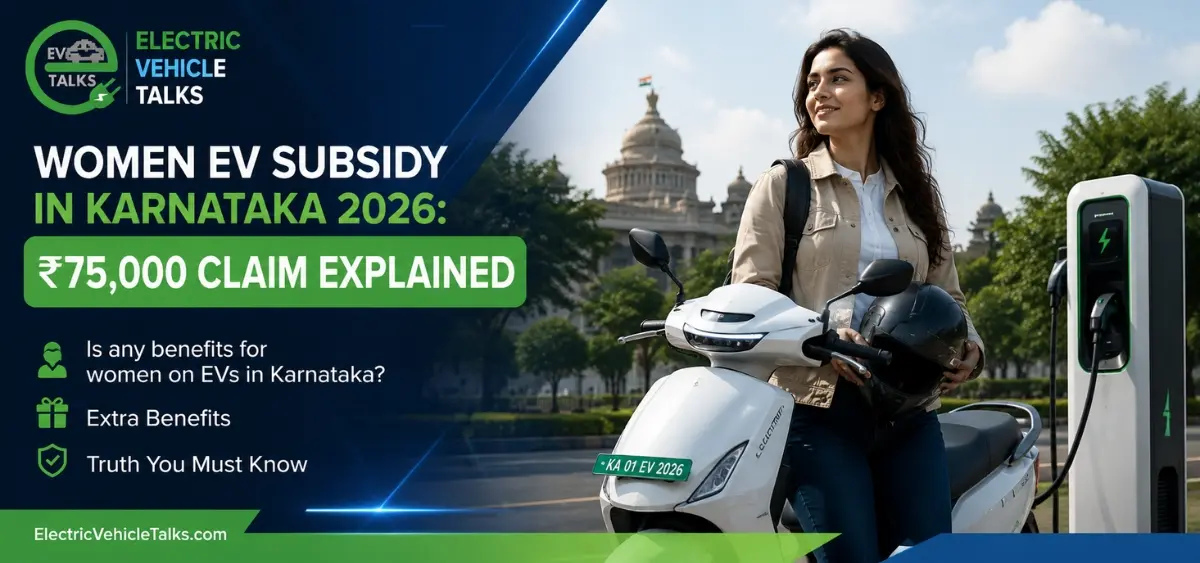

If you have recently searched for Women EV Subsidy in Karnataka 2026, you may have come across claims that women can receive an additional ₹75,000 subsidy on an electric scooter.
Here is the important answer upfront: there is no verified universal Karnataka government scheme that gives every woman ₹75,000 for purchasing an electric scooter. The ₹75,000 figure should therefore be treated as an online claim, not as an established statewide cash subsidy.
That does not mean women buying EVs in Karnataka receive no benefits. Eligible electric two-wheelers can benefit from applicable central incentives, while Karnataka continues to provide important policy support for electric mobility. Karnataka also has genuine women-focused financial programmes such as Udyogini, although these should not be confused with a universal EV purchase subsidy.
The distinction matters because subsidy misinformation can lead buyers to make decisions based on a discount that may not actually exist.
2026 Fact Check: No official source reviewed for this article establishes a universal ₹75,000 cash subsidy exclusively for women purchasing electric scooters in Karnataka. Buyers should verify any claimed benefit through the relevant government portal or department before paying a dealer.
Is there really a ₹75,000 EV subsidy for women in Karnataka in 2026?
No universal ₹75,000 women-only EV purchase subsidy has been verified.
Several online pages currently use phrases such as “EV Subsidy for Women in Karnataka 2026” and describe women-specific provisions, including employer-linked incentives. However, these secondary sources do not establish that the Karnataka government is depositing ₹75,000 into the account of every eligible woman who purchases an electric scooter.
This is where the confusion begins.
An EV buyer can potentially receive a combination of the following:
- A central-government incentive for an eligible electric two-wheeler.
- State-level EV policy benefits applicable to the vehicle category.
- Women-focused financial or entrepreneurship assistance, where separately eligible.
- Manufacturer or dealer offers.
Those four things are not the same as a ₹75,000 Karnataka women’s EV subsidy.
A dealer discount, corporate incentive, loan subsidy, or central EV incentive should not automatically be described as a Karnataka government women-specific subsidy.
Is There Any Subsidy for Women Buying an Electric Vehicle in Karnataka?
Then give a direct answer:
There is no verified universal Karnataka government subsidy exclusively for women buying an electric vehicle in 2026. Women can, however, benefit from applicable EV incentives such as PM E-DRIVE for eligible electric two-wheelers, Karnataka’s applicable EV tax benefits, and certain women-focused schemes where separate eligibility conditions are met. The widely circulated ₹75,000 women EV subsidy claim should not be treated as a confirmed universal government benefit without an official notification.
Why is the ₹75,000 figure trending?
The claim appears to have gained traction because several different government and welfare provisions have been combined in online articles and social-media discussions.
Karnataka has historically been one of India’s important EV markets and introduced policy measures to accelerate electric mobility. At the same time, the Karnataka State Women’s Development Corporation operates schemes aimed at women’s economic empowerment.
The result is an attractive search phrase:
“Women + Karnataka + EV + subsidy + ₹75,000.”
But an attractive search phrase is not necessarily an official scheme.
For consumers, the safest approach is simple:
Never treat a subsidy amount as genuine until the scheme notification, eligibility conditions, and application mechanism can be verified through an official government source.
What EV benefits can women actually get in Karnataka in 2026?
The answer depends on the vehicle and the buyer’s circumstances.
For a woman purchasing an electric scooter for personal use, the most relevant benefit in 2026 has been the central PM E-DRIVE incentive for eligible electric two-wheelers.
Karnataka also continues to have a favorable tax position for electric two-wheelers compared with electric cars.
And women entrepreneurs may have access to separate Karnataka State Women’s Development Corporation programmes.
Let’s look at each one separately.
1. PM E-DRIVE: the genuine central EV incentive
The PM Electric Drive Revolution in Innovative Vehicle Enhancement (PM E-DRIVE) scheme is the central government’s major EV demand-incentive programme.
The scheme was initially scheduled around the 2024–26 period, but the government has subsequently amended it.
Most importantly for someone reading this article today, the Ministry of Heavy Industries issued a 10 August 2026 notification extending the e-2W component through 31 March 2028.
That is a major update and means older articles saying that the e-2W incentive definitely ended on 31 July 2026 are now outdated.
What is the current e-2W incentive?
The 10 August 2026 notification retains the following incentive structure:
| Parameter | PM E-DRIVE e-2W |
|---|---|
| Incentive rate | ₹2,500/kWh |
| Maximum incentive | ₹5,000 per vehicle |
| Maximum ex-factory price | ₹1.5 lakh |
| Vehicle type | Eligible registered electric two-wheelers |
| Scheme terminal date for e-2W | 31 March 2028 |
| Gender requirement | None |
The incentive is also subject to the scheme’s technical, manufacturing, battery, and eligibility conditions. The government specifies that the incentive is limited by the prescribed amount or 15% of the ex-factory price, whichever is lower.
So this is a crucial distinction:
A woman can receive an eligible PM E-DRIVE benefit, but she receives it because the electric two-wheeler qualifies—not because she is a woman.
The official PM E-DRIVE portal also maintains a model-approval database, so buyers should verify whether their particular scooter is eligible rather than assuming that every EV receives the incentive.
Does PM E-DRIVE give women an extra ₹75,000?
No.
PM E-DRIVE is gender-neutral.
A qualifying woman and a qualifying man purchasing the same eligible electric two-wheeler are subject to the same PM E-DRIVE rules.
The current central incentive is therefore nowhere close to a universal ₹75,000 women-specific payment.
The scheme is also not a reimbursement that a buyer should blindly expect to receive weeks after purchasing an EV. Under the programme, demand incentives are structured as an upfront reduction in the purchase price, with the manufacturer subsequently claiming reimbursement from the government.
2. Karnataka EV road-tax benefit: an important 2026 distinction
This is where many older articles are now misleading.
For years, Karnataka was known for its generous EV road tax exemption. But the state changed its taxation framework in 2026.
The Karnataka Motor Vehicles Taxation (Amendment) Act, 2026, was enacted to modify the taxation structure for several categories of vehicles. The Karnataka Transport Department lists the 2026 amendment among its official notifications.
For electric cars and several other electric vehicle categories, the blanket tax-free position has been withdrawn.
However, electric two-wheelers remain exempt from the new lifetime tax, according to the notified 2026 framework and reporting on its implementation.
That is particularly relevant to women considering an electric scooter.
In simple terms
If you are comparing an electric scooter with an electric car in Karnataka, don’t assume they receive the same tax treatment.
| Vehicle | Karnataka 2026 position |
| Electric two-wheeler | Exempt from the new lifetime tax |
| Electric car | The new lifetime-tax structure applies |
| Women-specific tax exemption | No separate women-only exemption established |
This means an electric scooter can still have a meaningful registration-cost advantage in Karnataka even without a ₹75,000 women-specific subsidy.
3. What about Karnataka’s EV policy?
Karnataka’s EV policy is real, but it is important to understand what it was designed to accomplish.
The state’s EV policy framework has focused heavily on building an EV manufacturing and ecosystem base, including investment, charging infrastructure, batteries, components, and clean mobility.
The official Karnataka EV portal, e-Jagruthi, records state EV policy measures and incentives, including support directed toward the EV ecosystem and manufacturers.
This is different from saying
“Karnataka gives every woman ₹75,000 when she buys an electric scooter.”
Those are two entirely different propositions.
4. Are there women-specific EV benefits in Karnataka?
This is the area where careful wording is essential.
There are references online to women-targeted provisions and employer-linked EV adoption initiatives. However, I could not verify a government notification establishing a universal ₹75,000 payment to individual women buying electric scooters.
Therefore, buyers should distinguish between the following:
a) Universal consumer subsidy
A clearly notified benefit is available to qualifying individual buyers.
b) Women-focused programme
A programme targeting women but potentially requiring specific employment, income, entrepreneurship, or institutional conditions.
c) Employer incentive
A benefit that may operate through an employer or organization rather than being an automatic government payment to every woman.
d) Dealer discount
A commercial offer—not a government subsidy.
This distinction can save buyers from paying a booking amount based on an imaginary discount.
5. What is the Udyogini Scheme?
The Udyogini Scheme is genuine, but it is not a blanket electric-scooter subsidy.
It is administered through the Karnataka State Women’s Development Corporation (KSWDC) and is intended to support women undertaking income-generating activities through bank finance and subsidy assistance.
The current KSWDC information states that women can obtain loans in the ₹1 lakh to ₹3 lakh range under Udyogini, with subsidy support of 30% for general and special categories and 50% for women belonging to Scheduled Castes/Scheduled Tribes, subject to the scheme’s conditions.
The scheme also has eligibility conditions, including Karnataka residency, age requirements, income criteria, and an income-generating project.
Therefore:
Udyogini should not be advertised as “₹75,000 EV subsidy for women.”
It may be relevant to a woman using an approved income-generating activity, but the applicant must satisfy the actual Udyogini rules.
Readers can check the official KSWDC information before making any financial commitment.
What about FAME II?
Another common mistake is to describe FAME as a current 2026 subsidy.
FAME II is not the current consumer EV subsidy programme.
The central government moved through EMPS 2024 and then PM E-DRIVE.
PM E-DRIVE was introduced to accelerate EV adoption, charging infrastructure, and the EV manufacturing ecosystem.
Therefore, an article published in 2026 should not tell readers:
“Apply for the FAME II subsidy.”
That is outdated guidance.
For current eligibility, readers should check PM E-DRIVE instead.
Is Section 80EEB a ₹1.5 lakh EV benefit in 2026?
This is another widely repeated piece of outdated EV information.
Section 80EEB did provide a deduction of up to ₹1.5 lakh on interest paid on an eligible electric-vehicle loan.
However, the Income Tax Department specifies the relevant loan-sanction period as ending 31 March 2023.
Therefore, a person taking a new EV loan in 2026 should not assume they can claim a fresh ₹1.5 lakh deduction under Section 80EEB.
This is an excellent example of why old EV subsidy articles need to be updated.
A benefit can be genuine historically and still be irrelevant to a new buyer today.
How much can a woman actually save on an electric scooter?
There is no single answer because the saving depends on the vehicle.
For example, consider an eligible e-scooter with a battery large enough to reach the PM E-DRIVE maximum.
The central incentive can be up to ₹5,000, subject to the applicable rules and price/technical eligibility.
A qualifying electric two-wheeler can also retain Karnataka’s exemption from the new lifetime motor-vehicle tax.
But neither benefit should be added together and described as
“₹75,000 women’s subsidy.”
A more accurate way to think about the purchase is the following:
| Potential benefit | Woman buyer? | Depends on |
| PM E-DRIVE incentive | Yes | Eligible model and scheme conditions |
| Karnataka e-2W lifetime-tax exemption | Yes | Vehicle/category eligibility |
| ₹75,000 women-only cash subsidy | Not verified | No universal official scheme established |
| Udyogini subsidy | Potentially | Approved income-generating activity + eligibility |
| Section 80EEB for a new 2026 loan | No | The loan must meet historical eligibility period |
How to verify an EV subsidy before buying
This is arguably the most useful part of the article.
If a showroom salesperson tells you:
“Madam, the government is giving a ₹75,000 subsidy.”
Don’t immediately pay the booking amount.
Ask for the following:
1. Ask for the official scheme name
A legitimate government incentive should have a scheme name.
2. Ask for the notification
Request the government notification, circular, or official portal reference.
3. Check the vehicle’s eligibility
For PM E-DRIVE, use the official model-approval information rather than relying only on a salesperson’s statement.
4. Check the invoice
If an incentive is being applied upfront, the quotation/invoice should make the pricing transparent.
5. Don’t confuse discount with subsidy
A ₹20,000 manufacturer discount is not a ₹20,000 government subsidy.
6. Don’t pay a “subsidy processing fee” to an unknown person
Government incentives should be verified through the responsible department or official portal.
7. Be careful with Aadhaar and bank details
Never submit sensitive documents to an unverified WhatsApp number or unofficial website simply because someone promises a subsidy.
Common mistakes women EV buyers should avoid
Mistake 1: Believing every viral subsidy headline
A headline saying “₹75,000 subsidy” doesn’t prove that the government has announced ₹75,000.
Mistake 2: Using old EV articles
Tax rules and central incentives have changed repeatedly.
The PM E-DRIVE e-2W framework itself was amended in March and again in August 2026.
Mistake 3: Assuming every electric scooter qualifies
PM E-DRIVE eligibility depends on model and scheme conditions.
Mistake 4: Buying solely because of subsidy
A ₹5,000 incentive should never outweigh battery warranty, service quality, range, safety, and charging convenience.
Mistake 5: Ignoring after-sales support
An EV is a technology product as much as it is a vehicle.
The nearest service centre can matter more than a small upfront discount.
What should women check before buying an electric scooter?
A sensible EV purchase starts with usage, not subsidy.
Daily distance
If your daily commute is 25–50 km, many urban electric scooters can comfortably fit the use case, but claimed range should never be treated as real-world range.
Charging access
A home charging point is a major advantage.
Before purchasing, check:
- Parking location
- Power socket availability
- Cable length
- Charging time
- Electricity connection capacity
- Apartment/RWA permission where applicable
Battery warranty
Read the battery warranty carefully.
Look for:
- Years covered
- Kilometres covered
- Battery capacity-retention conditions
- Replacement terms
- Charging-related exclusions
Safety
Prioritise:
- ABS where available
- Combined braking systems
- Good-quality tyres
- Adequate lighting
- Stable chassis
- Proven battery-management system
- Proper water and dust protection
A subsidy cannot compensate for poor braking or inadequate after-sales support.
Charging cost: the overlooked EV advantage
Electric scooters generally cost far less to “fuel” than petrol scooters, although the exact saving depends on electricity rates, efficiency, and charging losses.
A simple calculation is
Charging cost = Battery capacity × electricity tariff ÷ charging efficiency
For example, if a 3 kWh battery requires roughly 3.3 units from the wall after charging losses and electricity costs ₹8 per unit, the charging cost would be approximately ₹26 for a full charge.
Actual consumption varies considerably between models and riding conditions.
That means the financial case for an electric scooter doesn’t depend entirely on subsidies.
Over several years, energy savings and lower routine maintenance can become more significant than a one-time purchase incentive.
Why charging infrastructure matters in Karnataka
Karnataka is already a major EV market and is receiving additional charging infrastructure support.
In May 2026, the Ministry of Heavy Industries announced approval for 1,243 new EV chargers in Karnataka, with a financial outlay of ₹123.26 crore under PM E-DRIVE-related charging infrastructure support.
That matters because EV adoption isn’t just about the purchase price.
A successful transition also requires:
- Convenient public charging
- Reliable electricity supply
- Home charging
- Highway charging
- Service infrastructure
- Battery recycling
- Skilled technicians
For a woman using an electric scooter for work, education, family responsibilities, or daily commuting, dependable charging can be more valuable than an uncertain subsidy headline.
Expert Insight from Electric Vehicle Talks
The most important lesson from the Women EV Subsidy in Karnataka 2026 discussion is that buyers should separate verified financial benefits from marketing claims.
The ₹75,000 number is attention-grabbing, but it should not become the basis for an EV purchase until a government notification clearly establishes the amount, eligibility, and application process.
For most personal electric-scooter buyers, the better strategy is to calculate the total cost of ownership.
Consider:
Purchase price + insurance + financing + electricity + maintenance − applicable incentives − resale value.
Then compare that figure with an equivalent petrol scooter.
This gives a much more realistic picture of whether an EV makes financial sense.
The 2026 policy environment also shows why buyers should check information immediately before purchase. Karnataka has retained a favorable tax position for electric two-wheelers while changing taxation for several other EV categories. At the central level, PM E-DRIVE’s e-2W provisions were modified again in August 2026.
For readers following EV policy, technology, and ownership economics, Electric Vehicle Talks provides additional EV news and practical buying information at ElectricVehicleTalks.com.
Women’s EV Subsidy in Karnataka 2026: Truth vs Myth
| Claim | Truth |
| Every woman gets ₹75,000 for an electric scooter | ❌ Not verified |
| Women can benefit from PM E-DRIVE | ✅ Yes, if the vehicle qualifies |
| PM E-DRIVE gives women a special additional amount | ❌ No |
| Electric two-wheelers retain Karnataka’s tax exemption | ✅ Yes, under the 2026 framework |
| Karnataka has women-focused financial schemes | ✅ Yes |
| Udyogini is an automatic EV subsidy | ❌ No |
| FAME II is the current 2026 EV subsidy | ❌ No |
| New 2026 EV loans automatically qualify for ₹1.5 lakh under 80EEB | ❌ No |
| Every electric scooter qualifies for PM E-DRIVE | ❌ No |
| Buyers should verify eligible models and incentives | ✅ Absolutely |
People Also Ask
Is there a ₹75,000 EV subsidy for women in Karnataka in 2026?
No universal ₹75,000 Karnataka government subsidy for every woman buying an electric scooter has been verified. The amount should be treated as an online claim unless supported by a current government notification.
Does PM E-DRIVE give extra subsidies to women?
No. PM E-DRIVE is not a women-only programme. Eligible buyers receive benefits according to the vehicle and scheme conditions, regardless of gender.
How much is the PM E-DRIVE subsidy for electric scooters?
Under the August 2026 notification, the e-2W incentive is ₹2,500 per kWh, capped at ₹5,000 per vehicle, subject to the scheme’s eligibility and price conditions. The e-2W component has been extended through 31 March 2028.
Are electric scooters exempt from road tax in Karnataka?
Electric two-wheelers remain exempt from the new lifetime tax introduced for several other electric vehicle categories under Karnataka’s 2026 taxation changes.
Can women use the Udyogini Scheme to buy an electric scooter?
Udyogini is a genuine women-focused entrepreneurship and income-generation programme, but it should not automatically be interpreted as an electric-scooter subsidy. Eligibility depends on the approved activity, applicant category, and scheme conditions.
Can a woman claim ₹1.5 lakh tax deduction for an EV loan in 2026?
Not simply for taking a new loan in 2026. Section 80EEB’s eligibility relates to loans sanctioned during the specified historical period ending 31 March 2023.
How can I verify whether an electric scooter has a government subsidy?
Check the official PM E-DRIVE portal and its approved-model information, then compare the applicable incentive with the dealer’s quotation and invoice. Do not rely solely on social media posts or verbal promises.
Women EV Subsidy in Karnataka 2026 FAQs
1. What is the Women EV Subsidy in Karnataka 2026?
There is no verified universal Karnataka government cash subsidy of ₹75,000 exclusively for women purchasing electric scooters. Women can, however, qualify for general EV incentives and separate women-focused schemes when they meet their respective conditions.
2. Is the ₹75,000 Karnataka EV subsidy real or a myth?
The ₹75,000 universal subsidy claim is unverified. It should not be presented as an established Karnataka government benefit without an official notification specifying the amount, eligibility, and application procedure.
3. What is the biggest confirmed EV benefit for a woman buying a scooter in Karnataka?
For an eligible model, the central PM E-DRIVE incentive can reduce the purchase price by up to ₹5,000 under the current 2026 structure. Electric two-wheelers also remain exempt from Karnataka’s new lifetime tax framework.
4. Does Karnataka give a separate women-only electric scooter subsidy?
No universal women-only purchase subsidy has been verified. Certain women-focused and employer-linked programmes may exist under specific conditions, but they should not be confused with a ₹75,000 benefit available to every woman.
5. What documents should I keep when purchasing an EV?
Keep your Aadhaar/PAN or other KYC documents; the dealer purchase invoice; registration documents; insurance; financing documents; warranty information; and any documentation showing the incentive applied to the vehicle.
6. Should I buy an EV because of the subsidy?
No. Treat the subsidy as one part of the financial calculation. Range, battery warranty, service availability, charging access, safety, insurance, and resale value are equally important.
7. Where should I check before believing an EV subsidy advertisement?
Start with official government sources such as the Ministry of Heavy Industries’ PM E-DRIVE portal, Karnataka Transport Department, and Karnataka State Women’s Development Corporation. For PM E-DRIVE, also verify the specific vehicle model.
Final Verdict: Should Women in Karnataka Expect ₹75,000?
No—not as a universal government subsidy.
The trending Women EV Subsidy in Karnataka 2026 search is based on a real interest in making electric mobility more affordable, but the popular ₹75,000 figure should not be treated as confirmed government cash assistance for every woman.
The genuine benefits are more nuanced.
Eligible electric two-wheelers can receive the applicable PM E-DRIVE incentive, while Karnataka’s 2026 tax framework continues to give electric two-wheelers an exemption from the new lifetime tax applied to several other EV categories. Women entrepreneurs may separately qualify for programmes such as Udyogini if they satisfy the prescribed conditions.
The bigger lesson is simple: don’t buy an EV because someone promises ₹75,000. Buy it because the complete ownership economics make sense—and verify every government benefit before signing the invoice.
India’s EV market is moving quickly, and so are its policies. For buyers, staying updated is becoming just as important as choosing the right battery, range, and charging setup.
For more fact-checked EV policy updates, ownership guides, charging information, and electric mobility insights, explore at ElectricVehicleTalks.com.
Sources: Ministry of Heavy Industries/PM E-DRIVE, Karnataka Transport Department, Karnataka State Women’s Development Corporation, and Karnataka Motor Vehicles Taxation Law.
Related Articles:









