
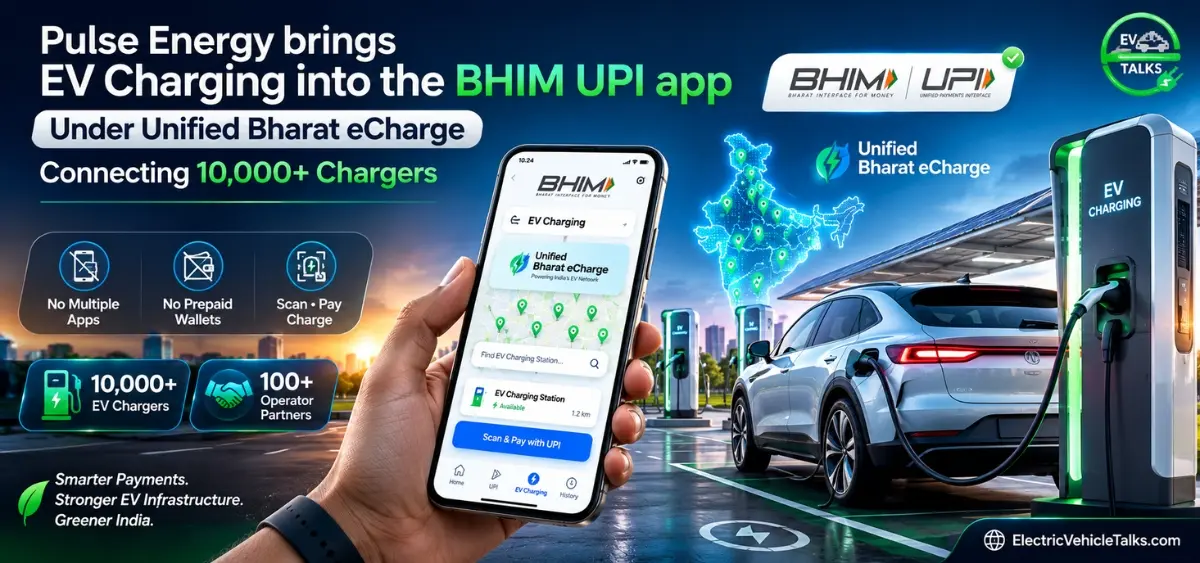

India’s electric vehicle charging ecosystem is taking a major step toward interoperability as Pulse Energy brings EV Charging into the BHIM UPI app under Unified Bharat eCharge (UBC), a nationwide interoperable EV charging network supported by the Ministry of Heavy Industries (MHI), Bharat Heavy Electricals Limited (BHEL), and the National Payments Corporation of India (NPCI).
The initiative is designed to address one of the biggest pain points for EV users in India: charging fragmentation. Instead of downloading multiple charging applications, creating separate accounts, or maintaining operator-specific prepaid wallets, EV drivers will be able to discover participating charging stations and pay directly through UPI using the BHIM app.
Pulse Energy, one of India’s leading EV charging technology companies, has joined UBC as one of the first certified technology enablers for charging operators. The company currently works with more than 100 charge point operator partners and has a connected network of 10,000+ EV chargers.
What Is Unified Bharat eCharge?
Unified Bharat eCharge is being developed as a nationwide digital public infrastructure for interoperable EV charging.
The initiative is supported by the Ministry of Heavy Industries, BHEL, and NPCI to create a seamless, consumer-friendly charging ecosystem across India. MHI is supporting the development of the National Unified Hub for EV Charging, known as Unified Bharat eCharge.
MHI appointed Bharat Heavy Electricals Limited (BHEL) as the Project Implementation Agency (PIA) and engaged NPCI BHIM Services Ltd (NBSL) for the design and development of the platform.
The network uses an open architecture based on the Beckn protocol, with the underlying digital public infrastructure developed by the Network for Humanity (NFH) team.
Rather than forcing charging operators to work inside isolated technology ecosystems, UBC is intended to create a common layer through which charging operators, technology providers, and consumer-facing applications can connect.
Pulse Energy Brings EV Charging Into BHIM UPI App
The biggest change for EV users is the payment experience.
Under the Unified Bharat eCharge model, an EV driver can open the BHIM app, identify a UBC-enabled charging station, scan its QR code and pay for the charging session directly from their bank account through UPI.
There is no need to
- Download a separate application for every charging network
- Create multiple charging accounts
- Maintain different prepaid wallets
- Load money into operator-specific charging wallets
- Determine which charging network operates a particular charger before using it
In simple terms, Pulse Energy brings EV Charging into the BHIM UPI app to make the discovery and payment process more familiar for millions of users already accustomed to UPI-based transactions.
The objective is to make EV charging closer to the simplicity of everyday digital payments: find the charger, scan, pay, and charge.
10,000+ Chargers Connected Through Pulse Energy
Pulse Energy is playing a technology-enabler role within the UBC ecosystem.
The company already works with more than 100 charge point operator partners and has a connected network of more than 10,000 EV chargers.
Through its integration with Unified Bharat eCharge, Pulse Energy will help charging operators connect their existing infrastructure to the interoperable network.
Importantly, operators do not necessarily have to replace their existing charging hardware or abandon their own brands.
Instead, Pulse Energy enables existing charging infrastructure to become discoverable and accessible through UBC. This could allow charging operators to reach a wider pool of EV users beyond customers who use their individual applications.
For India’s rapidly expanding EV charging infrastructure, this interoperability could become particularly important as more charging networks emerge across cities, highways, and intercity routes.
If you’re planning to establish a business in India’s EV charging infrastructure sector, discovering the available Government Subsidy for EV charging stations could help you understand the financial support and opportunities available.
Why Unified Bharat e-Charge (UBC) Matters for India’s EV Charging Ecosystem
India’s EV charging market has expanded significantly, but fragmentation remains a practical challenge for drivers.
An EV owner travelling across cities may encounter charging stations operated by different companies, each with its own application, registration process, payment mechanism, and wallet system.
This can create unnecessary friction, particularly during long-distance travel when drivers need quick access to reliable charging.
Unified Bharat eCharge is designed to tackle this issue by creating a common network for charger discovery and payments.
The broader vision is to allow EV users to access participating chargers through platforms they already use, instead of requiring a separate application for every charging operator.
As Pulse Energy brings EV Charging into the BHIM UPI app, the initiative also demonstrates how India’s existing digital payments infrastructure can be integrated with the country’s growing electric mobility ecosystem.
How BHIM UPI EV Charging Will Work
The user journey is intended to be straightforward.
Step 1: Open the BHIM app.
An EV driver can access the BHIM digital payments application.
Step 2: Find a UBC-Enabled Charger
The user can identify a participating charging point connected to the Unified Bharat eCharge network.
Step 3: Scan the QR code.
Once at the charging station, the driver can scan the relevant QR code.
Step 4: Pay Through UPI
The charging payment can be completed directly from the user’s bank account through UPI.
Step 5: Start Charging
The user can then proceed with the charging session without having to maintain a separate operator-specific prepaid wallet.
This approach could be especially useful for EV owners who travel frequently and encounter multiple charging operators during a journey.
UBC to Expand Across Cities and National Highways
The initial rollout of Unified Bharat eCharge will be available through the BHIM app, with participating charging points being added across cities and national highways.
The network is expected to expand beyond the initial application ecosystem as well.
According to the initiative’s roadmap, UBC-enabled charging infrastructure can become accessible through other applications across payments, mobility, and automotive sectors.
This means EV drivers could eventually discover and access interoperable charging stations through platforms they already use for mobility, payments, or automotive services.
Pulse Energy will support application providers in connecting to the UBC network. Its role therefore extends beyond charging infrastructure integration to the consumer applications through which users discover and access charging services.
Open Beckn Protocol at the Core of the Network
A key technology component behind Unified Bharat eCharge is the open Beckn protocol.
UBC has been developed as digital public infrastructure, allowing different participants to connect through an interoperable architecture instead of building completely closed networks.
The underlying digital public infrastructure has been developed by the Network for Humanity (NFH) team.
The open architecture is intended to bring together:
- EV charging operators
- Charging technology providers
- Consumer applications
- Payment platforms
- Mobility platforms
- Automotive applications
- Government-backed digital infrastructure
This model could help create a more connected EV charging ecosystem where infrastructure and consumer applications can communicate through common digital rails.
Pulse Energy’s Role as a Technology Enabler
Pulse Energy is not simply adding another charging application to India’s EV ecosystem. Its role within UBC is focused on enabling existing charge point operators to participate in an interoperable network.
The company’s technology allows charging operators to connect their existing charging infrastructure to UBC while retaining their own hardware and brands.
This could provide two major advantages.
For charging operators, interoperability can open access to a larger pool of EV users without requiring every customer to install their individual application.
For EV users, the same integration can make more charging points discoverable through a common ecosystem and reduce the number of applications and wallets required for charging.
Akhil Jayaprakash, Co-founder and CEO of Pulse Energy, said the objective is to ensure that EV drivers do not have to think about which charging network they are using before they plug in.
He described UBC’s approach as bringing different networks onto a common infrastructure to simplify payments for consumers while allowing charging operators to serve users beyond their own applications.
NPCI BHIM Highlights the Need for Simpler EV Payments
Lalitha Nataraj, CEO of NPCI BHIM, highlighted the problem UBC is intended to address: multiple applications and wallet-loading requirements for EV charging.
The core proposition is straightforward—users should be able to discover an EV charger through the BHIM payments ecosystem, charge their vehicle, pay, and continue their journey without unnecessary digital friction.
This payment-led approach could become increasingly relevant as EV adoption grows and charging becomes a routine part of daily mobility.
What This Means for EV Owners
For electric vehicle owners, the potential benefits of Unified Bharat eCharge are primarily about convenience, accessibility, and interoperability.
A common charging ecosystem could make it easier to locate participating chargers during city commutes as well as longer highway journeys.
The ability to pay through UPI directly from a bank account could also reduce dependence on prepaid charging wallets.
For new EV buyers, a simpler charging experience could make electric mobility easier to understand and use. For existing EV owners, it could reduce the friction associated with managing multiple charging networks.
However, the effectiveness of UBC will ultimately depend on the scale of charger participation, geographic coverage, platform integration, and the reliability of participating charging points.
Feedback and Future Development
Pulse Energy has also established a feedback mechanism for Unified Bharat eCharge.
Users can submit feedback and request new features through the designated UBC feedback channel. Such feedback can then be routed to the relevant government points of contact involved in the network.
This feedback mechanism is significant because interoperability is not a one-time technology deployment. As EV adoption, charging technologies, and user expectations evolve, the network will need to adapt accordingly.
What the Unified Bharat eCharge Launch Means for EV Charging in India
The launch brings together three important parts of India’s digital and electric mobility ecosystem: government-backed EV infrastructure, interoperable technology and UPI-based payments.
MHI is supporting the national initiative, BHEL is serving as the Project Implementation Agency, and NPCI BHIM Services Ltd. has been engaged for the design and development of the platform.
Pulse Energy, meanwhile, is helping charging operators connect their existing infrastructure to the network.
The participation of more than 100 charge point operator partners and connectivity to more than 10,000 chargers gives the initiative a substantial technology and infrastructure base from which to expand.
As Pulse Energy brings EV Charging into the BHIM UPI app, the development could mark an important shift from fragmented charging networks toward a more interoperable model.
About Pulse Energy
Pulse Energy Technologies Pvt. Ltd. is an Indian EV charging technology company focused on helping charging operators connect, manage, and operate EV charging infrastructure.
The company has a connected network of more than 10,000 EV chargers and works with 100+ charge point operator partners.
Pulse Energy is among the first certified technology enablers for charging operators on Unified Bharat eCharge and is supporting the integration of charging operators into the interoperable network.
The company is backed by Peak XV Partners, AdvantEdge, Antler, and Razorpay Ventures.
About the Organisations Behind Unified Bharat eCharge
1. Ministry of Heavy Industries
The Ministry of Heavy Industries, Government of India, works across India’s capital goods, heavy electrical, and automotive sectors and supports initiatives aimed at accelerating the country’s transition toward electric mobility.
2. Bharat Heavy Electricals Limited
BHEL is a Maharatna public sector enterprise and one of India’s major manufacturers of power generation and industrial equipment. The company has also expanded its activities into electric mobility and EV charging infrastructure.
3. National Payments Corporation of India
NPCI is the umbrella organization for retail payments and settlement systems in India. It operates key payment infrastructure, including the Unified Payments Interface (UPI) and the BHIM digital payments application.
4. Network for Humanity
Network for Humanity develops open digital public infrastructure based on the Beckn protocol. Its team developed the digital public infrastructure underlying Unified Bharat eCharge.
The Road Ahead for India’s EV Charging Network
India’s electric mobility transition is no longer only about selling more electric cars, scooters, and commercial vehicles. Building a convenient, accessible, and interoperable charging ecosystem is equally critical.
Unified Bharat eCharge attempts to address one of the most visible pain points in the current charging experience by bringing charger discovery and payments into a common ecosystem.
With BHIM UPI as the initial consumer-facing platform, more than 10,000 chargers connected through Pulse Energy, 100+ charge point operator partners and an open Beckn-based architecture, the initiative has the potential to simplify EV charging as the network expands.
The next phase will depend on how rapidly additional charging operators, applications, and infrastructure providers join the ecosystem and how consistently users can access chargers across cities and national highways.
For India’s EV industry, however, the direction is clear: charging interoperability and seamless digital payments are becoming increasingly important components of mainstream electric mobility.
As Pulse Energy brings EV Charging into the BHIM UPI app, Unified Bharat eCharge aims to move EV charging closer to the convenience users already expect from India’s digital payments ecosystem—discover, pay, charge, and go.

Related Articles:









