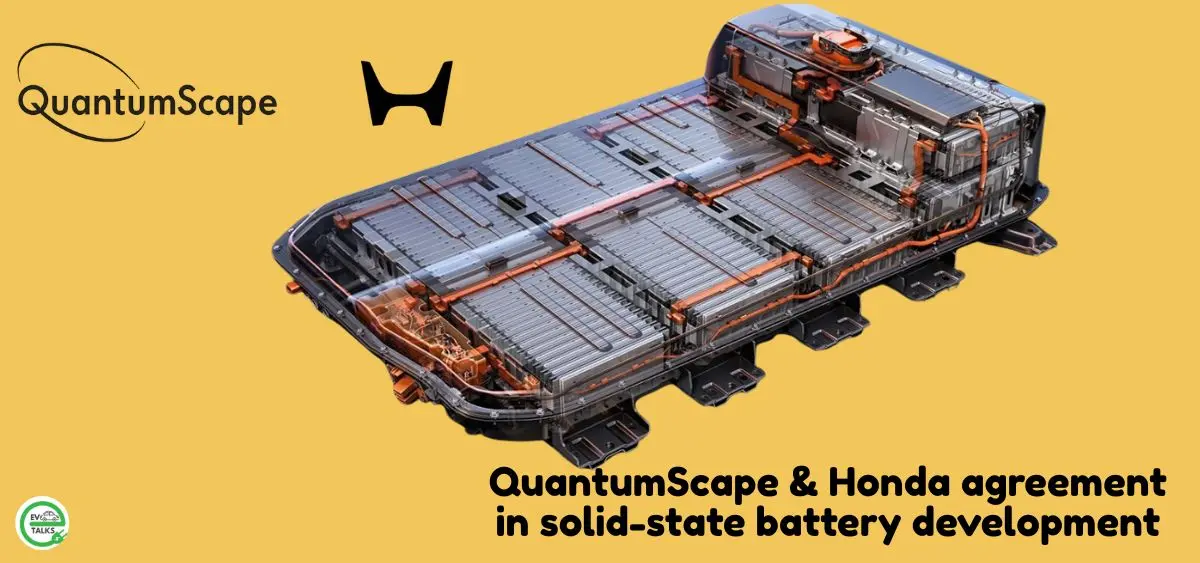

NYSE-listed QuantumScape (QS) has signed a joint research agreement with Japanese automaker Honda through its subsidiary, Honda R&D, to accelerate the development of advanced solid-state lithium-metal battery technology. The QuantumScape & Honda agreement establishes a multi-year collaboration focused on improving both solid-state battery performance and the manufacturing processes required for future commercial production.
The partnership follows Honda’s successful completion of a technology evaluation of QuantumScape’s battery platform. According to Honda R&D Research Center of Excellence Chief Operating Officer Atsushi Ogawa, the company found QuantumScape’s technology to offer compelling and distinctive advantages during its assessment, paving the way for deeper collaboration.
Focus on Commercializing Solid-State Batteries
Under the QuantumScape & Honda agreement, both companies will jointly develop next-generation solid-state batteries designed to deliver higher efficiency, improved safety, and better performance than conventional lithium-ion batteries. The collaboration also aims to refine manufacturing methods, an essential step toward large-scale commercialization.
Honda has already outlined ambitious plans to introduce its own solid-state batteries into electric vehicles during the latter half of this decade. By 2040, the automaker expects these batteries to become approximately 60% smaller, 45% lighter, and 40% less expensive than its current EV battery technology. Beyond passenger vehicles, Honda also plans to expand solid-state battery applications into motorcycles and aircraft.
Why QuantumScape’s Technology Stands Out
QuantumScape’s battery platform uses a solid electrolyte, allowing the integration of a lithium-metal anode instead of the graphite anodes used in conventional lithium-ion batteries. This design significantly increases energy density while reducing battery weight, enabling longer driving ranges and faster charging capabilities.
The company is currently prioritizing automotive applications but also intends to expand its technology into stationary energy storage systems in the future. In 2022, QuantumScape entered a multi-year collaboration with a battery energy storage system integrator to explore additional commercial applications.
Strong Industry Validation and Future Outlook
Founded in 2010, QuantumScape has partnered with Volkswagen since 2012. Independent testing by Volkswagen in early 2024 showed that QuantumScape’s battery technology retained more than 95% of its capacity after over 1,000 charging cycles, outperforming the industry benchmark of approximately 80% capacity retention after 700 cycles.
The QuantumScape & Honda agreement reflects growing confidence in solid-state battery technology, widely regarded as the future of electric mobility because of its superior safety, faster charging, higher energy density, and extended driving range. While experts expect limited pilot deployments around 2027, widespread commercial adoption is still expected to take several more years due to manufacturing complexity and high production costs. Nevertheless, this collaboration represents another important milestone in advancing next-generation battery technology for the global EV industry.

Related Articles: