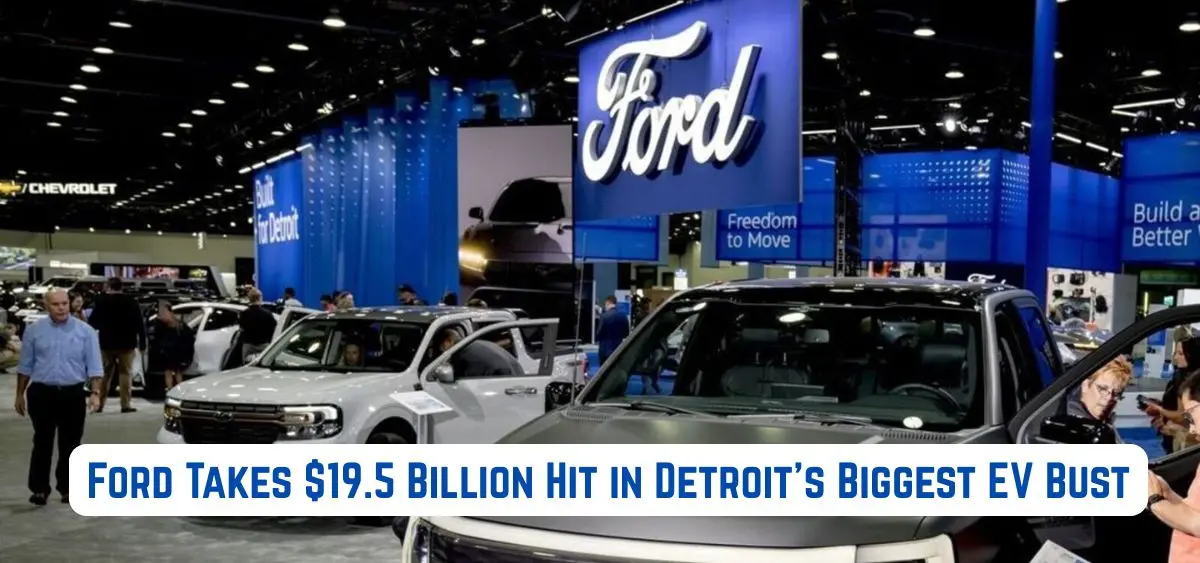

On December 15, 2025, the automotive world was shaken when Ford Takes $19.5 Billion Hit in Detroit’s Biggest EV Bust, signaling a dramatic turning point for America’s legacy carmakers. What began as a bold push toward an all-electric future has now become a costly reality check, exposing the gap between EV ambition and real consumer demand. As high-priced battery-electric vehicles struggle to gain traction, Ford’s massive writedown raises urgent questions: Was the EV boom overestimated, or is the market simply not ready? This shocking decision marks more than a financial loss—it’s a strategic reset that could redefine Detroit’s road ahead.
Breaking Down the $19.5 Billion Writedown
The massive charge is made up of several components tied directly to Ford’s retreat from ambitious EV plans. Around $8.5 billion relates to the cancellation of next-generation all-electric models, including a highly anticipated electric pickup (internally known as T3) and multiple commercial vans. Another $6 billion stems from ending a battery joint venture with South Korea’s SK On, which led to the closure of partnership-operated facilities. The remaining $5 billion has been classified as “program-related expenses,” covering a wide range of restructuring and transition costs.
While much of this writedown is non-cash and accounting-related, Ford confirmed that about $5.5 billion will directly impact cash flow, with most of those payments expected in 2026 and 2027.
A Major Shift in Product Strategy
Ford is now reshaping its product roadmap to align more closely with profitability and real-world consumer demand. One of the most notable decisions is the permanent halt of the all-electric F-150 Lightning. Instead of a direct BEV replacement, Ford plans to introduce an extended-range electric vehicle (EREV) version, using a gas-powered generator to deliver more than 700 miles of total driving range.
At the same time, Ford is betting on affordability. A California-based “skunkworks” team is developing a new Universal EV Platform, with the first model expected to be a $30,000 midsize electric pickup launching in 2027.
Repurposing Assets for New Opportunities
Ford is also redirecting its EV infrastructure. The Kentucky battery plant, initially planned for EV production, will now support a new Battery Energy Storage System (BESS) business. With a $2 billion investment, this unit will target data centers and utilities by late 2027. Meanwhile, the BlueOval City complex in Tennessee will pivot from EV trucks to gas-powered truck production starting in 2029.
Financial Outlook Remains Resilient
Despite the historic writedown, Ford raised its 2025 adjusted EBIT guidance to about $7 billion, supported by strong performance in its gasoline and hybrid businesses. These high-margin segments are currently offsetting EV losses, with Ford now targeting EV breakeven profitability by 2029.
Overall, the $19.5 billion hit underscores a hard lesson for Ford—and Detroit—about the cost of misjudging EV demand, while highlighting a pragmatic shift toward hybrids, affordability, and sustainable profits.

Related Articles:-