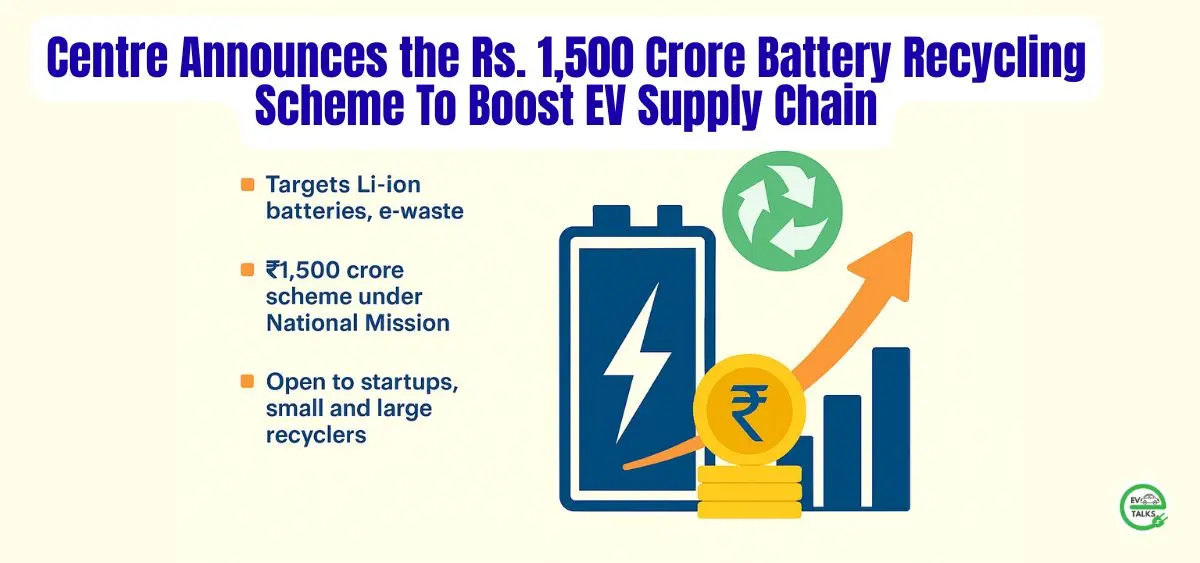

In a significant move to strengthen India’s electric vehicle (EV) ecosystem, the Centre announces the Rs. 1500 Crore Critical Mineral Recycling Incentive Scheme aimed at boosting domestic battery recycling, reducing import dependency, and securing critical raw materials for future EV production. The initiative was unveiled by Union Minister of Coal and Mines G. Kishan Reddy during the Battery Summit 2026.
The scheme is part of the National Critical Mineral Mission (NCMM) and focuses on creating a sustainable circular economy by encouraging the recycling of end-of-life lithium-ion batteries. Through this effort, India aims to recover valuable minerals such as lithium, cobalt, and nickel, which are essential for manufacturing EV batteries.

Why the Scheme Matters
The announcement comes at a time when India’s demand for lithium-ion batteries is rising rapidly. Industry estimates suggest annual battery demand could grow from 20 GWh in 2022 to nearly 220 GWh by 2030, driven by the increasing adoption of electric vehicles and energy storage solutions.
At the same time, battery imports have surged sharply, increasing from USD 1.2 billion in FY2018-19 to USD 4.7 billion in FY2025-26. To address this challenge, the Centre announces a Rs. 1500 Crore incentive package to support domestic recycling and mineral recovery.
Key Features of the Recycling Scheme
The newly launched program includes several incentives for recyclers and industry participants:
- 20% Capital Expenditure (Capex) subsidy on plant machinery and utilities.
- Operational Expenditure (Opex) incentives linked to incremental sales performance.
- Incentive period extending from FY2025-26 to FY2030-31.
- Funding cap of ₹50 crore for large companies and ₹25 crore for smaller entities.
The government expects the scheme to:
- Create 270 kilotons of annual battery recycling capacity.
- Recover approximately 40 kilotons of critical minerals every year.
- Attract nearly ₹8,000 crore in private investments.
- Generate around 70,000 direct and indirect jobs.
Building a Complete Critical Mineral Ecosystem
Beyond recycling, the Centre announces a Rs. 1500 Crore initiative as part of a broader strategy to strengthen India’s critical mineral value chain. The government plans to establish four Critical Mineral Processing Parks and nine centers of Excellence (CoEs) to enhance research, technology development, and mineral processing capabilities.
Efforts to secure long-term raw material supplies are also underway. Since 2015, more than 570 mineral exploration projects have been undertaken, while 46 critical mineral blocks have been auctioned across the country. Additionally, state-run Khanij Bidesh India Limited (KABIL) has secured five lithium brine blocks in Argentina to support future supply requirements.
Outlook for India’s EV Industry
Industry experts believe the center’s announcement of a Rs. 1500 Crore battery recycling scheme could become a crucial step toward achieving supply chain resilience, lowering production costs, and reducing dependence on imported battery materials. By promoting mineral recovery and domestic manufacturing, the initiative is expected to strengthen India’s position as a global EV and clean energy hub in the coming years.

Related Articles: