
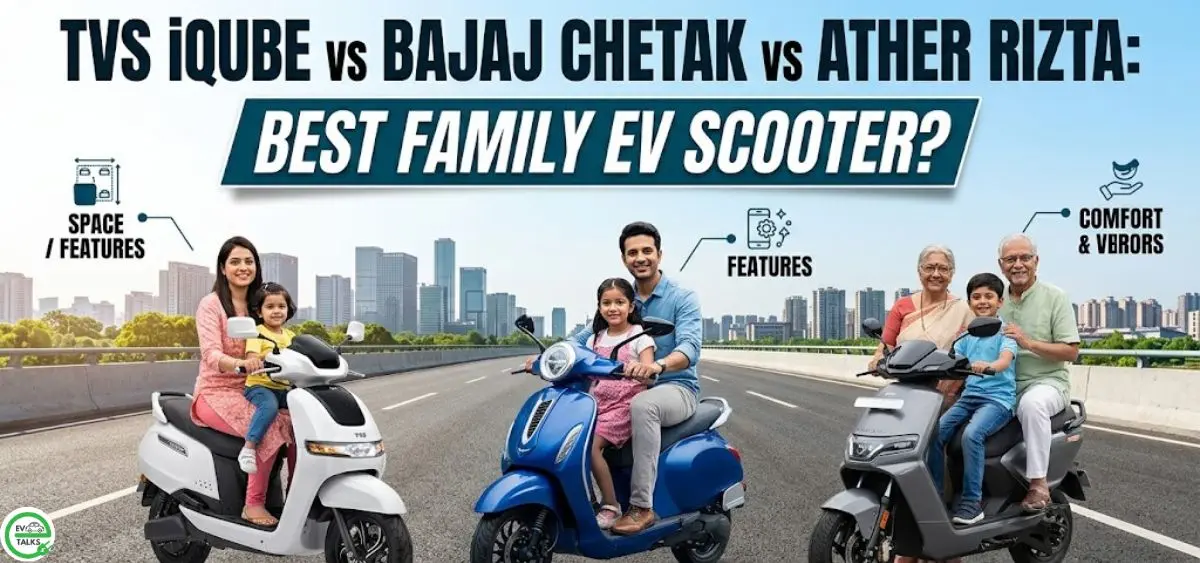

Choosing between the TVS iQube vs Bajaj Chetak vs Ather Rizta can be challenging, especially when all three electric scooters are among the most popular family EVs in India. Each model brings a unique combination of range, comfort, technology, build quality, and ownership value, making them strong contenders in the growing electric two-wheeler market. Whether you’re looking for a practical daily commuter, a feature-rich family scooter, or a premium long-term investment, understanding their real-world strengths and limitations is essential. In this detailed comparison, we analyze the TVS iQube vs Bajaj Chetak vs Ather Rizta to help you make the right buying decision.
Quick Answer
If you’re comparing TVS iQube vs Bajaj Chetak vs Ather Rizta, the right choice depends on your priorities.
- Ather Rizta is the best for family comfort, storage, and technology.
- TVS iQube offers the most balanced package for daily commuting and ownership.
- Bajaj Chetak stands out for premium build quality, durability, and long-term reliability.
For most Indian families, the TVS iQube remains the safest all-round choice, while the Ather Rizta is ideal for buyers seeking maximum practicality and modern features.

Why This Comparison Matters in 2026
India’s electric scooter market is evolving rapidly. Family buyers are no longer looking only for range. They now want:
- Comfortable seating
- Reliable battery performance
- Affordable running costs
- Smart connectivity
- Ample storage space
- Easy charging
- Strong after-sales support
With electric scooters accounting for a significant share of India’s EV two-wheeler sales, models like the TVS iQube, Bajaj Chetak, and Ather Rizta have emerged as the leading choices for urban families.
The challenge is that all three are excellent products—but they serve different types of users.
TVS iQube vs Bajaj Chetak vs Ather Rizta: Specifications Comparison
| Specification | Ather Rizta | TVS iQube | Bajaj Chetak |
|---|---|---|---|
| Battery Options | 2.9 kWh / 3.7 kWh | 2.2 kWh to 5.3 kWh | 2.5 kWh to 3.5 kWh |
| Claimed Range | 123-159 km | 94-212 km | 113-153 km |
| Top Speed | 80 km/h | Up to 82 km/h | 60-73 km/h |
| Motor Power | 4.3 kW PMSM | 4.4 kW BLDC | Up to 4.2 kW |
| Storage Space | 34L + Joey Pocket | 30-32L | Approx. 21L+ |
| Charging Time (0-80%) | ~4.5 hrs | 2.5-4.5 hrs | 2.5-3.5 hrs |
| Connectivity | Advanced | Advanced | Good |
| Body Construction | High-quality polymer | Mixed construction | All-metal body |
| Best For | Families & tech lovers | Balanced ownership | Premium durability |
Which Scooter Offers the Best Family Comfort?
Ather Rizta Takes the Lead
When it comes to family-focused design, Ather specifically engineered the Rizta for Indian households.
Highlights
- Longest seat in the segment (900 mm)
- Optional pillion backrest
- Massive flat floorboard
- Easy ingress and egress
- Comfortable riding posture
The scooter feels less sporty and more practical, making it ideal for daily family use.
Why Families Love It
Parents carrying children to school, grocery shoppers, and office commuters will appreciate the extra space and comfort.
Verdict
Winner: Ather Rizta
TVS iQube: A Close Second
The TVS iQube provides:
- Comfortable dual-tone seating
- Flat floorboard
- Smooth suspension tuning
- Stable ride quality
Its ergonomics suit riders of different heights and age groups.
Unlike many sporty EVs, the iQube prioritizes everyday usability.
Verdict
Runner-Up: TVS iQube
Bajaj Chetak: Premium Yet Compact
The Chetak feels premium but offers slightly less practicality.
While comfortable for daily commuting, its neo-retro design limits available storage and floorboard space compared to its rivals.
Verdict
Best for premium urban commuting rather than maximum family utility.
Which Scooter Has the Best Storage Space?
Storage is becoming one of the biggest deciding factors for family EV buyers.
| Model | Storage Capacity |
|---|---|
| Ather Rizta | 34L + 2L Pocket |
| TVS iQube | 30-32L |
| Bajaj Chetak | Lower than rivals |
Ather Rizta Wins Again
Its 34-liter boot can accommodate the following:
- Full-face helmets
- Grocery bags
- School bags
- Daily essentials
The additional Joey Pocket is useful for mobile phones, wallets, and charging cables.
TVS iQube vs. Ather Rizta: Which is Better for Performance?
Performance matters even for family scooters.
TVS iQube
- Faster acceleration
- Excellent throttle calibration
- Smooth power delivery
- Confident overtaking
Real-World Experience
The iQube feels refined and predictable, especially in city traffic.
Ather Rizta
- Quick acceleration
- Responsive ride modes
- Better software tuning
- Sportier feel despite family focus
The Rizta inherits much of Ather’s performance DNA from the popular 450 series.
Verdict
Winner: Ather Rizta
Bajaj Chetak
The Chetak prioritizes smoothness over outright performance.
It feels mature and refined rather than aggressive.
Best For
- Relaxed urban riding
- Senior riders
- Daily office commutes
Charging and Range Comparison
Range anxiety remains one of the top concerns among Indian EV buyers.
Real-World Range Expectations
| Scooter | Real-World Range |
|---|---|
| Ather Rizta 3.7 kWh | 120-140 km |
| TVS iQube | 90-180 km depending on variant |
| Bajaj Chetak | 100-135 km |
Best Long-Range Choice
For buyers prioritizing range:
- TVS iQube ST
- Ather Rizta Z 3.7 kWh
- Bajaj Chetak 3501
Which Scooter Has the Best Technology?
Ather Rizta
Ather has built one of the most advanced software ecosystems in the industry.
Features
- Google Maps integration
- OTA updates
- FallSafe
- SkidControl
- AutoHold
- Alexa connectivity
- Find My Scooter
TVS iQube
TVS SmartXonnect offers the following:
- Navigation
- Geofencing
- Charge monitoring
- Alexa integration
- Crash alerts
- Reverse assist
Its interface is simple and user-friendly.
Bajaj Chetak
The Chetak has improved significantly with the following:
- TFT display
- OTA updates
- Vehicle tracking
- Call management
- TecPac upgrades
However, it still trails Ather in software sophistication.
Technology Winner
Ather Rizta
Bajaj Chetak vs TVS iQube: Which is Better?
This is one of the most searched EV scooter questions in India.
Choose TVS iQube If You Want the Following:
- More features
- Better practicality
- Larger storage
- Broader variant selection
- Balanced ownership experience
Choose Bajaj Chetak If You Want:
- Premium design
- All-metal body
- Long-term durability
- Classic styling
- Lower maintenance concerns
Expert Verdict
For most buyers, the TVS iQube offers better overall value, while the Bajaj Chetak offers superior build quality.
Chetak vs. Ather Rizta: Which is Better?
The answer depends on your priorities.
Choose Ather Rizta If You Want:
- Maximum storage
- Family comfort
- Advanced software
- Better riding performance
Choose Bajaj Chetak If You Want:
- Premium feel
- Metal construction
- Traditional styling
- Proven durability
Verdict
For families, Ather Rizta is the better choice.
For premium urban commuters, Chetak remains highly appealing.
If you are curious to know more about these electric scooters, then see the comparison table below.
No vehicle data found.
Ownership Cost Analysis
Electricity Cost
Assuming:
- Electricity rate: ₹8/unit
- Annual usage: 10,000 km
Expected annual charging costs:
| Scooter | Annual Charging Cost |
|---|---|
| Ather Rizta | ₹1,500-2,000 |
| TVS iQube | ₹1,600-2,200 |
| Bajaj Chetak | ₹1,500-2,100 |
Compared to petrol scooters, owners can save ₹15,000-25,000 annually.
Common Mistakes EV Buyers Make
Many buyers focus only on the claimed range.
Instead, evaluate:
- Service Network: TVS currently enjoys one of the widest service footprints.
- Storage Requirements: Family riders often underestimate daily storage needs.
- Charging Availability: Ensure home charging access before purchasing.
- Passenger Comfort: Test ride with your regular pillion rider.
- Software Support: OTA updates increasingly influence long-term ownership satisfaction.
Government Incentives and EV Policy Impact
Although the original FAME-II subsidy structure has evolved, India’s EV ecosystem continues receiving policy support through the following:
- Production Linked Incentive (PLI) schemes
- State EV policies
- Charging infrastructure programs
- Battery manufacturing incentives
Several states continue offering benefits such as the following:
- Road tax exemptions
- Registration fee waivers
- EV parking incentives
These policies help reduce the overall cost of EV ownership.
Charging Infrastructure Growth in India
India’s charging ecosystem is expanding rapidly.
Major contributors include:
- Public charging operators
- Oil marketing companies
- OEM charging networks
- Private charging startups
For scooter users, home charging remains the primary charging method.
Fortunately, all three scooters support convenient overnight charging using standard household sockets.
Expert Insight from Electric Vehicle Talks
At Electric Vehicle Talks, we closely monitor India’s evolving electric two-wheeler market and consumer buying behavior. Our analysis suggests three distinct buyer profiles emerging in 2026:
1. The Practical Family Buyer
Choose Ather Rizta.
Its seat comfort, boot space, safety technology, and family-first design make it exceptionally practical.
2. The Balanced Value Buyer
Choose TVS iQube.
It delivers the most complete ownership experience with strong service support, multiple battery choices, and dependable performance.
3. The Premium Long-Term Buyer
Choose Bajaj Chetak.
Its all-metal body and premium engineering make it one of the most durable electric scooters available today.
The ideal approach is to test ride all three and evaluate comfort, charging convenience, and local service quality before making a final decision.
People Also Ask
Is TVS iQube better than Ather Rizta?
TVS iQube offers a more balanced ownership experience and wider service support, while Ather Rizta excels in comfort, storage, and smart features. Families may prefer Rizta, while mainstream buyers may lean toward iQube.
Which electric scooter has the biggest storage space?
Among these three scooters, the Ather Rizta offers the largest storage capacity with a 34-liter boot and an additional utility pocket.
Is the Bajaj Chetak more durable than the TVS iQube?
The Bajaj Chetak’s all-metal body generally provides a more premium and durable feel compared to scooters that use more plastic body panels.
Which scooter offers the best range?
Higher-end TVS iQube variants currently offer the highest claimed range, followed closely by the Ather Rizta and Bajaj Chetak.
Which EV scooter is best for senior citizens?
Bajaj Chetak is often preferred by senior riders because of its smooth ride quality, approachable ergonomics, and predictable performance.
Is Ather Rizta good for long daily commutes?
Yes. The larger battery variant can comfortably handle long urban commutes and daily family usage.
Which scooter has the best connected features?
Ather Rizta currently offers the most advanced software ecosystem among these three scooters.
FAQs about TVS iQube vs Bajaj Chetak vs Ather Rizta
1. Which is the best family electric scooter in India?
The Ather Rizta is currently one of the best family-focused electric scooters due to its comfort, storage, safety features, and practical design.
2. TVS iQube vs Bajaj Chetak vs Ather Rizta: Which offers the best value?
TVS iQube offers the best overall value by balancing price, performance, range, service support, and practicality.
3. Does Bajaj Chetak have an advantage over its rivals?
Yes. Its all-metal body construction and premium build quality remain unique advantages.
4. Which scooter is cheaper to maintain?
All three are significantly cheaper to maintain than petrol scooters, but the Bajaj Chetak is particularly known for its low maintenance requirements.
5. Is charging an EV scooter difficult in India?
No. Most owners charge at home overnight using a standard household socket.
6. Which scooter is best for city traffic?
TVS iQube and Ather Rizta both perform exceptionally well in urban traffic conditions.
7. Which scooter should first-time EV buyers choose?
The TVS iQube is often the safest choice for first-time EV buyers because of its balanced nature and extensive service ecosystem.
Conclusion
The TVS iQube vs Bajaj Chetak vs Ather Rizta debate ultimately comes down to your lifestyle and priorities.
If you want the most family-friendly electric scooter with exceptional comfort and storage, choose the Ather Rizta.
If you want the most balanced package with strong performance, service support, and practical ownership, choose the TVS iQube.
If premium build quality, durability, and timeless design matter most, the Bajaj Chetak remains a compelling choice.
For more EV comparisons, buying guides, charging insights, industry analysis, and expert reviews, explore the latest resources available at Electric Vehicle Talks and stay informed about the future of sustainable mobility.

Related Article:-









