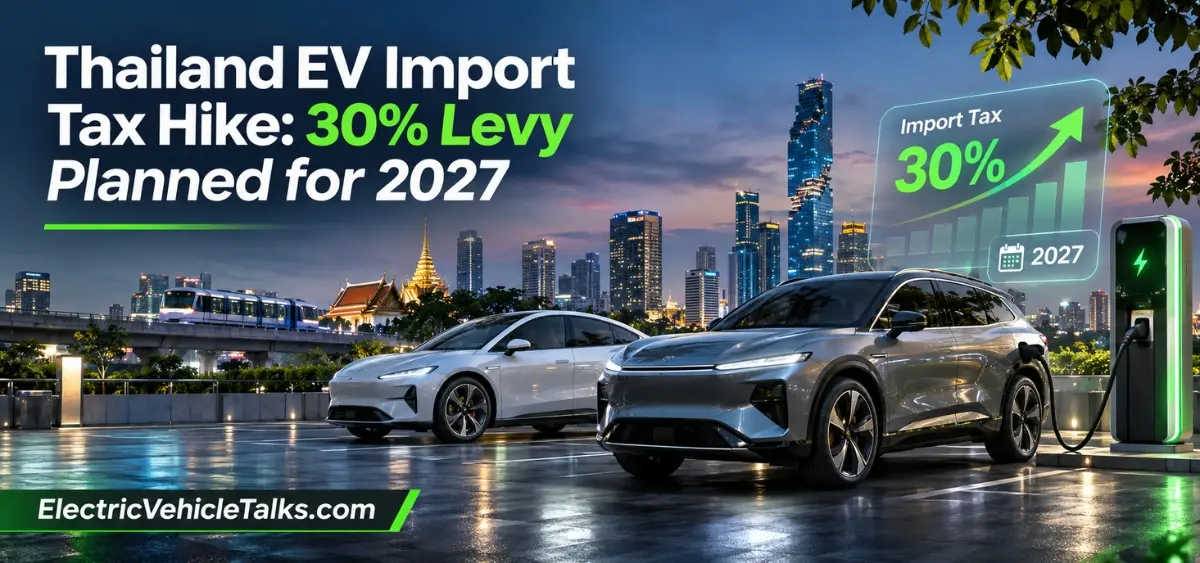

Thailand is preparing a major tax shake-up that could make fully imported electric cars substantially more expensive from January 1, 2027. The proposed Thailand EV Import Tax Hike would raise the excise duty on certain completely built-up electric vehicles from around 10% to at least 30%, with higher figures also discussed. The government wants overseas carmakers to build vehicles, source advanced components, and create local jobs instead of relying on imports.
Thailand’s EV policy board has backed a tiered approach in principle, but the Enklard still unobn br sjyeexr kdx dlcsi vcbov. Buyers and manufacturers are watching closely as the deadline rapidly approaches.

What Is Changing?
Thailand proposes taxing fully imported EVs without qualifying local production at 30% or more from January 2027, compared with roughly 10% today. Cabinet approval remains pending; domestically produced vehicles meeting requirements should receive more favorable treatment.
Three Tax Tiers Explained
The Thailand EV Import Tax Hike is designed to reward manufacturing investment rather than simply penalize electric mobility.
- Tier 1 — Lowest: EVs manufactured in Thailand with local content and high-value components.
- Tier 2 — Middle: Vehicles assembled locally but dependent on imported parts.
- Tier 3 — Highest: Completely built-up (CBU) vehicles imported by companies lacking qualifying Thai production, potentially facing rates of 30% or more.
Final details remain pending. Qualifying domestic EVs can already access preferential treatment, making the distinction between imported and locally produced models commercially increasingly important.
How Much Could EV Prices Rise?
Consider an imported electric car with a taxable value of THB 1 million:
- Current 10% tax: Approximately THB 100,000.
- Proposed 30% tax: Approximately THB 300,000.
- Additional tax burden: At least THB 200,000.
Actual price increases depend on pricing and final rules.
Analysts expect the Thailand EV Import Tax Hike to encourage some buyers to purchase imported cars before December ends. Buyers should check eligibility and registration deadlines.
Chinese Imports Under Pressure
Thailand’s September 2026 electric passenger-car imports climbed 138% year-on-year to approximately US$421 million. China supplied nearly 99% that month.
The figures strengthen the government’s argument for encouraging domestic assembly. The proposal targets sourcing, not nationality. Chinese automakers operating qualifying Thai factories may therefore benefit from lower rates.
Why Thailand Is Changing Course
Earlier, EV 3.0 and EV 3.5 programs accelerated adoption and attracted investment through incentives. Now, officials want more of that expanding market to generate local factory employment, specialized parts production and stronger supply chains.
The shift also aims to preserve Thailand’s role as a leading Southeast Asian automotive hub.
What It Means for Automakers and Investors
For brands including BYD, Geely and Great Wall Motor, the Thailand EV Import Tax Hike could increase pressure on imported-model margins. The impact will vary by company and model, depending on local manufacturing capacity, sourcing and pricing.
Investors should monitor Cabinet approval, final tax rates and factory expansion plans. For consumers, the key question is whether imported-car prices rise enough to make locally built alternatives more attractive.

Related Articles: