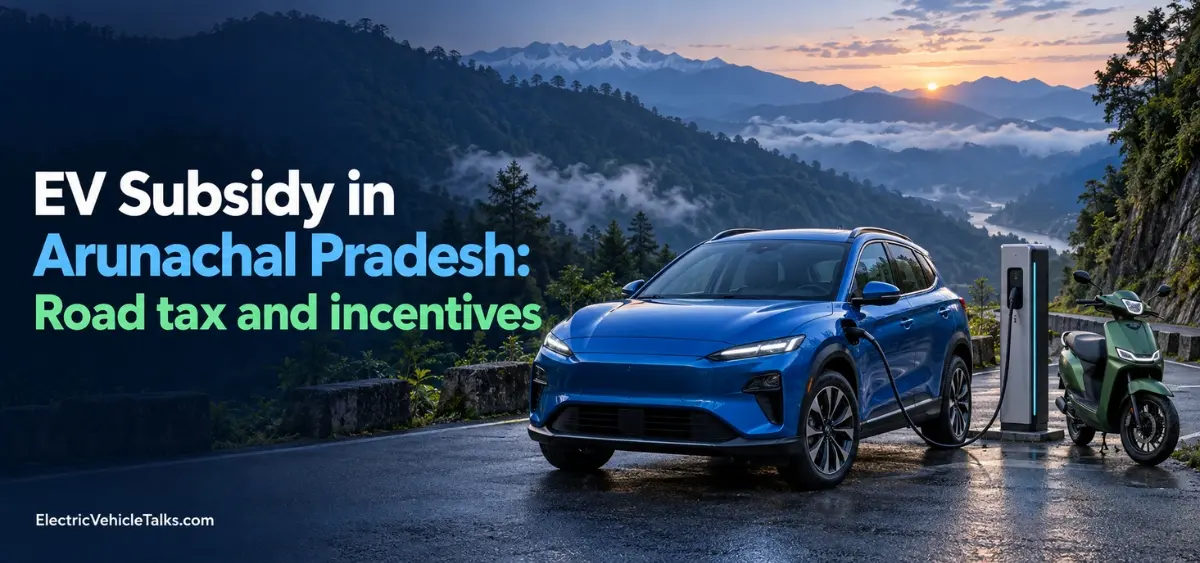

Could an EV Subsidy in Arunachal Pradesh save you ₹2 lakh—or is that headline hiding a costly misunderstanding? Before booking an electric car or scooter in 2026, there is one detail you cannot afford to miss: proposed incentives are not the same as money you can actually claim.
The state’s draft EV policy outlines attractive purchase incentives, but its notification status changes the buying equation. Meanwhile, national registration-fee relief, eligible central support, and targeted assistance for electric cargo vehicles offer separate opportunities worth understanding.
Whether you commute through Itanagar or plan journeys towards Arunachal’s mountain towns, knowing your actual benefits matters as much as battery range, charging access, and service coverage.
This guide separates draft promises from verified provisions, explains essential road-tax checks and highlights the questions every buyer should ask before paying a booking amount. Discover what may apply to your vehicle—and build your purchase budget around evidence, rather than expectations.
What is EV Subsidy in Arunachal Pradesh?
EV Subsidy in Arunachal Pradesh refers to proposed state purchase incentives and other applicable benefits intended to encourage electric mobility. The state’s 2021 EV policy remains classified as a draft, so its purchase subsidies and charging-infrastructure support should not be treated as currently claimable without an implementing notification.
Key EV Incentives in Arunachal Pradesh
- Proposed Purchase Subsidies: The draft outlines battery-linked incentives at ₹10,000 per kWh, with the following limits:
- 2-Wheelers: Up to ₹30,000 for the first 100 vehicles.
- 3-Wheelers: Up to ₹50,000 for the first 50 vehicles.
- 4-Wheelers: Up to ₹200,000 for the first 50 vehicles. The total proposed early-adopter pool is 200 vehicles across all three categories.
- Road Tax and Registration Fees: National rules exempt battery-operated vehicles from specified registration-certificate and registration-mark fees. A 100% Arunachal Pradesh state road-tax waiver has not been verified; buyers should confirm the applicable treatment with their local RTO.
- Proposed Charging-Infrastructure Subsidies: The draft proposes reimbursement of 15% of public charging-infrastructure costs for oil marketing company retail outlets and 25% for local entrepreneurs. These percentages are draft provisions, not verified active entitlements. Government Subsidy for EV Charging Station
- Proposed Disbursement: The draft envisages Direct Benefit Transfer (DBT) through the State Nodal Agency after submission of purchase evidence. It does not establish an operational subsidy-claim process or guarantee automatic processing by dealerships.
How much EV subsidy is available for each category?
Read the status column before using any amount in your budget. “Not verified” means an active entitlement was not established; it does not prove that no separate order could exist.
| Electric vehicle category | State purchase benefit supported by reviewed documents | Status for buyers in September 2026 |
|---|---|---|
| Electric scooters, bikes, and motorcycles | Draft: ₹10,000/kWh, maximum ₹30,000; first 100 two-wheelers | Draft proposal; active general state claim not verified |
| Electric three-wheelers | Draft: ₹10,000/kWh, maximum ₹50,000; first 50 three-wheelers | Draft proposal; active general state claim not verified |
| Private electric cars | Draft: ₹10,000/kWh, maximum ₹2 lakh; first 50 four-wheelers | Draft proposal; active general state claim not verified |
| Electric commercial passenger vehicles | No separately verified general state purchase amount | Do not assume every commercial EV qualifies. |
| Electric cargo/load carriers | Up to 10% of the ex-showroom price, maximum ₹50,000, for eligible new industrial-policy units | Notified provision; eligibility, quota, and sanction must be confirmed. |
| Electric buses | No separately verified dedicated state purchase subsidy | Central procurement support is a separate route. |
| Electric ambulances | No separately verified dedicated state purchase subsidy | Check the central e-ambulance framework separately. |
What about central subsidies?
The following are national scheme parameters, not additional Arunachal Pradesh state payouts. Availability requires the correct beneficiary, approved model, registration period, funds, and application route.
| Category | Central incentive framework |
|---|---|
| Eligible registered electric two-wheelers | ₹2,500/kWh; maximum ₹5,000; also capped at 15% of ex-factory price |
| Eligible registered e-rickshaws/e-carts | ₹2,500/kWh; maximum ₹12,500; also capped at 15% of ex-factory price |
| L5 electric three-wheelers | The component was reported as closed on 26 December 2025; the historical ₹25,000 cap is not a current entitlement. |
| Private electric cars | No PM E-DRIVE purchase subsidy |
| Eligible e-trucks | ₹5,000/kWh; capped at 10% of ex-factory price excluding trailer, with weight-based maximums |
| Eligible e-ambulances | ₹30,000/kWh; capped at 35% of ex-factory price |
| Eligible e-buses through scheme procurement | ₹10,000/kWh; capped at 20% of CESL-discovered vehicle cost, plus length-based ceilings |
Important update: The July 2026 PIB explanation predates the 10 August 2026 amendment extending e-two-wheeler support to 31 March 2028. The official portal now shows an overall ₹11,900 crore scheme outlay. Older pages citing only the July deadline or original outlay need updating. Official scheme notifications.
Is the EV Subsidy in Arunachal Pradesh active now?
No, direct cash subsidies for personal electric vehicles are not currently active from the Arunachal Pradesh state government. While the state released a draft EV policy proposing upfront cash incentives (such as up to ₹30,000 for two-wheelers and ₹200,000 for the first 50 electric cars), it remains a draft proposal and has not been officially notified for public claims.
You can still access the following active benefits in Arunachal Pradesh:
Active State & Central Incentives (2026)
- Road Tax & Registration Waivers: The state offers a 100% exemption on road tax and registration charges for electric vehicles at local RTOs, lowering the total on-road price.
- Commercial Vehicle Subsidies: Under the Arunachal Pradesh Industrial Development and Investment Policy, electric load carriers (minimum 785 kg capacity) qualify for a subsidy of up to 10% on the ex-showroom price, capped at ₹50,000 for eligible new business units.
- Central PM E-DRIVE Scheme: The central government’s PM E-DRIVE Scheme funds electric three-wheelers, e-buses, and public charging networks across India, though nationwide direct purchase incentives for personal electric two-wheelers have phased out.
Is there a 100% road tax and registration fee waiver?
Road tax: Do not assume a blanket exemption.
The attached nine-page draft does not contain an express blanket road-tax waiver. A current Arunachal Pradesh notification establishing 100% exemption was not verified here.
Ask the registering authority for the applicable tax assessment and exemption order, if any. An EV’s green number plate does not itself settle its state road-tax liability.
Registration fees: National relief is separate.
MoRTH’s G.S.R. 525(E), dated 2 August 2021, exempts battery-operated vehicles from fees for issuing or renewing the registration certificate and assigning a new registration mark. This is national relief rather than proof of a notified Arunachal EV policy. MoRTH explanation published by PIB.
What did the 2021 draft propose for private buyers?
EV Subsidy in Arunachal Pradesh for electric scooters
The proposal would calculate support using battery capacity, measured in kilowatt-hours, or kWh. This measures stored energy; it is different from motor power in kW.
Under the draft formula, a larger battery would increase support only until the vehicle cap is reached.
| Illustrative vehicle | Battery capacity | Draft calculation | Proposed capped amount |
|---|---|---|---|
| Electric scooter | 2 kWh | 2 × ₹10,000 | ₹20,000 |
| Electric scooter | 3 kWh | 3 × ₹10,000 | ₹30,000 |
| Electric motorcycle | 4 kWh | 4 × ₹10,000 | ₹30,000 |
| Electric three-wheeler | 6 kWh | 6 × ₹10,000 | ₹50,000 |
| Electric car | 30 kWh | 30 × ₹10,000 | ₹2 lakh |
These calculations illustrate the draft, not available discounts. The malformed scooter maximum of “₹30,05,000” in the accumulated notes is incorrect; the supplied PDF says ₹30,000.
EV Subsidy in Arunachal Pradesh for electric car buyers
The proposed four-wheeler ceiling was substantial but limited to a small initial pool. There is no basis to deduct it from a current car quotation without an implementing order.
The draft also proposed payment directly to owners through DBT after proof of purchase, via the State Nodal Agency. This describes a proposed mechanism; it does not establish a functioning 2026 application portal.
Which electric cargo buyers can seek industrial-policy assistance?
The Arunachal Pradesh Industrial Development and Investment Policy, 2025, provides a distinct route for eligible new units.
Its e-load-carrier provision excludes e-rickshaws, requires at least 785 kg carrying capacity, supports one carrier per unit, and is limited to 100 units on a first-come, first-served basis. Confirm the remaining quota and approval with the Industries Department.
This makes the EV Subsidy in Arunachal Pradesh for electric cargo relevant to qualifying enterprises rather than every delivery operator.
For commercial buyers, distinguish payload from gross vehicle weight. Payload is what the vehicle carries; gross weight includes the vehicle itself. A specification meeting one threshold may fail the other.
Before placing an order, ask the District Industries Centre to confirm the enterprise’s eligibility and the proposed vehicle’s carrying-capacity documentation.
How to apply for EV subsidy in Arunachal Pradesh
For private scooters, motorcycles, and cars
There is no verified general state application route to recommend from the draft alone. Follow this practical process:
- Ask the dealer to identify the exact benefit: state subsidy, central incentive, fee exemption, or commercial discount.
- Request the government order supporting any claimed state payment.
- Obtain the current RTO/Vahan assessment for road tax and registration items.
- For central two-wheeler support, verify the exact model on PM E-DRIVE.
- Keep the invoice, registration certificate, payment evidence, and scheme records.
The central portal describes an Aadhaar face-authenticated e-voucher process. Eligible central support should be shown clearly in the purchase paperwork; it should not be confused with the draft state DBT proposal. PM E-DRIVE official portal.
Arunachal Pradesh electric vehicle policy timeline: What changed?
| Date | Verified milestone | Meaning for buyers |
|---|---|---|
| 2021 | APEDA EV policy document prepared as a draft | Proposed incentives require notification. |
| 2 August 2021 | National registration-fee exemption notification | Separate legal basis for specified fee relief |
| 31 March 2024 | FAME-II implementation ended. | Historical FAME figures are not new-purchase offers. |
| 1 April 2025 | Industrial policy, 2025, took effect. | The separate notified framework includes e-load-carrier support. |
| 1 March 2026 | OMC charging-network reporting date | Infrastructure evidence, rather than subsidy eligibility |
| 28 July 2026 | PIB published Northeast FAME data. | Historical support must be read within its scheme period. |
| 10 August 2026 | PM E-DRIVE two-wheeler extension amendment | Earlier two-wheeler deadline superseded |
| 12 September 2026 review | BEE still lists Arunachal’s EV policy as draft. | General state buyer payouts remain unverified. |
How developed is Arunachal Pradesh’s EV charging network?
Official data shows progress, but each dataset has a defined scope.
| Government dataset | Arunachal Pradesh figure | Correct interpretation |
|---|---|---|
| OMC EVPCS reporting, as of 1 March 2026 | 55 reported installed over the stated reporting period; 46 operational | OMC-reported stations, not a census of all chargers |
| Northeast FAME statement, 28 July 2026 | 3 chargers sanctioned in Arunachal Pradesh under the reported programme | Scheme-specific sanctions; not the entire state network |
| Historical FAME buyer-support statement | 15 incentivized EVs; ₹0.08 crore disbursed | Historical scheme beneficiaries, not total state EV registrations |
Do not add the two charger figures together: their units, coverage, and reporting periods differ.
Does the state reimburse charging-station costs?
Section 12.1 of the attached draft proposes 15% support for oil-marketing-company retail outlets and 25% for local entrepreneurs. Active implementation was not verified.
The draft’s highway-spacing and urban-grid provisions are planning proposals, not evidence that a compatible charger exists at every stated interval today.
Before travelling, check connector compatibility, opening hours, recent successful sessions, and backup charging. A pin on a map is only the beginning of route planning.
Are EVs practical on Arunachal Pradesh’s mountain roads?
Picture a quiet morning drive through the foothills: immediate motor response, no engine idling outside homes, and an overnight charge replacing a petrol station stop. That is a compelling ownership experience—when charging and support match the route.
A routine Itanagar–Naharlagun commute and a journey towards high-altitude Tawang require different buying decisions.
Climbing, passenger load, cargo, cabin heating, and cold batteries can raise energy demand or reduce usable range. Regenerative braking recovers some energy downhill but cannot cancel the entire cost of climbing.
Evaluate hill-start ability, braking, ground clearance, and sustained performance with your typical load. For commercial EVs, test a representative route before committing a fleet.
What can an EV save without a state cash subsidy?
Energy savings can still be meaningful. The following are illustrative assumptions, not current Arunachal electricity tariffs, fuel prices, or model test results.
| Vehicle/use case | Consumption assumption | Energy-price assumption | Energy cost/km | Cost over 10,000 km |
|---|---|---|---|---|
| Electric scooter, home charging | 0.04 kWh/km drawn from supply | ₹7/kWh | ₹0.28 | ₹2,800 |
| Petrol scooter | 45 km/liter | ₹100/liter | ₹2.22 | ₹22,222 |
| Electric car, home charging | 0.18 kWh/km drawn from supply | ₹7/kWh | ₹1.26 | ₹12,600 |
| Electric car, public charging | Same consumption | ₹18/kWh | ₹3.24 | ₹32,400 |
| Petrol car | 15 km/liter | ₹100/liter | ₹6.67 | ₹66,667 |
Using electricity drawn from the supply includes charging losses in the assumption. If using battery-only consumption instead, add those losses separately.
In this example, home charging makes a substantial difference to car economics. Actual hill-route consumption may be higher.
For a complete comparison, add financing, insurance, tyres, maintenance, charger installation, battery risk, and resale value. Calculate break-even using the EV’s extra upfront cost divided by realistic annual net savings.
Expert Insight from Electric Vehicle Talks
Our analysis is that Arunachal’s strongest near-term EV opportunities are routes with predictable mileage, dependable overnight charging, and accessible service: commuter scooters, local delivery vehicles, and carefully planned institutional fleets.
Historic FAME support demonstrates that central incentives reached the state. It does not establish an active state purchase programme or predict reimbursement for today’s buyer.
The policy priority should be reliable charging where vehicles actually stop, transparent tax treatment, and clear implementing orders. For owners, a smaller verified benefit can be more useful than a larger draft promise.
Common mistakes to avoid
- Deducting draft subsidies from the on-road price.
- Treating registration-fee relief as a road-tax exemption.
- Assuming every commercial EV meets cargo-support conditions.
- Using a certified range as a mountain-route guarantee.
- Depending on a single unverified public charger.
- Comparing only EMI while ignoring downtime and charging costs.
- Confusing dealer discounts with government support.
People Also Ask
1. How is the EV Subsidy in Arunachal Pradesh working in 2026?
Separate the draft state buyer scheme from national incentives and industrial assistance. The draft describes a proposed DBT process, while central support uses its own eligibility and paperwork. A benefit becomes usable when its operative rules and your eligibility are established.
2. Can I claim the proposed scooter subsidy immediately?
The draft alone is insufficient. Ask for the implementing notification, open claim mechanism, and model eligibility before expecting a payment. Budget using only the support documented in your purchase transaction.
3. Does an electric car qualify for PM E-DRIVE?
Private electric cars are outside its purchase-subsidy categories. Their economics depend on the actual purchase price, verified local tax treatment, charging access, and operating savings.
4. Is the EV Subsidy in Arunachal Pradesh for electric buses a private-buyer offer?
No verified general state offer was identified. Central bus support operates through defined procurement arrangements. A private operator should establish eligibility rather than applying a public-procurement ceiling to a dealer quotation.
5. Is the EV Subsidy in Arunachal Pradesh for electric ambulance buyers separate from cars?
Yes, the central framework treats eligible e-ambulances separately. An electric passenger car converted for medical use does not automatically qualify. Verify type approval, beneficiary eligibility, and programme requirements before procurement.
6. Should I wait for a final state EV policy?
Compare your present transport needs with the vehicle’s unsubsidised economics. Waiting for an uncertain notification may not suit a high-mileage owner with home charging. Conversely, weak service coverage can justify postponement even if an attractive incentive appears.
EV Subsidy in Arunachal Pradesh: FAQs
Can a used EV receive the proposed early-adopter state benefit?
Do not assume so. The draft does not establish an active used-vehicle entitlement. Any eventual scheme would need its own purchase, ownership, and registration rules.
Are hybrids covered by the same registration-fee exemption?
The cited notification concerns battery-operated vehicles. Do not automatically extend its treatment to mild hybrids, strong hybrids, or plug-in hybrids; confirm the applicable vehicle classification.
Can state and central benefits be combined?
The draft envisages state incentives in addition to central support, but that is proposed wording. Actual stacking depends on operative rules, including restrictions against duplicate assistance.
Is a home charger installation subsidized?
The attached charging-support proposal concerns public infrastructure. A verified general household wallbox subsidy was not identified. Check installation inclusions directly with the vehicle seller.
Where should I check Arunachal Pradesh electric vehicle policy updates?
Check the Transport Department/RTO for vehicle taxation, the Department of Power/APEDA for the EV framework, the Industries Department for enterprise incentives, and PM E-DRIVE for central rules.
Final Verdict
EV Subsidy in Arunachal Pradesh 2026: road tax and incentives must be explained through the status of each provision. The EV draft contains ambitious purchase proposals, but it is insufficient evidence of claimable payments or a blanket road-tax waiver.
Build your budget around a written quotation, documented incentives, and your real route. Check home charging, loaded hill performance, warranty, and nearby service before choosing the vehicle.
Arunachal’s mobility transition will become more convincing when clean vehicles fit everyday life—from a commuter’s morning journey to a business’s dependable delivery run.
Explore more practical EV buying guides, charging resources, and ownership insights at Electric Vehicle Talks
Related Articles: