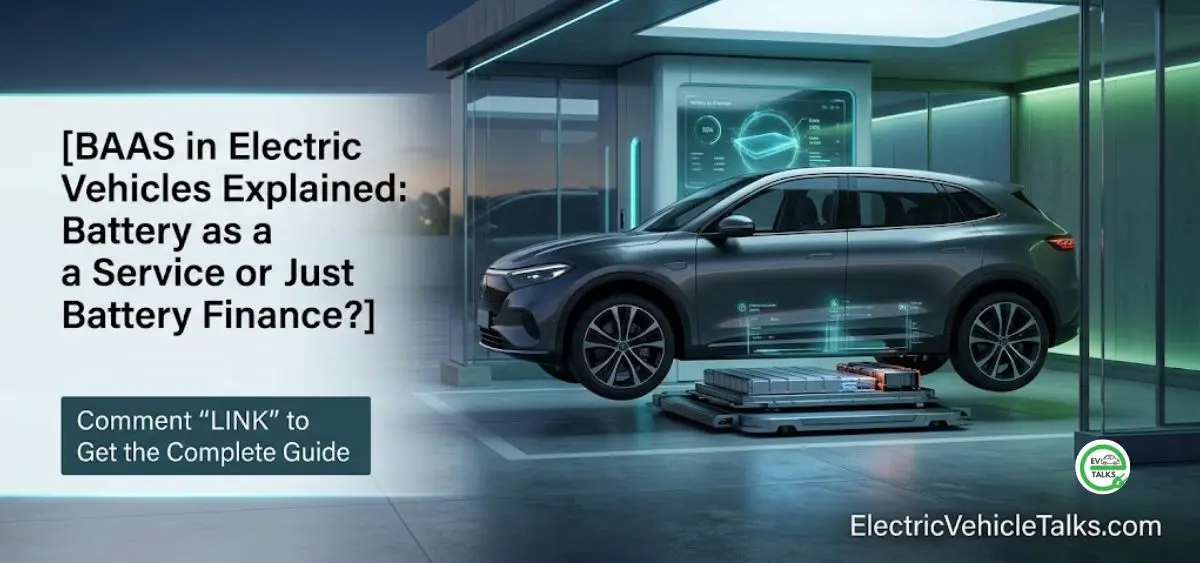

Electric Vehicle (EV) manufacturers are increasingly promoting Battery as a Service (BAAS) to make electric cars more affordable. By separating the battery cost from the vehicle price, buyers can purchase an EV at a significantly lower upfront cost. However, does the current BAAS model in India truly function as a battery service, or is it simply another form of financing? BAAS in Electric Vehicles Explained
After independently researching the BAAS offerings from major manufacturers, including Tata Motors, MG Motor, Hyundai, and Maruti Suzuki, we found that the answer is more complex than the advertisements suggest. While BAAS undoubtedly reduces the initial purchase price, most current models in India are structured more like separate battery financing than a traditional Battery-as-a-Service ecosystem.
In this article, Electric Vehicle Talks analyzes how BAAS works in India, compares the offerings from leading manufacturers, explains the hidden costs, and discusses what a true Battery-as-a-Service model should look like.
Quick Summary
| Question | Answer |
|---|---|
| What is BAAS? | A model that separates the battery cost from the vehicle price. |
| Is BAAS a battery rental? | Not in most current Indian passenger EV models. |
| Who owns the battery after repayment? | Usually the customer. |
| Is ₹/km true pay-per-use? | Generally no, as most plans include minimum monthly commitments. |
| Does BAAS reduce upfront costs? | Practically no. Explain below |
| Can BAAS increase the total ownership cost? | It can, depending on financing terms and interest rates. |
What is Battery as a Service (BAAS)?
Battery as a Service, commonly known as BAAS, is a business model where the battery is separated from the vehicle purchase. Instead of paying the entire cost of the electric vehicle upfront, the buyer pays a lower vehicle price while the battery cost is handled separately.
The concept was originally designed to reduce the high upfront cost of electric vehicles and encourage faster EV adoption.
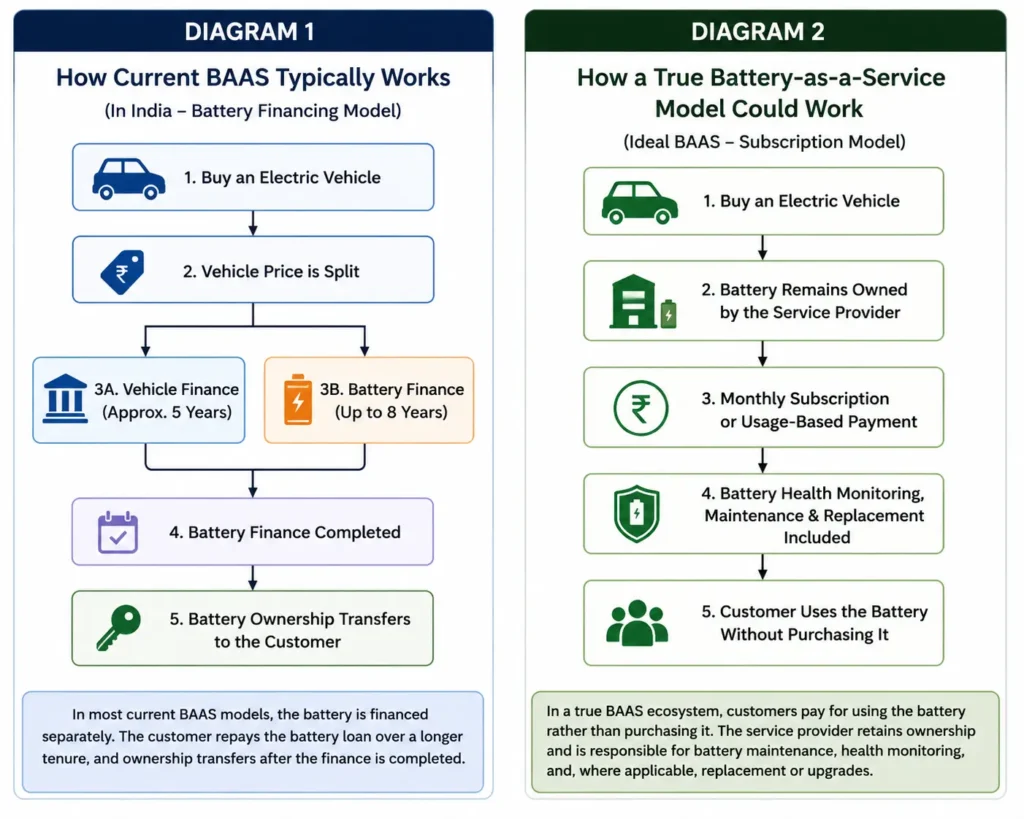
In its purest form, BAAS means that the battery remains the property of the service provider, while the customer pays only for using it through a subscription, rental, or pay-per-use model. The service provider is typically responsible for battery health, maintenance, replacement, and sometimes even battery upgrades.
This model is already being used in several battery-swapping ecosystems across the world, particularly for commercial fleets and electric two-wheelers.
However, the BAAS models currently available in India follow a different approach.
Why Did EV Companies Introduce BAAS?
The battery pack is the single most expensive component of an electric vehicle, often accounting for 30–40% of the total vehicle cost. This makes EVs appear expensive when compared to petrol or diesel vehicles.
To address this challenge, manufacturers introduced BAAS to reduce the advertised purchase price.
For example, instead of displaying the full price of a ₹16 lakh electric vehicle, the company may advertise it at approximately ₹11 lakh by separating the battery cost. The remaining battery amount is then financed or paid through a separate payment structure.
This strategy makes electric vehicles appear more affordable and attracts buyers who might otherwise hesitate due to the higher upfront investment.
From a marketing perspective, the approach is effective because customers focus on the lower ex-showroom price. However, understanding the complete payment structure is essential before making a purchase decision.
What Does a True Battery-as-a-Service Model Look Like?
Globally, the term “Battery as a Service” has a very specific meaning. In a true BAAS ecosystem, the customer is purchasing only the vehicle, while the battery continues to belong to the manufacturer or service provider throughout its lifecycle.
A genuine BAAS model typically offers the following features:
- The battery remains permanently owned by the company.
- Customers pay only for battery usage through a subscription or rental plan.
- The service provider is responsible for battery health and degradation.
- Battery replacement is included if performance falls below acceptable levels.
- Customers may receive upgraded battery technology in the future without purchasing a new vehicle.
- There is no separate battery loan or financing because the battery is never purchased by the customer.
In such a model, the customer is essentially paying for energy storage as a service, rather than buying the battery itself.
Is the Current BAAS Model in India Really Battery as a Service?
This is where the discussion becomes interesting.
Based on our research, most BAAS schemes currently offered in India do not operate as a traditional Battery-as-a-Service model. Instead, they function much closer to battery financing.
In many cases, the customer is effectively taking two financial commitments:
- A loan for the electric vehicle.
- A separate financial arrangement for the battery.
Although manufacturers often market the battery payment using attractive figures such as ₹2.60 per kilometre, ₹3.90 per kilometre, or ₹4.50 per kilometre, these payments are generally linked to financing structures with minimum monthly commitments rather than unlimited pay-per-use access.
More importantly, once the repayment period ends, the battery typically becomes the customer’s property. This means the battery is not permanently owned by the manufacturer, which differs from the traditional definition of Battery-as-a-Service.
For this reason, we believe it is more accurate to describe most current Indian BAAS offerings as battery financing models designed to reduce the upfront purchase price, rather than full-fledged Battery-as-a-Service ecosystems.
A lower purchase price doesn’t always mean a lower ownership cost. Understanding the financing structure is just as important as understanding the vehicle itself.
Battery as a Service vs Battery Finance
The following table highlights the key differences between a traditional BAAS model and the structures currently offered by most passenger EV manufacturers in India.
| Feature | True Battery as a Service | Current BAAS Models in India |
|---|---|---|
| Battery Ownership | The company retains ownership | The customer owns the battery after completing financing. |
| Payment Model | Subscription or rental | Separate battery finance or EMI |
| Battery Loan | Not required | Usually applicable |
| Interest Charges | Not applicable | Interest charged on battery finance |
| Battery Replacement | Included as part of the service | Not included beyond standard warranty |
| Battery Upgrade | Often possible | Generally not available |
| Warranty | Service-based support | Standard manufacturer warranty |
| Primary Objective | Pay only for battery usage | Reduce the vehicle’s upfront purchase price |
This comparison illustrates why many EV buyers confuse battery financing with Battery as a Service. While both approaches reduce the initial purchase price, they operate very differently from an ownership and financial perspective.
Is the ₹/km Pricing Really Pay-as-You-Drive?
One of the biggest reasons behind the growing popularity of BAAS is the way it is marketed. Almost every manufacturer highlights battery payments using attractive figures such as ₹2.60/km, ₹3.90/km, or ₹4.50/km, making buyers believe they only pay for the distance they drive.
At first glance, this sounds like a true pay-per-use model. If you drive less, you pay less, and if you drive more, you pay more.
However, our research suggests that the reality is different.
Most BAAS plans offered by passenger EV manufacturers in India require a minimum monthly running commitment. Even if a customer drives fewer kilometres than the committed limit, they are generally required to pay the minimum monthly amount.
For example, a plan may advertise ₹3.90 per kilometre, but it could also require a minimum commitment of 1,500 km per month. Whether the customer drives 700 km or 1,500 km, the minimum monthly payment remains applicable.
From a buyer’s perspective, this makes the payment structure resemble a monthly EMI rather than a completely flexible pay-per-use service.
This does not necessarily make the model unfair, but buyers should clearly understand that the advertised per-kilometre figure is often linked to a financing commitment rather than unlimited usage-based billing.
Myth vs Reality: Understanding BAAS
| Myth | Reality |
|---|---|
| BAAS means the battery is rented. | In most current passenger EV BAAS models, the battery is financed and eventually owned by the customer. |
| ₹3.90/km means I pay only when I drive. | Most plans have a minimum monthly commitment. |
| BAAS always makes EV ownership cheaper. | It looks like a car’s upfront price is low; in reality, the full price is taken by financing. |
| BAAS provides a better battery warranty. | Current BAAS schemes generally offer the same battery warranty as standard purchases. |
| All BAAS models work the same way. | Financing structures vary across manufacturers and lenders. |
Company-Wise Analysis of BAAS in India
To understand how BAAS is being implemented, we analyzed the financing structures currently offered by four major passenger EV manufacturers in India.
1. Tata Punch EV BAAS
Tata Motors offers BAAS by separating the battery cost from the vehicle price. However, instead of a battery subscription model, the company uses two different financing structures.
Key Highlights
- Battery Price
- 30 kWh Battery: ₹3.2 lakh
- 40 kWh Battery: ₹3.6 lakh
- Two separate financing arrangements:
- Vehicle finance: 5 years
- Battery finance: 8 years
- Interest Rate
- Approximately 9% per annum for both vehicle and battery.
Running Charges
| Battery Pack | Charge | Minimum Monthly Running |
|---|---|---|
| 30 kWh | ₹2.60/km | 1,800 km |
| 40 kWh | ₹2.93/km | 1,800 km |
Important Observations
- The battery warranty remains the same as the standard purchase model.
- No additional battery warranty is provided because of BAAS.
- Battery finance continues even after the vehicle loan may have ended.
For buyers, this means the lower purchase price comes with a longer financial commitment.
2. Maruti Suzuki e-Vitara BAAS
Maruti Suzuki has also adopted the BAAS model to reduce the upfront price of the upcoming e-Vitara.
Partner Banks
- Bajaj Finance
- HDFC Bank
- ICICI Bank
- Axis Bank
- Kotak Mahindra Bank
Finance Structure
- Vehicle Interest Rate: 9%
- Battery Interest Rate: 9.25%
- Up to 100% finance available
- Finance tenure:
- 5 years
- 8 years
Minimum Running Commitment
- Minimum 60 km per day
- Approximately 1,800 km per month
Vehicle Pricing Structure
| Ex-showroom Price | Vehicle Price | Battery Cost | Running Charge |
|---|---|---|---|
| ₹15.99 lakh | ₹10.99 lakh | ₹5 lakh | ₹3.99/km |
| ₹17.49 lakh | ₹11.99 lakh | ₹5.5 lakh | ₹4.39/km |
| ₹19.79 lakh | ₹14.29 lakh | ₹5.5 lakh | ₹4.39/km |
Important Observations
After the financing period ends, the battery becomes the customer’s property.
This indicates that the battery is financed rather than permanently owned by the manufacturer throughout its life.
3. MG BAAS
Among all the manufacturers studied, MG currently offers the most distinctive BAAS structure.
Unlike the others, MG allows customers to purchase the vehicle separately while financing only the battery through its financial partners.
This provides greater flexibility for buyers who may wish to pay for the vehicle upfront but prefer financing only the battery.
Partner Finance Companies
- Bajaj Finance
- Hero FinCorp
- Ecofy
- VidyutTech
Available Plans
| Battery Pack | Running Charge | Minimum Monthly Running |
|---|---|---|
| 38 kWh | ₹3.90/km | 1,500 km |
| 52.9 kWh | ₹4.50/km | 1,500 km |
Interest Rate
Based on available information, financing rates generally range between the following:
11.3% to 15.4%
Actual rates may vary depending on the financing partner and customer eligibility.
Important Observation
MG is currently the only major manufacturer among the four studied that allows battery-only financing, making its BAAS structure noticeably different from Tata, Hyundai, and Maruti.
4. Hyundai Creta Electric BAAS
Hyundai has also introduced BAAS with the Creta Electric, following a financing-based approach.
Key Details
- Battery Interest Rate
- Approximately 8.75%
- Battery Tenure
- 96 months
- Vehicle Loan
- 60 months
Is BAAS Right for You?
| Buyer Type | BAAS Suitable? | Why |
|---|---|---|
| First-time EV buyer | ✅ Maybe | A lower upfront cost can help. |
| Cash buyer | ⚠ Depends | Compare financing costs versus outright purchase. |
| High-mileage user | ✅ Possibly | Lower initial investment may improve cash flow. |
| Low-mileage user | ⚠ Check carefully | Minimum monthly commitments may reduce value. |
| Planning to sell within 3 years | ❌ Evaluate carefully | Outstanding battery finance may affect resale. |
| Long-term owner | ✅ Depends | Compare total ownership cost over the full tenure. |
“Who Should Consider BAAS?”
Instead of only discussing advantages and disadvantages, provide practical guidance.
BAAS May Be Suitable If
- You want to reduce the upfront purchase cost.
- You plan to keep the vehicle for a long time.
- You need financing flexibility.
- You have a high monthly driving requirement.
BAAS May Not Be Ideal If
- You plan to sell the vehicle within a few years.
- You drive very little each month.
- You prefer a simple financing structure.
- You want to avoid long-term battery finance commitments.
Can Customers Finance Only the Battery?
No.
Customers opting for BAAS cannot purchase the vehicle outright while financing only the battery.
1. Battery Warranty
No additional battery warranty benefits are offered under BAAS.
The warranty remains identical to a standard purchase.
2. Starting Offer
Hyundai promotes the Creta Electric with the following:
- Vehicle price starting at ₹10.99 lakh (ex-showroom)
- Battery payments starting from approximately ₹3.90/km
Comparison of BAAS Models in India
| Feature | Tata Punch EV BAAS | Maruti e Vitara BAAS | MG BAAS | Hyundai Creta Electric BAAS |
|---|---|---|---|---|
| Battery-Only Finance Available? | ❌ No | ❌ No | ✅ Yes | ❌ No |
| Vehicle & Battery Financed Separately? | ✅ Yes | ✅ Yes | ✅ Battery financed separately | ✅ Yes |
| Vehicle Finance Tenure | 5 Years | 5 or 8 Years* | It depends on vehicle loan | 60 Months |
| Battery Finance Tenure | 8 Years | 5 or 8 Years | Depends on NBFC | 96 Months |
| Battery Interest Rate | ~9% | 9.25% | ~11.3%–15.4% | ~8.75% |
| Vehicle Interest Rate | ~9% | 9% | It depends on the lender. | It depends on the lender. |
| Minimum Monthly Commitment | 1,800 km | 1,800 km | 1,500 km | Not publicly disclosed |
| Starting Battery Charge | ₹2.60/km | ₹3.99/km | ₹3.90/km | From ₹3.90/km |
| Battery Ownership After Repayment | ✅ Customer | ✅ Customer | ✅ Customer | ✅ Customer |
| Additional Battery Warranty? | ❌ No | ❌ No | ❌ No | ❌ No |
| Main Advantage | Lower upfront vehicle cost | Up to 100% finance | Battery-only finance option | Lower entry price |
| Things to Consider | Battery financing lasts longer than vehicle loan | Minimum running commitment | Higher interest rates through NBFCs | Longer battery tenure than vehicle loan |
Note: Financing terms, interest rates, and eligibility may vary depending on the lender, customer profile, and location. Verify the latest details with the respective manufacturer or financing partner before making a purchase decision.
True BAAS vs Current BAAS in India
| Feature | True Battery-as-a-Service | Current BAAS in India |
|---|---|---|
| Who Owns the Battery? | Service Provider | Customer after repayment |
| Payment Model | Monthly subscription or rental | Separate battery finance / EMI |
| Interest Charges | No | Yes |
| Battery Replacement Included | Usually yes. | No (standard warranty applies) |
| Battery Upgrade Option | Possible | Generally Not Available |
| Pay Only for Usage? | Yes | Usually minimum monthly commitment applies |
| Battery Warranty | Service-based | Standard manufacturer warranty |
| Battery Finance Required? | No | Yes (in most cases) |
| End of Tenure | The battery remains with provider unless purchased | Battery ownership transfers to the customer. |
Advantages of Current BAAS Models
Despite the concerns discussed above, current BAAS models do offer several genuine benefits.
a) Lower Upfront Purchase Price
Separating the battery cost significantly reduces the advertised vehicle price, making EVs more accessible to first-time buyers.
b) Improved Financing Accessibility
Some buyers who may not qualify for a large vehicle loan could still benefit from separate financing arrangements.
MG’s battery-only finance model provides even greater flexibility in this regard.
c) Better Cash Flow
Business owners and fleet operators can reduce their initial investment and preserve working capital.
d) Psychological Affordability
A vehicle priced at ₹11 lakh naturally feels more affordable than one priced at ₹16 lakh, even though the battery cost still has to be paid separately.
This marketing strategy has undoubtedly helped increase buyer interest in electric vehicles.
Hidden Challenges Buyers Should Understand
Our research also identified several factors that buyers should carefully evaluate before choosing BAAS.
a) Total Ownership Cost May Be Higher
Although the initial vehicle price is lower, financing the battery separately means additional interest costs over several years.
b) Battery Finance May Continue After Vehicle Loan Ends
In several cases, the vehicle loan may be completed before the battery financing.
This means the buyer continues making battery payments even after the vehicle itself has been fully financed.
c) Selling the Vehicle Can Become More Complicated
If the battery finance has not been completed, the remaining outstanding amount may need to be cleared before ownership can be transferred to another buyer.
This is an important consideration for customers planning to upgrade or sell their EV within a few years.
d) Battery Warranty Remains Unchanged
One common misconception is that BAAS provides additional battery protection.
Based on our research, none of the studied manufacturers currently offer extra battery warranty benefits simply because the customer opted for BAAS.
The warranty remains the same as that offered with a standard battery purchase.
What Should a True Battery as a Service Model Look Like?
After analyzing the BAAS models currently available in India, one question naturally arises:
Is this really “Battery as a Service,” or is it simply a new way of financing the battery?
In our opinion, the current BAAS offerings have undoubtedly made EVs more affordable by reducing the upfront purchase price. However, they still follow a financing model where customers eventually own the battery after completing the repayment.
A true Battery-as-a-Service ecosystem would operate differently.
Instead of selling the battery to the customer through a separate finance agreement, the battery would remain the property of the manufacturer or service provider throughout its lifecycle. Customers would simply pay for using the battery, similar to paying a monthly subscription for internet, mobile services, or cloud storage.
A genuine BAAS model could include the following:
- Manufacturer retains ownership of the battery throughout its life.
- Customers pay only for actual battery usage or a monthly subscription.
- No separate battery loan or financing.
- Battery replacement if capacity falls below a predefined health level.
- Battery upgrades as newer technologies become available.
- Reduced concerns about battery degradation and long-term replacement costs.
Such a model would shift the focus from buying a battery to using battery energy as a service, which aligns more closely with the original concept of BAAS.
Could Digital Battery Ownership Make True BAAS Possible?
One of the biggest challenges in implementing a genuine BAAS model is ownership management.
Unlike a vehicle, which is registered and financed through well-established systems, batteries require a reliable way to track ownership, usage, and transfer.
As India’s EV ecosystem evolves, technologies such as digital battery identification, battery traceability, or a unique battery identity system could make this easier. Such systems could allow manufacturers or service providers to retain ownership while customers simply pay for usage.
If supported by future regulations and digital infrastructure, this approach could enable:
- Easier battery ownership tracking.
- Simplified transfer of battery subscriptions.
- Better lifecycle management.
- Transparent service history.
- More practical subscription-based BAAS models.
While such systems are still evolving, they represent one possible direction for the future of Battery-as-a-Service in India.
Editor’s Note: The discussion above reflects a possible future evolution of BAAS based on industry trends and emerging battery traceability concepts. It should not be interpreted as an announced policy or confirmed roadmap.
Expert Insight from Electric Vehicle Talks
Based on our independent research of the BAAS offerings currently available in India, we believe buyers should evaluate these schemes from a total ownership cost perspective rather than focusing only on the lower advertised vehicle price.
The current BAAS models offered by major manufacturers are innovative financing solutions that improve affordability by separating battery costs. However, in most cases, they still require customers to finance the battery and eventually become its owner after completing the repayment.
For many buyers, this structure may be suitable because it lowers the initial investment and makes EV ownership more accessible. At the same time, customers should carefully compare financing tenure, interest costs, minimum monthly commitments, warranty terms, and resale implications before making a purchase decision.
As India’s electric mobility ecosystem matures, BAAS may gradually evolve into a subscription-based model where manufacturers retain battery ownership, and customers pay only for battery usage. Until then, understanding the complete financial picture remains essential for making an informed decision.
Disclaimer
This analysis is based on publicly available information and independent research conducted by Electric Vehicle Talks. BAAS structures, financing terms, interest rates, and eligibility may vary depending on the manufacturer, lender, customer profile, and location. Readers are encouraged to verify the latest details with the respective manufacturer or financing partner before making a purchase decision.
Before Choosing BAAS, Ask These Questions
Before opting for any BAAS plan, consider asking the dealership or financing partner the following:
✔ Who owns the battery during the finance period?
✔ Does the battery become my property after repayment?
✔ Is the ₹/km charge based on actual usage or a minimum monthly commitment?
✔ What is the total interest paid on the battery finance?
✔ Can I prepay the battery finance without additional charges?
✔ What happens if I sell the vehicle before the battery finance is completed?
✔ Does BAAS provide any additional battery warranty?
✔ What is the total ownership cost compared to purchasing the battery outright?
These questions can help buyers compare different BAAS offerings more effectively and avoid unexpected financial commitments.
People Also Ask
Is BAAS cheaper than buying an EV normally?
Not necessarily. BAAS lowers the upfront purchase price, but the overall ownership cost may increase because of separate battery financing and interest charges.
Is BAAS the same as battery leasing?
No. Traditional battery leasing means the service provider retains ownership of the battery. Most current BAAS models in India eventually transfer battery ownership to the customer after repayment.
Why do companies advertise battery costs per kilometer?
Presenting battery payments as a per-kilometre charge makes the scheme easier to understand and highlights the lower upfront vehicle price. However, buyers should also review minimum monthly commitments and financing terms.
Can I finance only the battery?
Among the manufacturers analysed in this article, MG currently allows battery-only financing through selected financing partners, whereas Tata, Hyundai, and Maruti generally require financing structures that include both the vehicle and battery.
Does BAAS provide a better battery warranty?
Based on the current schemes analysed, the battery warranty generally remains the same as a standard purchase. BAAS does not automatically provide additional warranty benefits.
Is BAAS suitable for everyone?
Not always. Buyers should compare the total cost of ownership, financing duration, annual driving distance, and future resale plans before deciding whether BAAS is the right option.
FAQs
What is BAAS in electric vehicles?
Battery as a Service (BAAS) is a model that separates the battery cost from the vehicle price, reducing the initial purchase cost of an electric vehicle.
Is BAAS in India actually Battery as a Service?
Most current BAAS models in India operate more like battery financing, where customers repay the battery cost over time and eventually become its owner.
Which EV companies offer BAAS in India?
Major passenger EV manufacturers offering BAAS or similar battery financing models include Tata Motors, MG Motor, Hyundai, and Maruti Suzuki.
Does BAAS reduce the total cost of owning an EV?
BAAS reduces the upfront purchase price but may increase the overall ownership cost depending on interest rates, financing tenure, and minimum monthly commitments.
Should I choose BAAS for my next EV?
The answer depends on your budget, driving habits, financing preferences, and long-term ownership plans. Comparing the complete cost of ownership is more important than comparing the advertised purchase price alone.
Conclusion
However, our research indicates that most BAAS models currently available in India are structured primarily as battery financing solutions rather than traditional Battery-as-a-Service ecosystems. While the advertised lower vehicle price and per-kilometre payment structure may appear attractive, buyers should look beyond the marketing and carefully evaluate the total cost of ownership, financing terms, battery tenure, and resale implications.
As India’s EV ecosystem continues to evolve, BAAS is likely to play an increasingly important role in making electric vehicles more accessible. Whether today’s financing-based models eventually transition into true Battery-as-a-Service remains to be seen. Until then, buyers should focus not only on the lower purchase price but also on the complete ownership cost before making their decision.
At Electric Vehicle Talks, our goal is to help EV buyers look beyond marketing claims and understand the real economics of electric vehicle ownership. Explore our latest EV news, buying guides, ownership tips, charging resources, and expert industry analysis to make informed decisions in India’s rapidly evolving electric mobility landscape.

Related Articles: