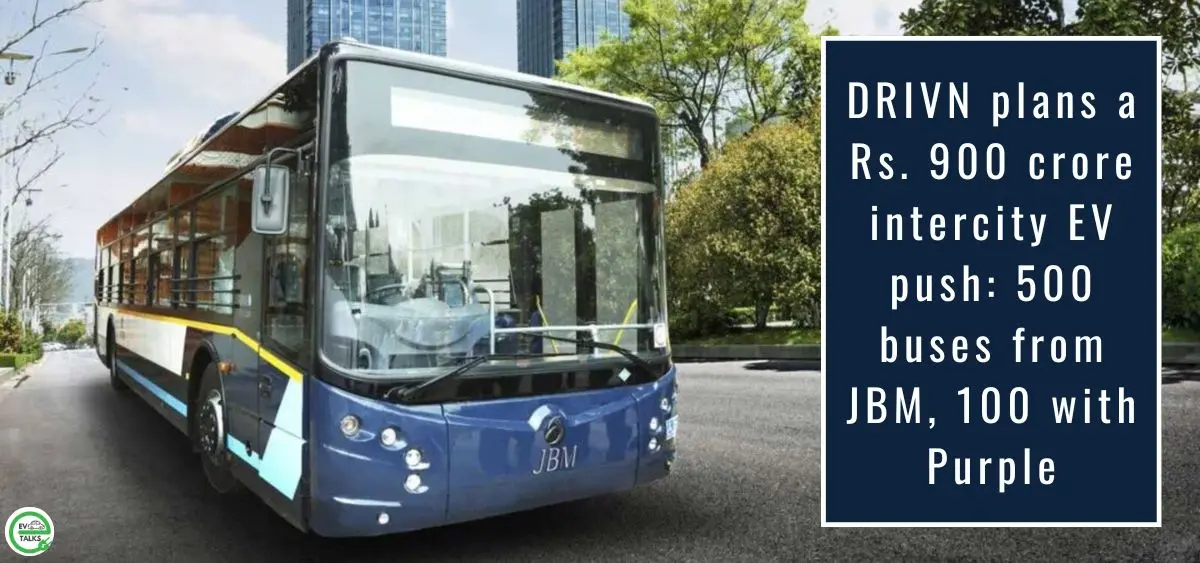

DRIVN plans a Rs. 900 cr intercity EV push to accelerate the electrification of India’s long-distance transportation sector through two major strategic partnerships. The commercial electric vehicle leasing platform has announced plans to finance and deploy 600 electric buses in collaboration with JBM Electric Vehicles and Prasanna Purple Mobility, creating an estimated ₹900-crore asset pipeline. The initiative aims to remove one of the biggest barriers to EV adoption—high upfront capital investment—by offering an asset-light, long-term leasing model for fleet operators.
600 Electric Buses to Be Deployed Across India
Under the new expansion strategy, DRIVN will finance the deployment of 500 electric buses from JBM Electric Vehicles and 100 electric buses for Prasanna Purple Mobility.
The larger JBM order is valued at approximately ₹750 crore, assuming an average cost of ₹1.5 crore per bus. Meanwhile, the Purple Mobility deployment is estimated at around ₹150 crore, although the final investment may vary depending on the mix of 12-meter and 13.5-meter electric coaches, whose prices range between ₹1.4 crore and ₹1.65 crore based on configuration.

Together, these partnerships establish a strong 600-bus electric pipeline that integrates vehicle manufacturing, financing, leasing, and fleet operations under one ecosystem.
Asset-Light Leasing Model to Reduce Upfront Costs
A major objective behind DRIVN’s Rs. 900-crore intercity EV push is to eliminate the heavy capital expenditure traditionally associated with commercial electric buses.
Instead of purchasing vehicles outright, fleet operators will lease buses through DRIVN’s financing platform. The company will own and finance the assets while also bundling essential services such as the following:
- Charging infrastructure
- Vehicle maintenance
- Battery lifecycle management
- Long-term operational support
This integrated model allows transport operators to focus on daily operations without worrying about high initial investments or vehicle asset management.
According to Alpna Jain, Co-founder and Chief Business Officer of DRIVN, the success of commercial electric mobility depends on bringing together manufacturing, financing, technology, and fleet operations into one coordinated ecosystem.
Focus on High-Demand Intercity Routes
The first phase of deployment will prioritize premium luxury intercity coach services.
The 500 JBM electric buses are expected to be rolled out over the next 12 months, while the first batch of buses for Prasanna Purple Mobility is scheduled to begin operations as early as August 2026.
Purple Mobility plans to operate both 12-meter and 13.5-meter electric coaches, with approximately 60–70% configured as seater buses and the remainder as sleeper coaches for longer journeys.
Initially, buses will serve point-to-point routes of less than 350 km, enabling operations without intermediate charging stops. Key corridors expected to benefit include the following:
- Mumbai–Pune
- Bengaluru–Chennai
- Hyderabad–Vijayawada
This strategy helps maximize vehicle utilization while simplifying charging logistics.
Strong Manufacturing and Financial Outlook
The electric buses will be manufactured at JBM Auto’s Delhi-NCR production facility, which has an annual manufacturing capacity of 20,000 buses, ensuring sufficient production capability for future expansion.
From a financial perspective, electric buses are expected to deliver significant operating advantages over conventional diesel vehicles. Operating costs are projected to fall from approximately ₹50 per kilometre for diesel buses to around ₹35 per kilometre for electric buses, generating savings of nearly ₹15 per kilometre.
For Prasanna Purple Mobility, the 100-bus fleet could generate an estimated annual revenue of ₹130–135 crore, with each electric coach targeting approximately ₹1.30–1.35 crore in annual revenue.
Expanding Beyond Intercity Transport
DRIVN plans a ₹900-crore intercity EV push at a time when India’s commercial electric vehicle market is witnessing rapid growth. Industry projections indicate that the sector could expand from $753.3 million in 2024 to nearly $2.43 billion by 2030, creating significant opportunities for electric fleet operators and financing platforms.
Looking ahead, DRIVN and its partners intend to extend this leasing ecosystem beyond intercity travel into employee transportation, corporate mobility, school bus services, and airport shuttle operations, supporting wider adoption of zero-emission commercial vehicles across India.
With manufacturing, financing, and fleet operations working together under one platform, DRIVN’s ₹900-crore intercity EV push marks a significant step toward making electric intercity transportation more affordable, scalable, and commercially viable.

Related Articles: