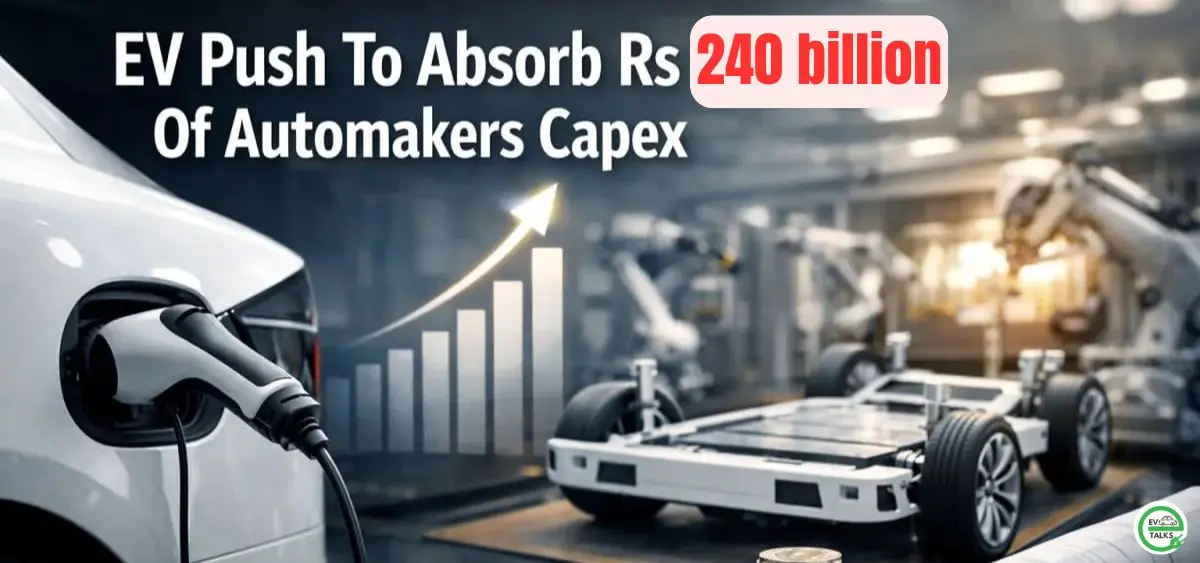

India’s passenger vehicle industry is making one of its biggest strategic shifts in recent years as EV Capex To Absorb Rs 240 billion out of the planned ₹600 billion capital expenditure over this financial year and the next. The investment highlights the growing confidence of automakers in the country’s electric vehicle (EV) future as consumer demand, product availability, and affordability continue to improve.
According to a recent industry assessment, more than 40% of planned investments will be directed toward expanding EV portfolios, localizing supply chains, and increasing electric vehicle manufacturing capacity. This indicates that electric cars are no longer a niche segment but are steadily becoming a mainstream choice for Indian buyers.

Electric Car Adoption Gains Strong Momentum
India’s electric four-wheeler (E4W) market has witnessed impressive growth in recent months. Average monthly sales increased by nearly 40% to around 26,000 units during the three months ending May 2026. As a result, EV penetration in the passenger vehicle market climbed to 6.1%, compared to the fiscal 2026 average of 4.6%.
Industry experts expect this momentum to continue. Annual electric car volumes are projected to more than double from approximately 220,000 units last fiscal to nearly 500,000 units by the next financial year. This could raise EV penetration to between 8% and 10%, reflecting strong long-term demand despite short-term market fluctuations.
EV Capex To Absorb Rs 240 bn to Expand Product Portfolio
The fact that EV Capex To Absorb Rs 240 billion demonstrates how aggressively manufacturers are preparing for future demand. A significant portion of these investments will be used to introduce new electric models, strengthen local component manufacturing, and scale production facilities.
The number of electric four-wheeler models available in India has already doubled to around 20 and is expected to exceed 35 by the next fiscal year. Most upcoming launches are planned in the highly competitive sub-₹15 lakh segment, making electric cars accessible to a much larger customer base.
Better Range and Lower Ownership Costs Drive Demand
Improved battery technology is making electric vehicles increasingly practical for Indian consumers. Premium electric cars now offer driving ranges between 500 km and 700 km on a single charge, while mid-range models deliver approximately 300 km to 450 km, significantly reducing range anxiety.
At the same time, vehicle acquisition costs have declined by nearly 10% to 15% over the past two financial years. Combined with lower running and maintenance expenses, these improvements have strengthened the overall ownership economics of electric vehicles.
Profitability Challenges Remain Despite Strong Investment
While EV Capex To Absorb Rs 240 bn reflects long-term confidence, the transition is expected to put pressure on automakers’ profitability in the near term. High initial investments, limited production scale, and high fixed costs may temporarily reduce operating margins.
Manufacturers continue to rely on profits generated from conventional internal combustion engine (ICE) vehicles to support their EV expansion. However, analysts expect profitability to improve as production volumes increase and operating leverage strengthens over the coming years.
Outlook
With rising consumer acceptance, expanding model choices, improving technology, and massive industry investment, India’s electric vehicle market appears set for sustained growth. The decision that EV Capex To Absorb Rs 240 bn underscores the industry’s commitment to accelerating EV adoption while laying the foundation for a more competitive and sustainable automotive future.

Related Articles: