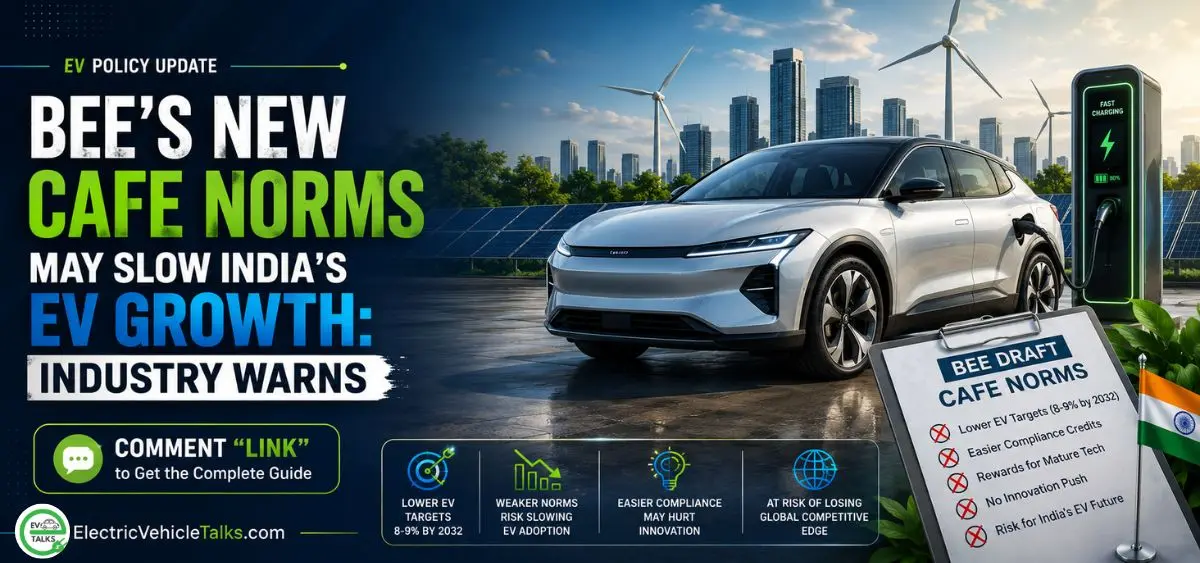

India’s electric mobility journey has entered a critical phase as BEE’s New CAFE norms spark fresh debate across the automotive industry. While Delhi recently introduced one of the country’s most progressive EV policies focused on full electrification, the Bureau of Energy Efficiency’s fourth draft of Corporate Average Fuel Efficiency (CAFE) standards appears to move in the opposite direction. Experts argue that instead of accelerating the transition to cleaner mobility, the draft weakens long-term ambitions and risks slowing India’s manufacturing and export competitiveness.

Lower EV Targets Raise Industry Concerns
The biggest criticism is the reduced ambition for electric vehicle adoption. Earlier proposals effectively required EVs to contribute around 14–15% of passenger car sales by 2032. That target later dropped to 11–12%, while the latest draft lowers expectations further to just 8–9%. With EVs already accounting for about 7.5% of passenger vehicle sales this financial year, many industry observers believe regulations should become more ambitious as technology matures. Instead, BEE’s New CAFE Norms are being viewed as a step backwards.
The contrast with global markets is equally striking. Electric vehicles account for over 75% of new car sales in Nepal and around 40% in Singapore and Vietnam, while India’s overall EV penetration remains comparatively low. Critics warn that weaker standards could delay innovation, reduce investment and leave India behind in the global race for advanced automotive technologies.
Innovation Takes a Back Seat
Another major concern is that the draft rewards already established technologies. Features such as LED lighting, tyre pressure monitoring systems and start-stop technology receive generous compliance credits despite being widely adopted across the industry. The proposal also offers significant benefits to flex-fuel vehicles, even though compatible fuel remains scarcely available across India. According to experts, BEE’s New CAFE Norms make regulatory compliance easier without demanding meaningful technological progress, reducing the incentive for manufacturers to invest in next-generation electric mobility.
Questions Over Regulatory Independence
The draft also introduces a controversial compliance mechanism that allows automakers to purchase credits directly from BEE at a fixed price, in addition to trading credits among themselves. Industry analysts argue this creates a potential conflict of interest, as the regulator would simultaneously oversee, price and participate in the compliance market. Globally, regulators typically remain neutral while manufacturers trade credits independently.
As India aims to become a global hub for EV manufacturing and exports, experts believe BEE’s New CAFE Norms should encourage stronger innovation rather than protect legacy technologies. A more ambitious framework, they argue, would attract investment, strengthen domestic manufacturing, and prepare the country’s automotive industry for the future rather than slowing its transition.

Related Articles: