
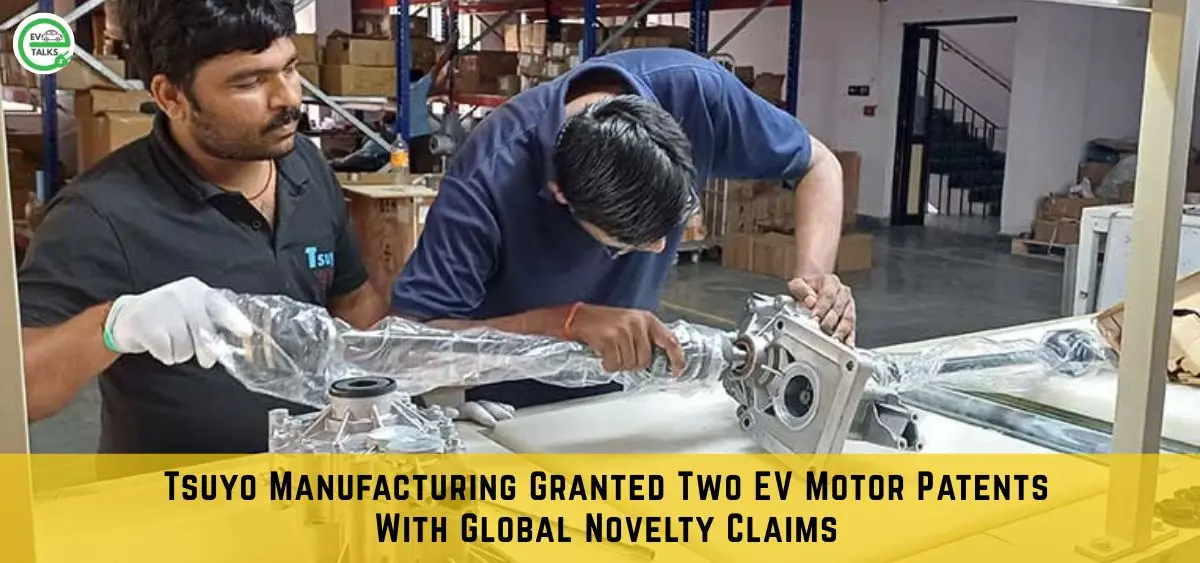

In a significant development for India’s electric vehicle (EV) ecosystem, Tsuyo Granted Two EV Motor Patents on April 30, marking a major step toward building indigenous intellectual property in a sector long dominated by global players from China, Japan, and Europe. The company described both innovations as globally novel, underscoring its ambition to transition from component supplier to technology originator.
Breakthrough in Synchronous Reluctance Motor Design
The first of the two patents introduces a redesigned synchronous reluctance motor (SynRM) featuring a non-magnetic bridge structure. Traditional SynRM motors rely on physical bridges within the rotor for mechanical strength, but these bridges often cause magnetic flux leakage, reducing efficiency.

Tsuyo’s approach replaces these with non-magnetic materials, significantly minimizing flux leakage. This results in improved torque density, enhanced efficiency, and stronger rotor integrity. Another key advantage is the reduced reliance on rare-earth materials like neodymium—resources that have faced global supply volatility due to concentrated production in China. This innovation could help manufacturers manage both costs and supply chain risks more effectively.
Advanced Five-Phase Motor with Fault Tolerance
The second innovation reinforces why Tsuyo Manufacturing’s being granted two EV Motor Patents is a notable milestone. The patent covers a five-phase permanent magnet synchronous motor (PMSM) integrated with a dual inverter system. Unlike conventional three-phase systems, this design distributes power across five phases, reducing torque ripple and improving operational smoothness.
The motor uses an open-end winding configuration, allowing independent control of each winding through dual inverters. This enables dynamic switching between star mode for efficiency at low loads and delta mode for higher torque demands. Crucially, the system can continue functioning even if one phase fails, making it ideal for commercial vehicles, agricultural machinery, and off-road applications where reliability is critical.
Collaboration and R&D-Driven Growth
The technologies were developed in collaboration with researchers from Visvesvaraya National Institute of Technology (VNIT), Nagpur, supported by academic experts. This aligns with broader government efforts to strengthen industry-academia partnerships in strategic sectors like EVs.
Founder and CEO Vijay Kumar emphasized that the achievement reflects the company’s “Design-In-India” philosophy and commitment to scalable, modular innovation.
Expanding Capabilities and Market Presence
Headquartered in Greater Noida, Tsuyo Manufacturing has deployed over 300,000 powertrains and supplies more than 25 OEMs across industries. Its motor portfolio ranges from 0.5 kW to 400 kW, catering to multiple vehicle segments.
With over 29 patentable innovations and recent approval for expansion in Karnataka, the company aims to boost production capacity under government initiatives like PMeDrive.
A Step Toward Self-Reliant EV Ecosystem
As Tsuyo Manufacturing is Granted Two EV Motor Patents, it highlights a broader shift in India’s EV sector—from dependence on imported technologies to homegrown innovation. With rising EV adoption driven by policies like FAME and PLI schemes, such advancements could play a crucial role in strengthening India’s global competitiveness in electric mobility.

Related Articles:









