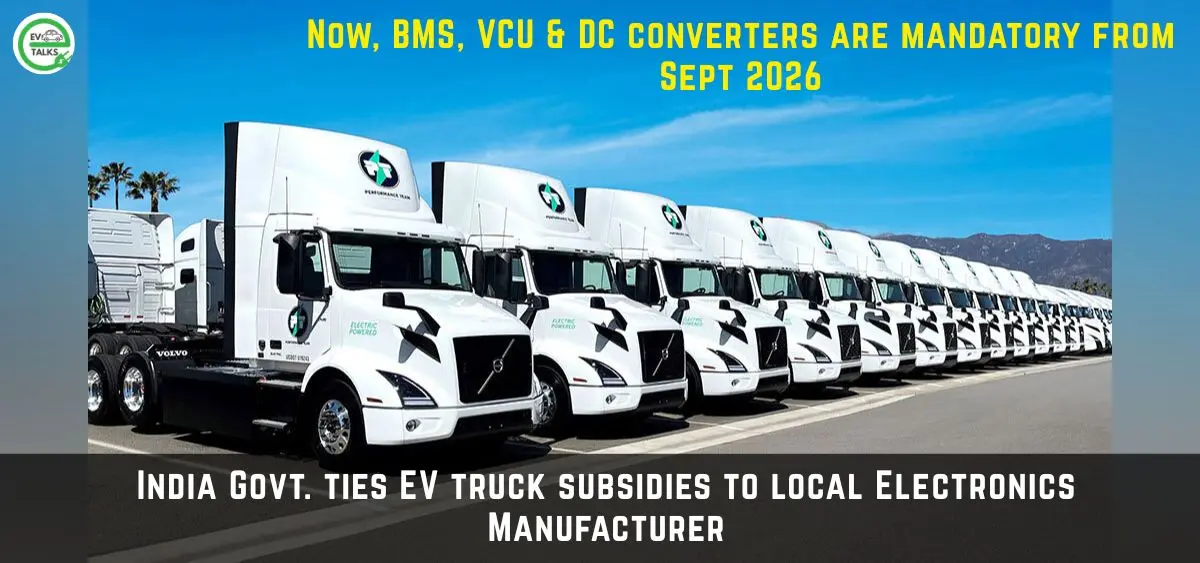

India has taken a decisive step to strengthen its electric vehicle ecosystem, as the Govt. ties EV truck subsidies to local Electronics manufacturing starting September 1, 2026. The Ministry of Heavy Industries (MHI), through a notification issued on April 29, has mandated domestic production of critical electronic components such as battery management systems (BMS), vehicle control units (VCUs), and DC-DC converters for electric trucks.
Shift from Assembly to Deep Localisation
The new rules mark a significant transition from simple vehicle assembly to full-scale component manufacturing. Under the updated phased manufacturing program (PMP) for N2 and N3 category trucks, manufacturers must now ensure that key electronics are built within India. This means assembling semiconductors, connectors, and electronic components directly on printed circuit boards (PCBs), along with integrating wiring, enclosures, and software systems locally.

With this move, the Govt. ties EV truck subsidies to local Electronics production at a deeper level, ensuring that not just final assembly but core technological components are domestically developed.
Import Deadline and Compliance Window
The policy provides a clear transition timeline. Imports of BMS and related systems will be allowed only until August 31, 2026. After this deadline, any electric truck using imported electronic systems will no longer qualify for government incentives. This effectively phases out dependency on foreign control systems and pushes manufacturers to localize operations.
Subsidy Structure and Eligibility
The localization mandate is directly linked to financial incentives under the ₹500 crore e-truck scheme, part of the larger ₹10,900-crore PM E-Drive initiative. Electric trucks with a gross vehicle weight between 3.5 tonnes and 55 tonnes are eligible.
Subsidies are calculated at ₹5,000 per kWh of battery capacity, capped at 10% of the ex-factory price. N2-category trucks can receive up to ₹2.7 lakh, while trucks in the 7.5–12 tonne range may get up to ₹3.6 lakh. Buyers must also scrap older vehicles to claim these benefits. Clearly, the Govt. ties EV truck subsidies to local Electronics as a central eligibility condition.
Industry Impact and Future Outlook
The policy is expected to reshape supply chains, especially for OEMs reliant on imported electronics. Companies will need to invest in local manufacturing capabilities, which may increase short-term costs. However, industry leaders believe the long-term benefits outweigh the challenges.
This initiative is likely to boost domestic component manufacturers and electronics service providers, encouraging innovation in both hardware and software. Global suppliers may also need to establish local units or partnerships to stay competitive.
Ultimately, as the Govt. ties EV truck subsidies to local Electronics, the move sets the foundation for a self-reliant EV ecosystem in India—one that prioritizes scale, innovation, and long-term sustainability.

Related Articles: