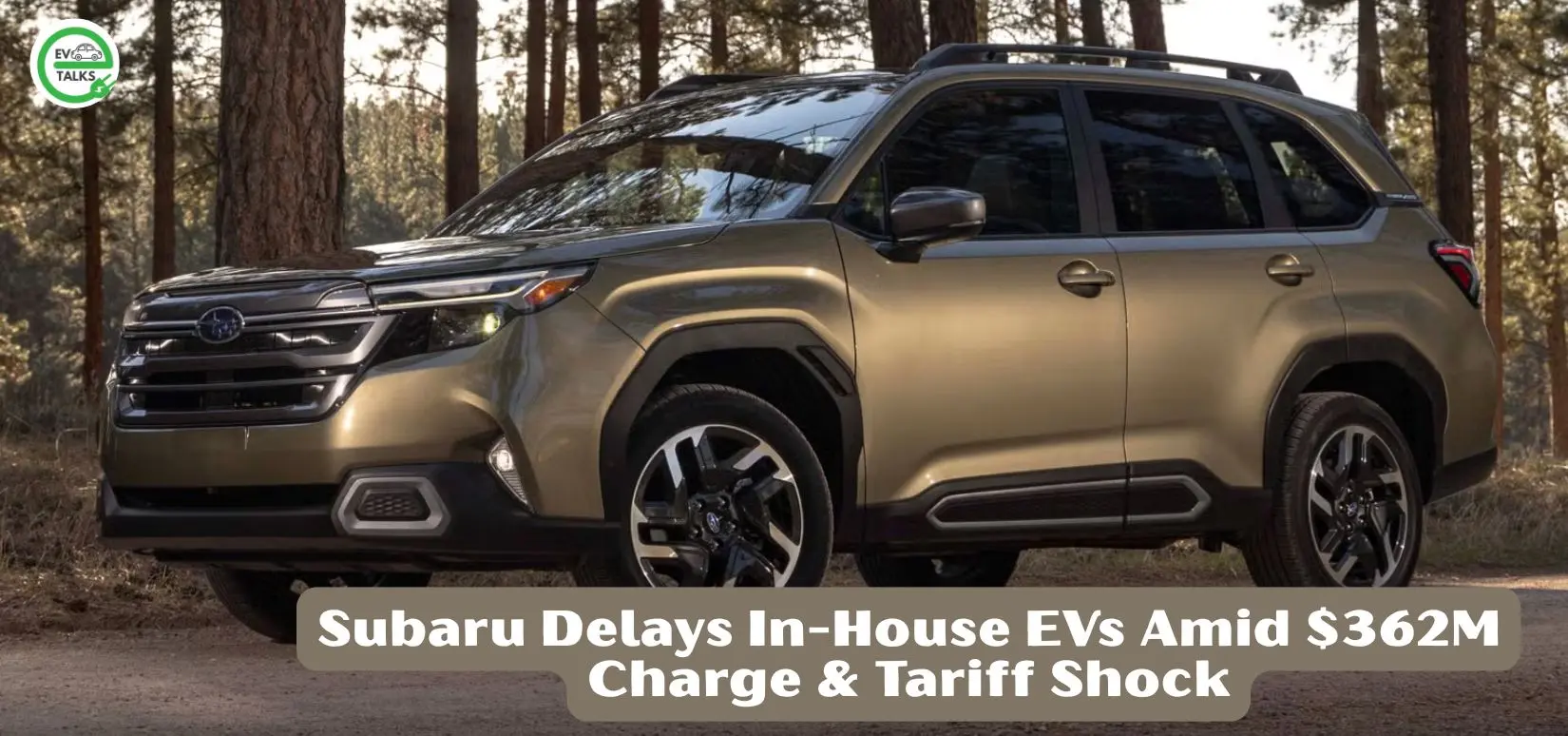

Subaru Corporation is facing a major strategic reset as Subaru Delays In-House EVs following a dramatic financial downturn driven by tariffs, weak EV demand, and regulatory shifts. The move highlights a growing Subaru EV delay trend across the global auto industry.
Massive Profit Drop Shocks Investors
The company reported a staggering Subaru profit drop, with operating profit plunging 90% to ¥40.1 billion ($251.2 million), compared to ¥405.3 billion the previous year. Net income also fell sharply by 73% to ¥90.8 billion ($568.7 million), signaling one of the toughest fiscal years in Subaru’s history.

A major contributor to this collapse was rising U.S. import tariffs, which erased ¥226.9 billion ($1.42 billion) from earnings. Since Subaru depends heavily on Japanese exports for nearly half of its U.S. sales, it remains particularly exposed to global trade fluctuations.
EV Production Delayed After Heavy Losses
Another key factor behind the downturn is the EV production delay strategy. The company recorded ¥57.8 billion ($362 million) in EV-related losses, including asset write-downs and reduced emissions credit value after changes in U.S. environmental policies.
As a result, Subaru Delays In-House EVs that were initially planned for mass production by 2028 at its Oizumi plant in Japan. CEO Atsushi Osaki confirmed the timeline is now on hold, with the facility shifting focus to gasoline and hybrid vehicle production instead.
Shift Toward Hybrids and ICE Vehicles
With Subaru Delays In-House EVs, the company is reallocating resources toward more profitable internal combustion engine (ICE) and hybrid models. This aligns with a broader industry trend, as automakers like Honda and Mazda also rethink aggressive EV expansion plans.
Future Outlook Remains Hopeful
Despite the challenges, Subaru remains optimistic. Through cost-cutting measures and production adjustments, including operations at its Indiana facility, the company expects operating profit to rebound to ¥150 billion by FY2027.
Still, Subaru Delays In-House EVs underscore a cautious approach as the company navigates uncertain EV market dynamics.

Related Articles: