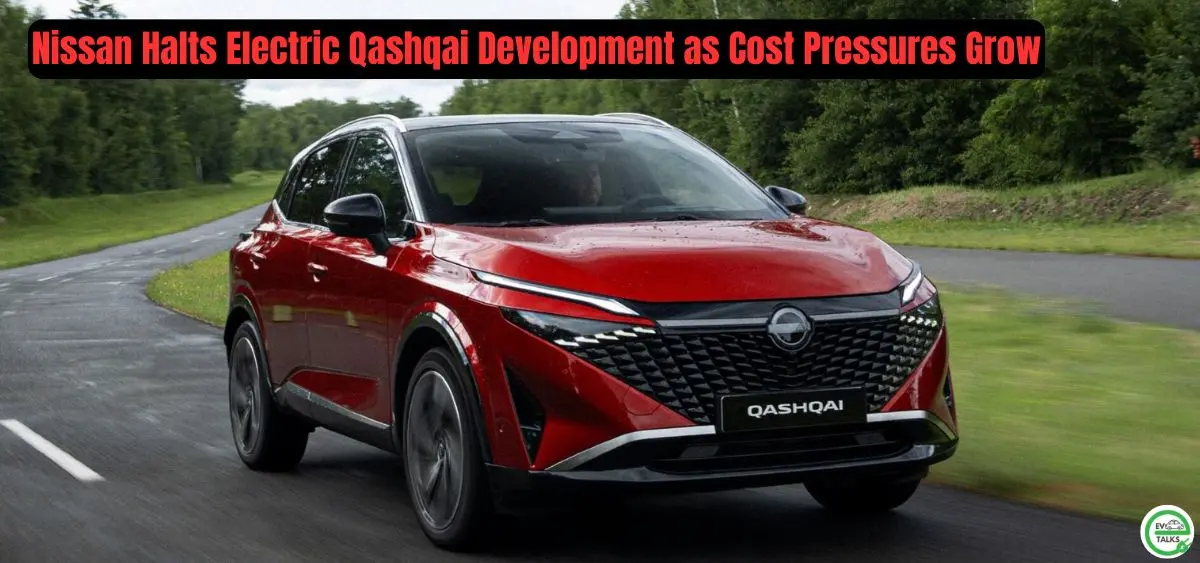

Nissan halts electric Qashqai development as the automaker restructures its global product strategy to reduce costs and respond to changing electric vehicle (EV) market conditions. According to multiple reports, the company has quietly paused the development of the fully electric version of its popular Qashqai SUV, reflecting the growing challenges faced by traditional car manufacturers in the rapidly evolving EV industry.

Why Nissan Paused the Electric Qashqai Project
Several factors reportedly contributed to the decision.
Intense Competition in the EV Market
The European electric vehicle market has become increasingly competitive, with affordable EVs from established manufacturers and rapidly expanding Chinese brands putting pressure on pricing and profitability. This has made it more difficult for legacy automakers to justify investments in new battery-electric models.
Fluctuating Consumer Demand
Nissan has also observed significant fluctuations in demand for fully electric vehicles across Europe. While EV adoption continues to grow in some regions, consumer preferences have shifted toward hybrid models in several key markets.
Global Cost-Cutting Measures
The move is part of Nissan’s broader restructuring program following heavy financial losses. The automaker plans to reduce its global product lineup by approximately 20%, cutting the number of models from 56 to 45 in an effort to improve operational efficiency.
Regulatory Challenges
Post-Brexit local content rules between the United Kingdom and the European Union have added uncertainty for UK-built vehicle exports, making long-term production planning more complex.
Production and Manufacturing Impact
The reported decision by Nissan to halt electric Qashqai development is expected to affect several manufacturing operations.
Nissan’s Sunderland plant in the UK, which was previously expected to produce the electric Qashqai, has already closed one of its two main production lines due to weaker-than-expected demand. To better utilize the unused production capacity, the company has signed a non-binding memorandum of understanding with Chinese automaker Chery to explore contract manufacturing opportunities.
In addition, Nissan subsidiary JATCO has cancelled plans to build a new three-in-one electric powertrain factory at the Sunderland facility.
Shift Toward Hybrid Vehicles
Rather than focusing exclusively on battery-electric vehicles, Nissan is now prioritizing a more balanced product strategy with greater emphasis on hybrid models. A similar approach is already being implemented at the company’s Canton, Mississippi, manufacturing facility in the United States.
Even if the project resumes in the future, industry sources suggest the electric Qashqai is unlikely to enter production before the early 2030s.
Outlook
The decision that Nissan halts electric Qashqai development underscores the evolving realities of the global EV market. Automakers are increasingly balancing electrification goals with financial discipline, shifting consumer demand, and regulatory uncertainty. For now, Nissan appears focused on strengthening its hybrid portfolio while reassessing the timing of future battery-electric models.

Related Articles: