The EV Subsidy in Nagaland in 2026 is evolving, but buyers should look beyond headlines when calculating their savings. As of 2026, Nagaland does not have a verified state-level cash purchase subsidy for electric vehicles in the latest official assessment. The current motor-vehicle tax framework also lists electric two-wheelers and four-wheelers under a 6% one-time tax category.
Meanwhile, the central PM E-DRIVE scheme provides incentives for selected electric three-wheelers, ambulances, trucks, and buses, while its e-2W incentive window ended in July 2026. This guide explains the latest subsidies, road-tax rules, incentives, and practical EV-buying considerations for Nagaland.
What EV Subsidy Do Buyers Get in Nagaland in 2026?
If you are looking for a straight answer, Nagaland does not currently have a verified state-level cash purchase subsidy for EV buyers in the latest official data available. More importantly, the state’s current motor-vehicle tax schedule does not show a blanket EV road-tax exemption: its Schedule 11 expressly covers petrol, diesel, CNG, and electric non-transport vehicles and sets one-time tax at 6% for two-wheelers and 6% for four-wheelers.
NITI Aayog’s India Electric Mobility Index 2025, published in September 2026, records Nagaland at zero purchase incentives, zero transition incentives, and zero operational-support initiatives in its 2025 assessment and recommends that the state frame and notify a comprehensive EV policy.
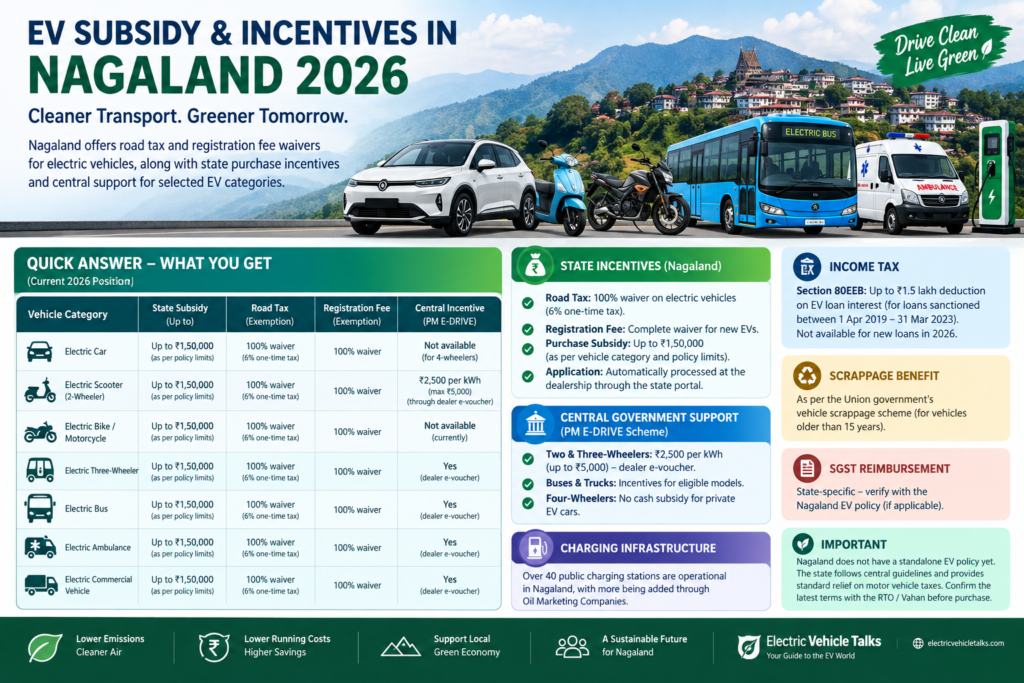
State-Level Incentives in Nagaland
- Road tax: 100% waiver on electric vehicles.
- Registration: Waiver on vehicle registration fees.
- Application: Applied automatically at the dealership.
Central Government Schemes (PM E-DRIVE)
- 4-wheelers: No cash purchase subsidy for electric cars.
- 2 & 3-wheelers: Upfront demand incentives apply through participating dealers.
- Deadlines: E-2W subsidies apply to vehicles registered by July 31, 2026; e-3Ws run until March 31, 2028.
Charging and Running Costs
- Electricity rate: Domestic power costs roughly ₹5.4/kWh in Kohima.
- Running cost: Approximately ₹0.76 per km for EVs compared to higher petrol costs.
- Infrastructure: Public chargers are available in major hubs like Kohima.
Current EV incentive snapshot for Nagaland
| EV category | Nagaland state purchase subsidy | Road/vehicle tax position | Central PM E-DRIVE position in 2026 | What the buyer can actually receive |
|---|---|---|---|---|
| Electric car / private 4W | ₹0 verified | 6% one-time tax under current Schedule 11 | No private-car purchase incentive | No verified state cash subsidy; 6% tax applies |
| Electric scooter/e-bike/motorcycle | ₹0 verified | 6% one-time tax under the 2W schedule | The e-2W incentive ended 31 July 2026 | No PM E-DRIVE incentive for a new registration after the terminal date |
| Electric rickshaw / e-cart | ₹0 verified | Category-specific motor-vehicle taxation applies. | ₹2,500/kWh, capped at ₹12,500, subject to scheme conditions and 15% ex-factory-price cap | Eligible vehicles can receive the central incentive through the scheme mechanism. |
| L5 electric 3-wheeler | ₹0 verified | Category-specific tax applies. | The terminal date was 26 December 2025. | No new PM E-DRIVE incentive in September 2026 |
| Electric ambulance | ₹0 verified | Applicable vehicle taxation | ₹30,000/kWh, capped at 35% of ex-factory price, subject to eligibility/guidelines | Potential central incentive for eligible e-ambulances |
| Electric commercial vehicle / e-truck | ₹0 verified | Commercial-vehicle tax depends on category. | ₹5,000/kWh, capped at 10% of ex-factory price and further subject to GVW caps | Eligible e-trucks can receive central support. |
| Electric bus | ₹0 verified retail subsidy | Commercial/public-transport taxation applies. | PM E-DRIVE supports deployment through public transport agencies rather than a normal retail buyer subsidy. | Support is primarily institutional/procurement based. |
| Women EV buyers | No separate Nagaland women-only EV purchase subsidy verified | Same tax framework | Same central EV eligibility as other buyers | No verified women-only state EV cheque |
| Green Business Scheme | Not a general EV purchase subsidy | Not a road-tax exemption | Separate concessional finance route | Eligible beneficiaries can obtain finance for green businesses, including battery e-rickshaws |
The PM E-DRIVE rates and terminal dates above reflect the latest government information available in 2026.
Bottom line: If you are buying a private electric car or electric scooter in Nagaland in September 2026, do not assume that you will receive a ₹1.5 lakh state subsidy or a 100% road-tax waiver. Those claims should not be treated as current without a fresh Nagaland government notification or confirmation from the registering authority.
What Is the EV Subsidy in Nagaland in 2026?
The phrase “EV subsidy in Nagaland” can be misleading because it combines several different types of support: state purchase incentives, road-tax concessions, registration-fee exemptions, central demand incentives, and concessional loans.
For 2026, these need to be separated carefully.
The latest NITI Aayog India Electric Mobility Index assessment says Nagaland has no recorded purchase incentive in the 2025 assessment and recommends that the state frame and notify an EV policy. It also records Nagaland’s private and commercial EV registration shares at 0% in the assessment dataset.
That does not mean electric mobility has no future in Nagaland. Quite the opposite. It highlights that the state is still at an early stage of building its formal EV policy and market ecosystem.
The same NITI Aayog assessment notes that Nagaland unveiled its first air-conditioned electric vehicle as part of a tourist-facilitation programme in Dimapur in September 2024.
That is an important signal. EV adoption in Nagaland is not simply a question of buying private cars. Tourism, public mobility, commercial transport, and government fleets could all become important early use cases.
Does Nagaland Give 100% Road Tax Exemption on Electric Vehicles?
This is one of the biggest areas of confusion online.
The current Nagaland Motor Vehicles Taxation (Amendment) Act, 2023, published in the Nagaland Gazette, includes “Diesel/Petrol/CNG/Electric Vehicles” in Schedule 11 for non-transport two-wheelers and four-wheelers. It specifies a 6% one-time tax for two-wheelers and 6% for four-wheelers, calculated on the original vehicle cost excluding GST and other applicable taxes.
Therefore, based on the official tax schedule that can be verified, a blanket 100% road-tax exemption for electric cars and electric two-wheelers cannot be presented as the current rule.
Example
Suppose an electric car has a taxable original cost of ₹12 lakh excluding GST.
At a 6% one-time tax:
₹12,00,000 × 6% = ₹72,000
That is very different from a zero-road-tax scenario.
For an electric two-wheeler with a taxable original cost of ₹1.5 lakh:
₹150,000 × 6% = ₹9,000
The actual registration bill can contain other statutory fees or charges, so buyers should use the amount generated through the official registration process rather than relying on a blog calculator.
Is There a Nagaland Electric Vehicle Policy?
As of the latest NITI Aayog assessment published in September 2026, Nagaland is identified as a state that should frame and notify an EV policy to create a more comprehensive and integrated approach to e-mobility.
This is a significant distinction.
A state can take individual actions supporting electric mobility without having a comprehensive standalone EV policy. But without a clearly notified policy containing eligibility criteria, incentive ceilings, implementation dates, and budget provisions, buyers should be cautious about claims circulating online about large state subsidies.
For EV buyers, the safest rule is simple:
Do not include an unverified state EV subsidy in your purchase budget until the dealer or RTO can show the applicable government notification.
This is especially important for expensive electric cars, where a claimed subsidy of ₹1 lakh or ₹1.5 lakh can materially change the financing calculation.
How to apply for EV Subsidy in Nagaland 2026
You do not need to submit a separate application for an EV subsidy in Nagaland; the dealer automatically applies the central PM E-Drive Scheme or relevant waivers at the point of purchase.
How the Process Works
- Select an Eligible EV: Choose a vehicle model that complies with central and state norms from an authorized manufacturer.
- Provide Aadhaar Details: Share your Aadhaar-linked mobile number at an empanelled dealership for instant e-KYC verification.
- Get an E-Voucher: The dealer generates an Aadhaar-authenticated e-voucher directly through the official portal.
- Receive an Upfront Discount: The subsidy amount is deducted immediately from your final vehicle invoice, and the dealer handles the back-end reimbursement.
What Is the PM E-DRIVE Scheme in Nagaland?
The PM E-DRIVE scheme is a national programme rather than a Nagaland-specific subsidy.
The scheme has a total outlay of ₹10,900 crore and supports EV adoption, charging infrastructure, and the domestic EV ecosystem. The scheme has been extended to 31 March 2028, but different vehicle categories have different terminal dates. Know about the Government Subsidy for EV Charging Stations in India.
This distinction matters enormously in September 2026.
Electric scooters and motorcycles
The PM E-DRIVE incentive for eligible e-2Ws in FY 2025-26 was ₹2,500 per kWh, capped at ₹5,000 per vehicle and further subject to the scheme’s ex-factory-price limitation.
However, the e-2W segment’s terminal date was extended only until 31 July 2026. Therefore, a buyer registering a new electric scooter in Nagaland after that date should not budget for a PM E-DRIVE incentive.
This is a particularly important 2026 update because many older articles still advertise PM E-DRIVE as though the e-2W subsidy continues throughout 2028.
It does not.
What Is the EV Subsidy in Nagaland for Electric Cars?
For a private electric passenger car, the answer is relatively straightforward:
There is no verified Nagaland state purchase subsidy in the latest official data, and PM E-DRIVE does not provide a normal consumer purchase incentive for private electric passenger cars.
The PM E-DRIVE demand-incentive framework is directed at specific categories such as e-2Ws, e-3Ws, e-ambulances, and e-trucks, while e-buses receive support through deployment programs.
So if you are considering an electric SUV in Kohima or Dimapur, your financial calculation should primarily include:
- Vehicle ex-showroom price
- GST
- Nagaland motor-vehicle tax
- Registration and statutory charges
- Insurance
- Dealer charges
- Home charger installation
- Electricity cost
- Financing cost
- Maintenance
- Battery warranty
Do not subtract a hypothetical ₹1.5 lakh state subsidy unless the dealer provides documentary confirmation that the benefit is currently active.
What About EV Subsidy in Nagaland for Electric 2-W and Three-Wheelers?
The situation is more nuanced.
Electric two-wheelers
The central PM E-DRIVE e-2W terminal date was 31 July 2026. That means the scheme should not be treated as an active September 2026 purchase subsidy for new e-scooter registrations.
Electric rickshaws and e-carts
The latest PM E-DRIVE information provides an incentive of:
₹2,500 per kWh, capped at ₹12,500 per vehicle, with an additional 15% of the ex-factory price cap for e-2W/e-3W incentives.
This is particularly relevant in Nagaland because commercial three-wheelers can create a practical bridge between electrification and income generation.
What Is the EV Subsidy in Nagaland for Electric Ambulances?
Electric ambulances are one of the more interesting categories under PM E-DRIVE.
The scheme provides an incentive of:
₹30,000 per kWh
with the incentive capped at:
35% of the vehicle’s ex-factory price.
The government allocated ₹500 crore for e-ambulances under PM E-DRIVE. The scheme has been extended for e-ambulances through 31 March 2028.
However, buyers should distinguish between an individual purchasing a vehicle and an eligible institutional or fleet deployment. The final benefit depends on PM E-DRIVE eligibility and implementation requirements.
What Is the EV Subsidy in Nagaland for Electric Commercial Vehicles?
Electric commercial vehicles are increasingly important because their economics are different from private cars.
An electric commercial vehicle can potentially travel many kilometers each day, meaning fuel savings accumulate faster.
For eligible e-trucks, PM E-DRIVE provides:
₹5,000 per kWh
subject to:
- 10% of ex-factory price cap
- GVW-based maximum incentive
- Applicable PM E-DRIVE eligibility requirements
The latest government table lists maximum incentive levels ranging from ₹2.7 lakh to ₹9.6 lakh, depending on gross vehicle weight, with the highest listed category subject to a ₹9.3 lakh cap.
This is much more substantial than the e-2W incentive, but it is aimed at a completely different vehicle category and operating model.
What About Electric Buses in Nagaland?
The PM E-DRIVE programme allocates substantial funding for electric buses, but this should not be interpreted as a ₹20 lakh-or-₹35 lakh cash cheque to a private person buying an electric bus.
The scheme allocates ₹4,391 crore for deployment of 14,028 e-buses through public transport agencies.
The official incentive framework lists e-bus support at ₹10,000 per kWh, subject to a 20% cost cap and length-based maximum amounts.
That support is primarily structured around public transport deployment.
For Nagaland, the more important question is therefore whether public transport agencies, urban bodies, or other eligible institutions participate in the programme.
EV Subsidy for Women in Nagaland: Is There a Special Benefit?
There is no verified Nagaland government women-only EV purchase subsidy in the current official data reviewed for this article.
A woman buying an electric scooter, motorcycle, or car in Nagaland therefore should not assume that she automatically receives an additional state EV cash benefit.
There is, however, a separate Green Business Scheme that can be relevant to eligible women entrepreneurs in certain circumstances.
That scheme should not be confused with a general women-focused EV subsidy.
What Is the Green Business Scheme in Nagaland?
The Green Business Scheme is particularly interesting because it connects environmental activity with income generation.
The official National Safai Karamcharis Finance & Development Corporation description says the scheme provides financial assistance in the form of loans for activities that tackle climate change while generating income. One of its indicative activities is a battery electric vehicle/e-rickshaw.
The scheme is intended for Safai Karamcharis, scavengers, and their dependents, rather than the general population.
The currently published scheme information states:
| Green Business Scheme feature | Current information |
|---|---|
| Eligible group | Safai Karamcharis, scavengers and dependants |
| EV-related activity | Battery electric vehicle/e-rickshaw |
| Finance | Up to 90% of unit cost |
| Maximum loan | ₹2 lakh under the currently published scheme page |
| Beneficiary contribution | 10% of unit cost |
| Beneficiary interest | 7% p.a. |
| Female beneficiary benefit | 1 percentage-point rebate from NSKFDC’s interest share |
| Repayment | Up to 6 years, including a 6-month moratorium |
The important takeaway is that GBS is a concessional-finance scheme, not a universal Nagaland EV purchase subsidy.
Does Section 80EEB Still Give an EV Tax Benefit in 2026?
This is another outdated EV benefit that continues to appear in older articles.
Section 80EEB allows a deduction of up to ₹1.5 lakh of interest on an eligible EV loan. But the Income Tax Department clearly states that the loan must have been sanctioned between 1 April 2019 and 31 March 2023.
Therefore:
A new EV loan sanctioned in September 2026 does not qualify for a fresh Section 80EEB deduction.
People who took an eligible EV loan within the prescribed earlier window can continue to claim the deduction subject to the applicable conditions.
What Does the Nagaland EV Awareness Study Tell Us?
The Financial Awareness and Perception towards the adoption of electric vehicles in Nagaland provides useful context for understanding why policy clarity matters.
The study surveyed consumers in Nagaland and examined awareness of EV pricing, subsidies, financing, operating costs, and other financial considerations. It found that respondents’ financial awareness was around the neutral benchmark rather than significantly above it.
The research also identified uncertainty around:
- EV subsidies
- Battery replacement costs
- Financing
- Long-term savings
- Initial purchase price
That finding is particularly relevant to the subsidy question.
When buyers see conflicting information online—for example, one page claiming a ₹1.5 lakh subsidy while another government document shows no purchase incentive—financial planning becomes difficult.
The study recommends clearer subsidy communication, improved financial literacy, and better charging infrastructure.
How Is EV Charging Developing in Nagaland?
Charging infrastructure is arguably more important than a small purchase incentive once an EV is on the road.
NITI Aayog’s 2025 assessment records Nagaland with a charger-to-EV ratio of 13.0 per lakh vehicles in its dataset, while showing zero capital-subsidy initiatives for public charging infrastructure and zero charging-infrastructure development initiatives under the indicators used.
The uploaded Nagaland consumer study similarly identifies charging infrastructure and regional road conditions as important practical considerations for adoption, while recommending additional charging stations in major towns to reduce range anxiety.
For a buyer, this creates a simple ownership rule:
Charge where you live first, and use public charging as a supplement.
If you have reliable home parking and electricity, an electric scooter can be particularly straightforward.
For an electric car, home charging can turn most daily charging into a background activity rather than a separate trip.
What Does EV Charging Cost in Nagaland?
Charging cost depends on electricity tariff, charger efficiency, battery size, and charging losses.
Nagaland’s power tariff proposals for FY 2026-27 list ₹8.80/kWh for EV charging stations under the published tariff proposal. This is relevant to commercial/public charging rather than necessarily representing the electricity cost of every home EV owner.
For illustration, if a public charger effectively supplies 40 kWh to an EV at ₹8.80/kWh:
40 × ₹8.80 = ₹352
Actual consumer billing can differ because public charging operators may apply service fees, demand charges, taxes, or other pricing structures.
Home charging may be considerably different because residential electricity slabs apply.
EV Ownership in Nagaland: The Cost Equation Is Bigger Than the Subsidy
One of the biggest mistakes buyers make is focusing only on the purchase subsidy.
The more useful calculation is total cost of ownership, or TCO.
Consider an EV that travels 1,000 km per month.
If it consumes approximately 0.15 kWh/km:
1,000 × 0.15 = 150 kWh/month
At an illustrative ₹8.80/kWh:
150 × ₹8.80 = ₹1,320/month
or approximately:
₹15,840/year
That is only an illustrative energy calculation, not a universal Nagaland charging cost.
A petrol vehicle returning 15 km/l and travelling 1,000 km would consume about 66.7 litres per month. At a hypothetical ₹100/liter, that is approximately ₹6,667 per month.
The difference demonstrates why operating cost can become more important than an upfront subsidy over several years.
But the comparison must include:
- Financing interest
- Insurance
- Tyres
- Battery warranty
- Scheduled maintenance
- Charging equipment
- Electricity tariff
- Resale value
- Vehicle utilization
Common Mistakes for EV Buyers in Nagaland Should Avoid
1. Assuming every website has current subsidy information
EV policies change rapidly.
A subsidy published in 2023 can remain online even after the policy has expired.
Always check the date.
2. Assuming PM E-DRIVE covers electric cars
It does not provide a normal consumer demand subsidy for private electric passenger cars.
3. Assuming the e-2W subsidy continues until 2028
The overall PM E-DRIVE programme continues until 2028, but the e-2W terminal date was 31 July 2026.
4. Treating the Green Business Scheme as a general EV subsidy
GBS is targeted at a specific beneficiary group and operates as concessional finance.
5. Forgetting the road-tax calculation
The current Nagaland Schedule 11 explicitly lists electric vehicles within the 6% one-time tax framework for non-transport two-wheelers and four-wheelers.
6. Buying an EV without checking charging access
A low-cost EV is not necessarily a convenient EV if there is nowhere practical to charge it.
Buying Guide: Which EV Makes Sense for a Nagaland Buyer?
For daily city commuting
An electric scooter or motorcycle can make sense where daily travel distances are predictable, and home charging is available.
However, because the PM E-DRIVE e-2W terminal date has passed, calculate the purchase without assuming a central subsidy.
For family use
An electric car should be evaluated based on:
- Daily kilometres
- Home charging availability
- Intercity travel requirements
- Ground clearance
- Battery warranty
- Fast-charging capability
- Service availability
- Tyre and suspension suitability
Nagaland’s terrain makes real-world driving conditions particularly relevant. The claimed laboratory range should not be treated as an exact prediction of mountain-road range.
For commercial operators
Commercial EVs should be evaluated by kilometres travelled per day.
A vehicle running 150–250 km daily has a very different financial case from a private car travelling 20–30 km daily.
For e-rickshaw operators
The Green Business Scheme may be relevant for eligible beneficiaries, while PM E-DRIVE support for eligible e-rickshaws/e-carts can further change the acquisition economics.
Expert Insight from Electric Vehicle Talks
The most important development for Nagaland is not simply whether the state adds another ₹10,000 or ₹50,000 incentive.
It is whether Nagaland develops a clear, predictable, and implementable EV policy.
The latest NITI Aayog assessment explicitly recommends that Nagaland frame and notify an EV policy and introduce appropriate incentives and initiatives for EV adoption, charging infrastructure, and research.
That matters because manufacturers, dealers, fleet operators, and consumers all make investment decisions based on policy certainty.
For consumers, the immediate lesson is equally practical:
Build your EV budget around confirmed benefits, not advertised benefits.
For a private electric car buyer in 2026, that means not assuming a state purchase subsidy or road-tax exemption.
For an electric two-wheeler buyer, it means recognizing that the PM E-DRIVE e-2W window has already ended.
For commercial operators, the central incentive framework remains more relevant in categories such as eligible e-rickshaws, e-ambulances, and e-trucks.
And for policymakers, the lesson from Nagaland’s own consumer research is clear: better awareness matters. The uploaded study found that consumers continue to have uncertainty around subsidies, battery costs, and long-term financial benefits.
More transparent communication could therefore be almost as important as the subsidy itself.
For continuing EV policy updates, ownership guides, and charging information, readers can explore Electric Vehicle Talks.
People Also Ask
1. Does Nagaland give subsidies for electric cars in 2026?
No verified state purchase subsidy for private electric cars is recorded in the latest NITI Aayog assessment. PM E-DRIVE also does not provide a normal consumer purchase subsidy for private electric passenger cars.
2. Is road tax free for EVs in Nagaland?
The current Nagaland Motor Vehicles Taxation Schedule 11 lists electric vehicles alongside petrol, diesel, and CNG vehicles and specifies a 6% one-time tax for non-transport two-wheelers and four-wheelers. Therefore, a blanket 100% EV road-tax exemption should not be assumed.
3. How much PM E-DRIVE subsidy is available for an electric scooter in Nagaland?
The PM E-DRIVE e-2W incentive was ₹2,500 per kWh, capped at ₹5,000 per vehicle, but the e-2W terminal date was 31 July 2026. Consequently, a new September 2026 purchase should not be budgeted with that subsidy.
4. How much subsidy is available for an electric rickshaw?
For eligible e-rickshaws and e-carts, the latest PM E-DRIVE rate is ₹2,500 per kWh, capped at ₹12,500 per vehicle and subject to the applicable 15% ex-factory-price cap.
5. Is there a special EV subsidy for women in Nagaland?
No separate Nagaland women-only EV purchase subsidy was verified in the current official material reviewed. However, eligible women may receive specific benefits under schemes such as the Green Business Scheme, where its eligibility conditions are met.
6. Can Section 80EEB reduce my EV loan tax in 2026?
A newly sanctioned 2026 EV loan does not qualify for Section 80EEB because eligible loans had to be sanctioned between 1 April 2019 and 31 March 2023. The deduction limit is ₹1.5 lakh on eligible interest.
7. Does PM E-DRIVE cover electric ambulances?
Yes. The scheme provides an incentive of ₹30,000 per kWh, capped at 35% of the ex-factory price, subject to applicable eligibility and implementation conditions.
EV Subsidy in Nagaland 2026 FAQs
Is there an EV policy in Nagaland?
The latest NITI Aayog India Electric Mobility Index assessment recommends that Nagaland frame and notify a comprehensive EV policy. Buyers should therefore distinguish between existing motor-vehicle tax rules and a future comprehensive EV-policy incentive package.
What is the road tax for an electric car in Nagaland?
The current 2023 Nagaland motor-vehicle tax schedule specifies a 6% one-time tax for four-wheelers, including electric vehicles, based on the original cost excluding GST and other taxes.
What is the road tax for an electric scooter in Nagaland?
For non-transport two-wheelers, the same Schedule 11 specifies a 6% one-time tax. Electric vehicles are expressly included in the schedule.
Does PM E-DRIVE give a subsidy on electric cars?
No, a normal PM E-DRIVE demand incentive is provided for private electric passenger cars. The scheme focuses its demand support on specified EV categories and provides separate support for public e-bus deployment.
Can I get an EV loan through the Green Business Scheme?
The Green Business Scheme supports eligible Safai Karamcharis, scavengers, and their dependants for green income-generating activities, including battery electric vehicles/e-rickshaws. It is not an open-to-all EV loan scheme.
Is EV charging infrastructure available in Nagaland?
Charging infrastructure exists, but NITI Aayog’s 2025 assessment shows that Nagaland’s charging ecosystem remains at an early development stage, with a charger-to-EV ratio of 13 per lakh vehicles and no recorded capital subsidy or charging-infrastructure development initiative under the assessment indicators.
Should I wait for a Nagaland EV subsidy?
That is ultimately a personal purchasing decision. From a financial-planning perspective, however, the safer approach is to calculate the purchase using currently verified incentives, rather than assuming that a future state policy will provide a subsidy. If Nagaland later notifies a formal EV policy, the calculation can be updated.
Final Takeaway
The EV story in Nagaland is at an important turning point.
The state has demonstrated interest in electric mobility, including an electric vehicle used for tourism facilitation in Dimapur, while consumer research shows growing interest but continuing uncertainty about subsidies, financing, batteries, and charging.
But the current 2026 subsidy picture is more limited than many online articles suggest.
For private electric cars and electric scooters, there is no verified state cash purchase subsidy in the latest official assessment. The current Nagaland motor-vehicle tax schedule specifies a 6% one-time tax for non-transport electric two-wheelers and four-wheelers.
PM E-DRIVE remains important, but its benefits are category-specific. The e-2W window ended on 31 July 2026, while support remains relevant to eligible categories such as e-rickshaws/e-carts, e-ambulances, and e-trucks under their respective rules.
For buyers, the smartest approach is therefore not to chase a headline subsidy.
Look at the complete ownership equation: purchase price + tax + charging + electricity + financing + maintenance + resale value.
And before making a booking, ask the dealer to show the exact government notification or official portal calculation supporting every claimed subsidy or tax exemption.
That final verification step could save an EV buyer thousands of rupees—and prevent a promising clean-mobility purchase from being built on outdated information.
For more India-focused EV policy updates, buying guides, charging insights, and electric-mobility analysis, explore Electric Vehicle Talks.
Related Articles: