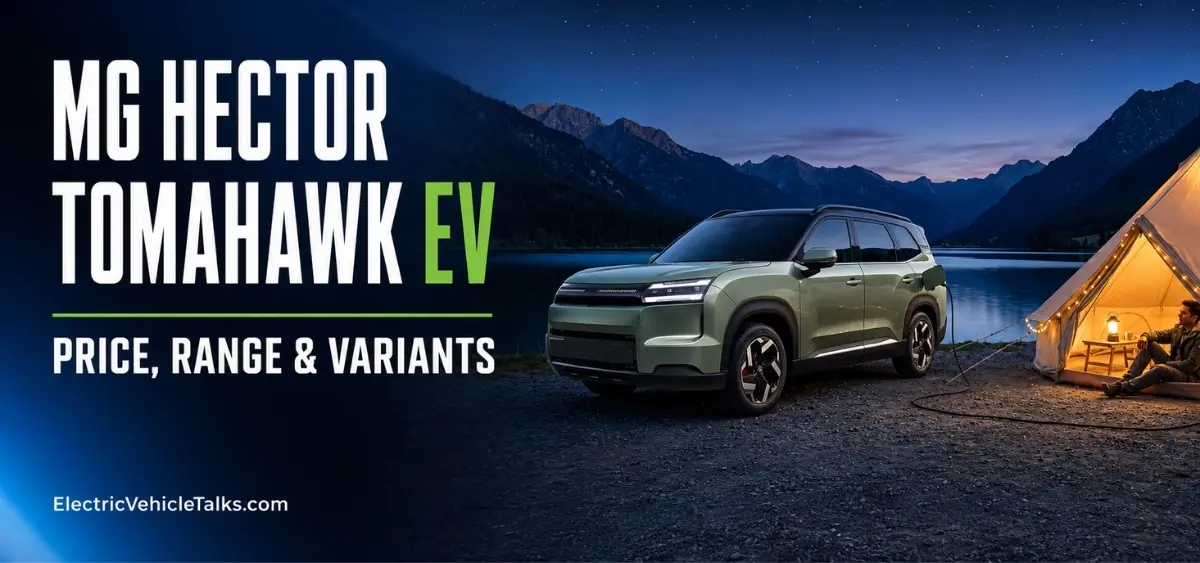

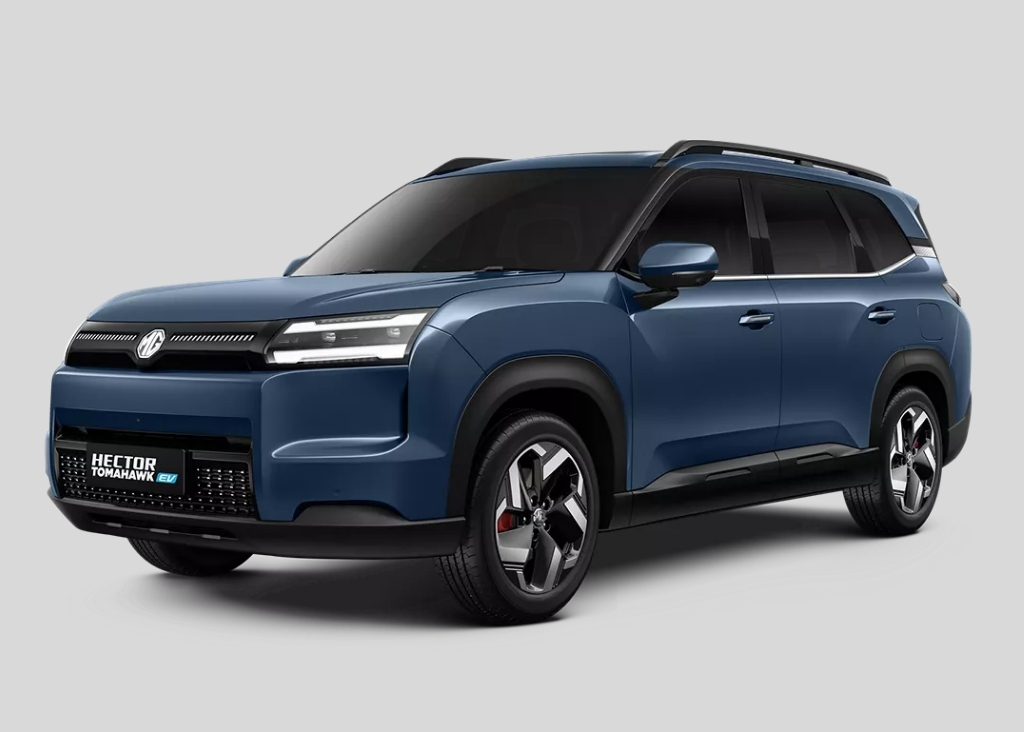
The MG Hector Tomahawk EV is a large electric family SUV priced from ₹19.49 lakh to ₹23.49 lakh, ex-showroom. It combines a 69.2 kWh battery, a claimed 517 km MIDC range and flexible five- and seven-seat layouts.
Under MG’s Battery-as-a-Service program, the entry price falls to ₹13.99 lakh, with battery rental charged at ₹4.90 per kilometer. This makes the SUV easier to finance, although buyers must evaluate the long-term rental commitment carefully.
The model is particularly significant because India has relatively few electric SUVs capable of accommodating seven occupants. Instead of chasing outright acceleration figures, the Tomahawk focuses on cabin space, comfort, family usability, and features such as a vehicle-to-Home power supply.
This detailed guide examines the price, variants, performance, charging, ownership costs, and limitations of the vehicle.
MG Hector Tomahawk EV: Key specifications
| Specification | Official figure |
|---|---|
| Battery capacity | 69.2 kWh |
| Battery type | MG MAGIC high-voltage battery |
| Electric motor | Permanent Magnet Synchronous Motor |
| Maximum power | 150 kW/approximately 204 hp |
| Maximum torque | 310 Nm |
| Drivetrain | Front-wheel drive |
| Claimed range | 517 km MIDC |
| Maximum DC charging capability | 90 kW |
| DC charging time | Approximately 35 minutes, 30–80% |
| AC charging time | Approximately 12.5 hours, 10–100%, 7.4 kW |
| Charging connector | CCS2 |
| Claimed 0–100 km/h time | 8.2 seconds |
| Length | 4,745 mm |
| Width excluding mirrors | 1,850 mm |
| Height | 1,770 mm |
| Wheelbase | 2,810 mm |
| Ground clearance | 230 mm, unloaded |
| Wheel and tyre size | 225/55 R18 |
| Seating options | Five or seven seats |
| Airbags | Six, standard across variants |
For more details, see the table below
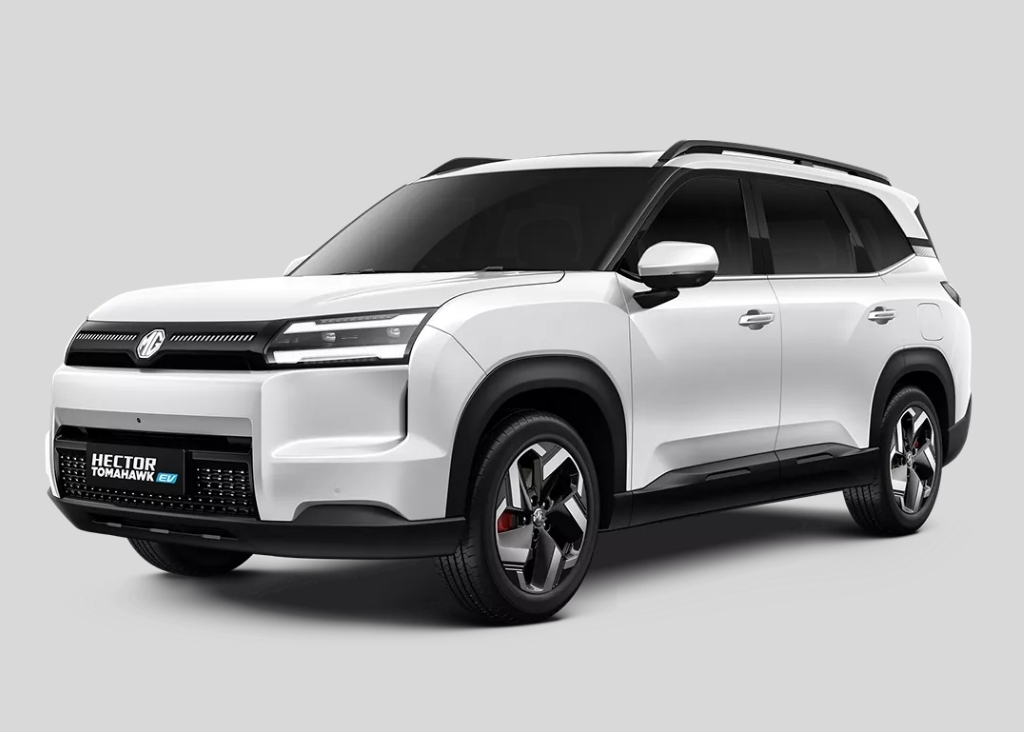 | 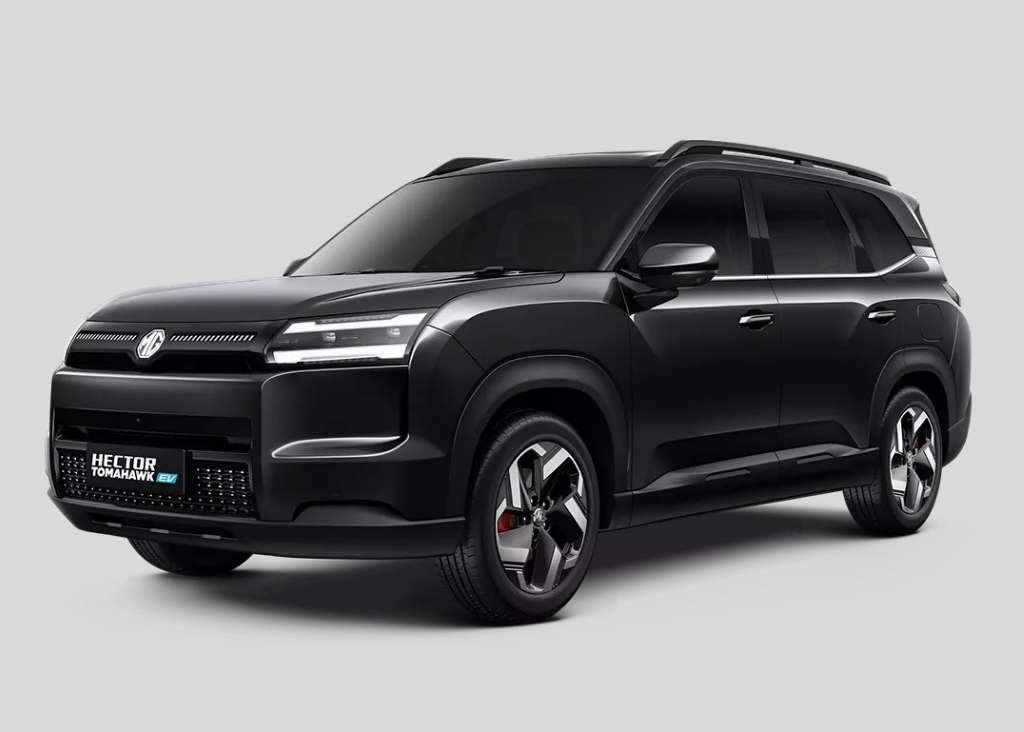 | 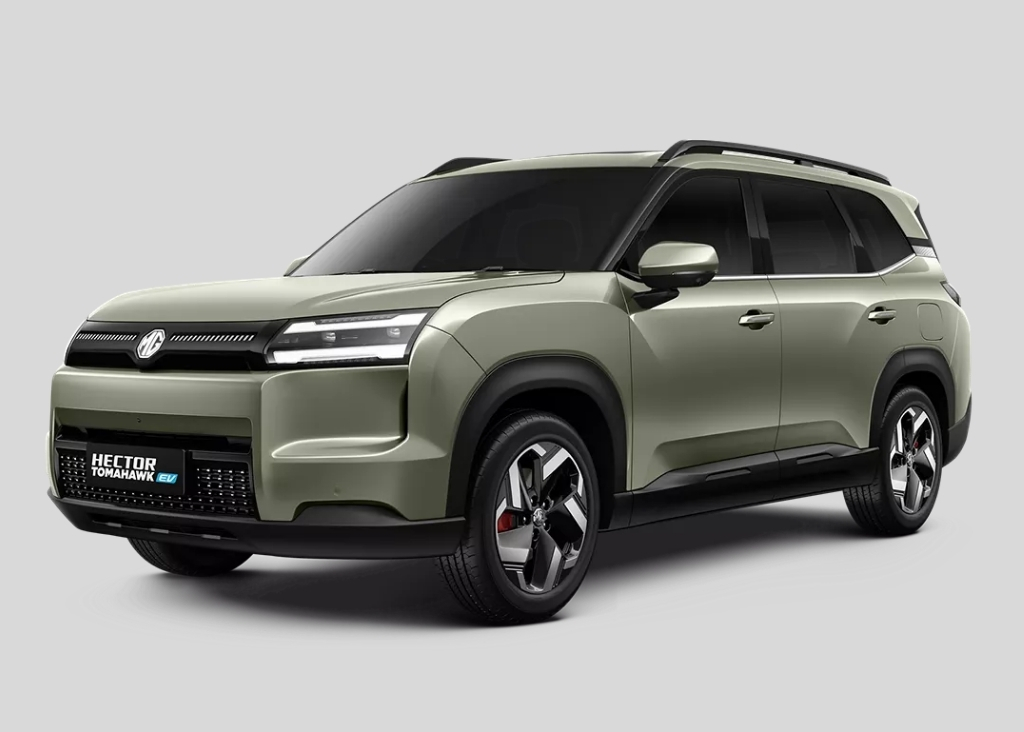 |  | |
| Name | MG Motor Hector Tomahawk | MG Motor Hector Tomahawk | MG Motor Hector Tomahawk | MG Motor Hector Tomahawk |
| Model | ESSENCE 7-SEATER 69.2 KWh | ESSENCE 5-SEATER 69.2 KWh | EXCLUSIVE 7-SEATER 69.2 KWh | EXCITE 7-SEATER 69.2 KWh |
| Year | 2026 | 2026 | 2026 | 2026 |
| Price | ₹23,49,000 | ₹22,99,800 | ₹21,99,800 | ₹19,49,800 |
Powertrain ⯆ | ||||
| Battery Type | LFP (Lithium Iron Phosphate) | LFP (Lithium Iron Phosphate) | LFP (Lithium Iron Phosphate) | LFP (Lithium Iron Phosphate) |
| Battery Pack | 69.2 KWh | 69.2 KWh | 69.2 KWh | 69.2 KWh |
| Electric Motor Type | Permanent Magnet Synchronous Motor (PMSM) | Permanent Magnet Synchronous Motor (PMSM) | Permanent Magnet Synchronous Motor (PMSM) | Permanent Magnet Synchronous Motor (PMSM) |
| Electric Motor Max Power (bhp@rpm/KW) | 150 kW | 150 kW | 150 kW | 150 kW |
| Electric Motor Max Torque (nm@rpm) | 310 Nm | 310 Nm | 310 Nm | 310 Nm |
| Drive Type | FWD | FWD | FWD | FWD |
| Number of Electric Motor | 1 | 1 | 1 | 1 |
| Dedicated Hybrid Engine | ||||
| Engine Max. Power (kW@rpm) | ||||
| Engine Max. Torque (Nm@rpm) | ||||
| Fuel Tank capacity (L) | ||||
| Fuel Type | ||||
| Transmission | ||||
Charging Info ⯆ | ||||
| AC charging time (0-100% SoC) | ~12.5hrs [7.4kW] | ~12.5hrs [7.4kW] | ~12.5hrs [7.4kW] | ~12.5hrs [7.4kW] |
| DC charging time (0-100% SoC) | ||||
| Charging Port | CCS2 | CCS2 | CCS2 | CCS2 |
| Charging Options | DC fast charging, 7.4 kW AC fast charging, 3.3 kW portable charging through a 15A socket, eHUB by MG charging network | DC fast charging, 7.4 kW AC fast charging, 3.3 kW portable charging through a 15A socket, eHUB by MG charging network | DC fast charging, 7.4 kW AC fast charging, 3.3 kW portable charging through a 15A socket, eHUB by MG charging network | DC fast charging, 7.4 kW AC fast charging, 3.3 kW portable charging through a 15A socket, eHUB by MG charging network |
| Charging Time (15/16 A Plug Point) | ||||
| Wireless Mobile Charging | Yes – 50W fast wireless charger with cooling | Yes – 50W fast wireless charger with cooling | Yes – 50W fast wireless charger with cooling | Yes – 50W fast wireless charger with cooling |
| AC Portable Charger | Yes – 3.3 kW portable charging cable included | Yes – 3.3 kW portable charging cable included | Yes – 3.3 kW portable charging cable included | Yes – 3.3 kW portable charging cable included |
| Home Charger | Yes – 7.4 kW AC fast charger with standard installation | Yes – 7.4 kW AC fast charger with standard installation | Yes – 7.4 kW AC fast charger with standard installation | Yes – 7.4 kW AC fast charger with standard installation |
| Charging Limiter | ||||
| Scheduled Charging & Scheduled Cabin Conditioning | ||||
| AC charging time (0-80% SoC) | ||||
| AC charging time (20-80% SoC) | ||||
| DC charging time (20-80% SoC) | ~35min [90kW] | ~35min [90kW] | ~35min [90kW] | ~35min [90kW] |
| DC charging time (0-80% SoC) | ||||
| Charger type / charging standard | CCS2; supports a 7.4 kW AC charger and DC fast charging up to 90 kW | CCS2; supports a 7.4 kW AC charger and DC fast charging up to 90 kW | CCS2; supports a 7.4 kW AC charger and DC fast charging up to 90 kW | CCS2; supports a 7.4 kW AC charger and DC fast charging up to 90 kW |
| DC charging time (10-80% SoC) | ||||
Warranty ⯆ | ||||
| Battery Warranty | Lifetime warranty | Lifetime warranty | Lifetime warranty | Lifetime warranty |
| Motor Warranty | ||||
| Vehicle Warranty | As a Private vehicle: 3 years with unlimited kilometres & As a Commercial vehicle: 3 years or 1,00,000 km | As a Private vehicle: 3 years with unlimited kilometres & As a Commercial vehicle: 3 years or 1,00,000 km | As a Private vehicle: 3 years with unlimited kilometres & As a Commercial vehicle: 3 years or 1,00,000 km | As a Private vehicle: 3 years with unlimited kilometres & As a Commercial vehicle: 3 years or 1,00,000 km |
| Tyre Warranty | 1 year | 1 year | 1 year | 1 year |
| Home Charger Warranty | ||||
| Portable Charger Warranty | ||||
Learn More ⯆ | ||||
| Read more | ||||
| Watch Video | ||||
Pricing ⯆ | ||||
| Ex Showroom Price | 2349000 | 2299800 | 2199800 | 1949800 |
Comfort & Convenience ⯆ | ||||
| Push Start | ||||
| Frunk Space (litres) | ||||
| Boot Space (litres) | 192 litres with all rows upright; 528 litres with the third row folded | 610L, and 1053L with 2nd row fold | 192 litres with all rows upright; 528 litres with the third row folded | 192 litres with all rows upright; 528 litres with the third row folded |
| Auto Headlamps | ||||
| Rain Sensing Wipers | ||||
| 2nd row AC vents | Yes, and 3rd row AC Vents | Yes, and 3rd row AC Vents | Yes, and 3rd row AC Vents | |
| Seat Belt Adjustment | ||||
| Console Storage Cooling | ||||
| Seat Recline | 2nd Row Seat Recline | 2nd Row Seat Recline | 2nd Row Seat Recline | 2nd Row Seat Recline |
| Auto AC | ||||
| Door Glass | All Windows Auto Up Down With Anti Pinch Function. | All Windows Auto Up Down With Anti Pinch Function. | All Windows Auto Up Down With Anti Pinch Function. | All Windows Auto Up Down With Anti Pinch Function. |
| Power Adjusted Driver Seat | 6-way electrically adjustable | 6-way electrically adjustable | 6-way electrically adjustable | 6-way electrically adjustable |
| Power Adjusted Co-Driver Seat | 4-way electrically adjustable | 4-way electrically adjustable | 4-way electrically adjustable | 4-way electrically adjustable |
| Electric adjust ORVM | ||||
| Power fold ORVM | ||||
| ORVM Auto Dip on Reverse | ||||
| Auto Dimming IRVM | ||||
| Ventilated Front Seats | ||||
| Ventilated Rear Seats | ||||
| Door Handles | Door handles with chrome finish | Door handles with chrome finish | Door handles with chrome finish | Door handles with chrome finish |
| Window Sun Shades | Yes – rear-window sunshades | Yes – rear-window sunshades | ||
| One Touch Driver Power Window | Yes – all windows have automatic up/down | Yes – all windows have automatic up/down | Yes – all windows have automatic up/down | Yes – all windows have automatic up/down |
| Parcel Shelf | Only Rear Parcel Curtain | |||
| Front Row Arm Rest with Storage | Ye | Ye | Ye | Ye |
| 2nd Row Arm Rest with Cup Holder | Ye | Ye | Ye | Ye |
| Magzine Pockets for Rear Passengers | Ye | Ye | Ye | Ye |
| Bottle Holder | Ye | Ye | Ye | Ye |
| Umbrella Holder | ||||
| Heads Up Display (augmented reality HUD) | ||||
| 2nd Row Recline | ||||
| Soft Wrapped Dashboard & Door Trims | Man-made leather dashboard | Man-made leather dashboard | Man-made leather dashboard | Man-made leather dashboard |
| Keep, Pet & Camp Modes (climate control) | ||||
| Interior Device Charging Port | 50W cooled wireless charger, front USB-A and fast-charging USB-C, second-row USB-A and fast-charging USB-C, plus a 12V outlet | 50W cooled wireless charger, front USB-A and fast-charging USB-C, second-row USB-A and fast-charging USB-C, plus a 12V outlet | 50W cooled wireless charger, front USB-A and fast-charging USB-C, second-row USB-A and fast-charging USB-C, plus a 12V outlet | 50W cooled wireless charger, front USB-A and fast-charging USB-C, second-row USB-A and fast-charging USB-C, plus a 12V outlet |
| Power Socket in Boot | ||||
| ISOFIX Rear Seats | ||||
| ESP | ||||
| Door Open Alert (DOA) | ||||
| Autonomous Emergency Steering (AES) | ||||
| Evasive Steering Assist (ESA) | ||||
| Emergency Lane Keep Assist | ||||
| Highway Assist (including driver initiated auto lane change) | ||||
| Rear Collision Warning (RCW) | ||||
Technology ⯆ | ||||
| Screen Size | 39.6 cm [15.6 inch] Grand viewTM Touch display | 39.6 cm [15.6 inch] Grand viewTM Touch display | 32.5 cm (12.8-inch) touchscreen | 32.5 cm (12.8-inch) touchscreen |
| Chipset & Memory | ||||
| Wireless Technology | Yes, Android Auto & Apple CarPlay | Yes, Android Auto & Apple CarPlay | Yes, Android Auto & Apple CarPlay | Yes, Android Auto & Apple CarPlay |
| Connectivity | Wi-Fi, Bluetooth, USB-A, USB-C, FM, wireless smartphone integration, i-SMART connected services and Jio Fiber-based Home-to-Car connectivity | Wi-Fi, Bluetooth, USB-A, USB-C, FM, wireless smartphone integration, i-SMART connected services and Jio Fiber-based Home-to-Car connectivity | Wi-Fi, Bluetooth, USB-A, USB-C, FM, wireless smartphone integration, i-SMART connected services and Jio Fiber-based Home-to-Car connectivity | Wi-Fi, Bluetooth, USB-A, USB-C, FM, wireless smartphone integration, i-SMART connected services and Jio Fiber-based Home-to-Car connectivity |
| Apps | Yes, MG App Store, Jio Sphere with built-in apps, Jio Games, JioSaavn | Yes, MG App Store, Jio Sphere with built-in apps, Jio Games, JioSaavn | Yes, MG App Store, Jio Sphere with built-in apps, Jio Games, JioSaavn | Yes, MG App Store, Jio Sphere with built-in apps, Jio Games, JioSaavn |
| BYOD ( Bring your own Device) | ||||
| Connected Features | Yes, 80+ connected-car features | Yes, 80+ connected-car features | Yes, 80+ connected-car features | Yes, 80+ connected-car features |
| Speakers | 10 speakers/tweeters, including one subwoofer | 10 speakers/tweeters, including one subwoofer | 6 speakers and tweeters | 6 speakers and tweeters |
| Dolby Atmos | ||||
| Voice Commands | ||||
| NFC Key | ||||
| Passive Keyless Entry (PKE) | ||||
| Auto Park | ||||
| Video calling with in-car camera | ||||
| AIR Purifier | Yes, PM2.5 filter | Yes, PM2.5 filter | Yes, PM2.5 filter | Yes, PM2.5 filter |
| Internet Connectivity | ||||
| Power Tailgate with Gesture Control | ||||
| Tailgate Ajar Warning | ||||
| Vechicle to Vehicle Charging | Yes – V2V capability | |||
| Vehicle to Load Charging | Yes – V2L capability | |||
| Heater | ||||
| Follow Me Home Headlamps | ||||
| Memory Function Seats | ||||
| LightMeUp (ambient lights) | 256-colour ambient and roof lighting. | 256-colour ambient and roof lighting. | Mono Blue ambient lighting | |
| OTA Updates (infotainment & maps) | ||||
| OTA Updates (vehicle features) | ||||
| OTA Updates (ePowertrain) | ||||
| Ecosense & Driving Analytics | ||||
| App Store | Yes – MG App Store | Yes – MG App Store | Yes – MG App Store | Yes – MG App Store |
| Music & Calling Connectivity | ||||
Safety ⯆ | ||||
| Airbags | 6 airbags: dual front, front side and curtain airbags | 6 airbags: dual front, front side and curtain airbags | 6 airbags: dual front, front side and curtain airbags | 6 airbags: dual front, front side and curtain airbags |
| Body Shell | High-strength steel body structure | High-strength steel body structure | High-strength steel body structure | High-strength steel body structure |
| Front Brake Type | Disc brake | Disc brake | Disc brake | Disc brake |
| Rear Brake Type | Disc brake | Disc brake | Disc brake | Disc brake |
| Brake Technology | ABS with EBD | ABS with EBD | ABS with EBD | ABS with EBD |
| EyeDentity (driver & occupant Monitoring) | ||||
| EPB (electric park brake) | ||||
| Rear Parking Sensor | ||||
| Front Parking Sensor | ||||
| Radar | ||||
| Reverse Camera | ||||
| Tyre Pressure Monitoring | ||||
| Fog Lamps | Rear LED fog lamp | Rear LED fog lamp | Rear LED fog lamp | Rear LED fog lamp |
| Cornering Lamps | ||||
| Auto Headlamps | ||||
| Auto Booster Lamps | ||||
| 360 Degree Camera | ||||
| Blind Spot Monitor | ||||
| Secure 360 - Live View & Recording | ||||
| Rear Defogger | Yes – front and rear defoggers | Yes – front and rear defoggers | Yes – front and rear defoggers | Yes – front and rear defoggers |
| Windshield Auto Defogging | Front defogger, No automatic | Front defogger, No automatic | Front defogger, No automatic | Front defogger, No automatic |
| Central Locking | ||||
| Child Safety Locks | ||||
| Anti-lock Braking System (ABS) | ||||
| Brake Assist | ||||
| ADAS | Yes – Level 2 ADAS with 11 driver-assistance functions | Yes – Level 2 ADAS with 11 driver-assistance functions | ||
| Forward Collision Warning System (FCW) | ||||
| Automatic Emergency Braking System (AEB) | ||||
| Lane Departure Warning System (LDW) | ||||
| Lane Keep Assist System (LKA) | ||||
| Lane Sway Alert (LSA) | ||||
| Lane Centering Function (LCF) | ||||
| Traffic Sign Recognition (TSR) | ||||
| Front Vehicle Start Alert (FVSA) | ||||
| Adaptive Cruise Control (ACC) | ||||
| Intelligent Adaptive Cruise Control (iACC) | ||||
| Smart Pilot Assist (SPA) | ||||
| Risk Mitigation Support | ||||
| High Beam Assist (HBA) | ||||
| Forward Cross Traffic Alert (FCTA) | ||||
| Rear Cross Traffic Alert (RCTA) | ||||
| Find My Car | Available through i-SMART | Available through i-SMART | ||
| Geo-Fencing | Available through i-SMART | Available through i-SMART | ||
| Live Location Sharing & Tracking | Available as an i-SMART premium subscription feature | Available as an i-SMART premium subscription feature | ||
Design ⯆ | ||||
| Driving Space | Best-in-segment space claim; 85% of the floor area is usable | Best-in-segment space claim; 85% of the floor area is usable | Best-in-segment space claim; 85% of the floor area is usable | Best-in-segment space claim; 85% of the floor area is usable |
| Illuminated Logo | ||||
| Headlamps & DRL | Beacon LED projector headlamps with LED DRLs | Beacon LED projector headlamps with LED DRLs | Beacon LED projector headlamps with LED DRLs | Beacon LED projector headlamps with LED DRLs |
| Tail Lamps | Dynamic LED tail lamps | Dynamic LED tail lamps | Dynamic LED tail lamps | Dynamic LED tail lamps |
| Upholstery | Man-made leather seat upholstery | Man-made leather seat upholstery | Man-made leather seat upholstery | Man-made leather seat upholstery |
| Wheels | R18 dual-tone precision-cut Rotor alloy wheels | R18 dual-tone precision-cut Rotor alloy wheels | R18 dual-tone precision-cut Rotor alloy wheels | R18 dual-tone precision-cut Rotor alloy wheels |
| Spare Wheel | T145/70 R17 | T145/70 R17 | T145/70 R17 | T145/70 R17 |
| Cladding | Side-body cladding | Side-body cladding | Side-body cladding | Side-body cladding |
| Sunroof | Dual-pane panoramic Cockpit Sunroof | Dual-pane panoramic Cockpit Sunroof | Dual-pane panoramic Cockpit Sunroof | |
| Steering Wheel | leather-wrapped steering wheel with mounted audio controls | leather-wrapped steering wheel with mounted audio controls | leather-wrapped steering wheel with mounted audio controls | leather-wrapped steering wheel with mounted audio controls |
| Cap Touch Switches | ||||
| Steering Wheel & E-shifter | ||||
| Mood Lighting | Yes, 256-colour ambient and roof lighting | Yes, 256-colour ambient and roof lighting | Mono ambient lighting in Blue | |
| Night Trail - Carpet Lamps | ||||
| Sequential Turn Indicators | Floating Light Turn Indicators | Floating Light Turn Indicators | Turn Indicator On ORVM | Turn Indicator On ORVM |
| Start Up / Good bye Animations | ||||
| Center Tail Lamp with Animations | ||||
| Integrated Antenna | Yes – glass antenna | Yes – glass antenna | Yes – glass antenna | Yes – glass antenna |
| Length (mm) | 4,745 mm | 4,745 mm | 4,745 mm | 4,745 mm |
| Width (mm) | 1,850 mm | 1,850 mm | 1,850 mm | 1,850 mm |
| Height (mm) | 1,770 mm | 1,770 mm | 1,770 mm | 1,770 mm |
| Wheelbase (mm) | 2,810 mm | 2,810 mm | 2,810 mm | 2,810 mm |
| Ground Clearance (mm) | 230 mm | 230 mm | 230 mm | 230 mm |
| Vanity Mirror | ||||
| Rear Reading Lamp | Yes – front and rear LED reading lights | Yes – front and rear LED reading lights | Yes – front and rear LED reading lights | Yes – front and rear LED reading lights |
| Rear Seat Headrest | Height-adjustable headrests for all rows | Height-adjustable headrests for all rows | Height-adjustable headrests for all rows | Height-adjustable headrests for all rows |
| Cup Holders | ||||
| Digital Cluster | 22.3 cm (8.8-inch) Multi-Information Display | 22.3 cm (8.8-inch) Multi-Information Display | 22.3 cm (8.8-inch) Multi-Information Display | 22.3 cm (8.8-inch) Multi-Information Display |
| Body Type | SUV | SUV | SUV | SUV |
| Seating Capacity | 7 | 5 | 7 | 7 |
| No. of Doors | 5 | 5 | 5 | 5 |
| Rear Spoiler | ||||
| Electrically Deployed Front Door Handles | ||||
| Premium Finish Exterior Cladding | ||||
| Rear Seating Dimensions L× W (inch.) | ||||
| Front Seating Dimensions L× W (inch.) | ||||
Performance ⯆ | ||||
| Steering Type & Column | ||||
| Steering Adjustment | Tilt and telescopic adjustment | Tilt and telescopic adjustment | Tilt and telescopic adjustment | Tilt and telescopic adjustment |
| Turning Radius (Metres) | ||||
| Drive Modes | Eco, Normal, Sport and Custom | Eco, Normal, Sport and Custom | Eco, Normal, Sport and Custom | Eco, Normal, Sport and Custom |
| Regenerative Braking Levels | ||||
| Single Pedal Drive | ||||
| Virtual Engine Sound | ||||
| Front Suspension | MacPherson strut | MacPherson strut | MacPherson strut | MacPherson strut |
| Rear Suspension | Independent multi-link suspension | Independent multi-link suspension | Independent multi-link suspension | Independent multi-link suspension |
| Suspension Damper Type | ||||
| Shock Absorbers Type | ||||
| Technology | ||||
| Road Vibrations | ||||
| Tyre Type & Size | 225/55 R18 | 225/55 R18 | 225/55 R18 | 225/55 R18 |
| Cruise Control | ||||
| Boost Mode | ||||
| Performance Dashboard | ||||
| 1-100 Km Acceleration (Sec) | 8.2 seconds | 8.2 seconds | 8.2 seconds | 8.2 seconds |
| Top Speed | 160 km/h | 160 km/h | 160 km/h | 160 km/h |
| Real World Range | ||||
| ARAI Range | 517 km | 517 km | 517 km | 517 km |
| Combined ARAI Range | ||||
| Real World Combined Range | ||||
Sources: All the specifications are from the official page.
What is the MG Hector Tomahawk EV price in India?
The conventional ex-showroom price starts at ₹19.49 lakh for the seven-seat Excite and reaches ₹23.49 lakh for the seven-seat Essence.
MG Hector Tomahawk EV price and variants
| Variant | Seats | Ex-showroom price | BaaS price | Battery rental |
|---|---|---|---|---|
| Excite | 7 | ₹1,949,800 | ₹1,399,000 | ₹4.90/km |
| Exclusive | 7 | ₹2,199,800 | ₹1,599,000 | ₹4.90/km |
| Essence | 5 | ₹2,299,800 | ₹1,699,000 | ₹4.90/km |
| Essence | 7 | ₹2,349,800 | ₹1,749,000 | ₹4.90/km |
All prices are ex-showroom and can change. Registration, insurance, accessories, extended warranty, and applicable state charges are extra.
The MG Hector Tomahawk EV base model is the Excite seven-seater. There is no five-seat Excite or Exclusive. Buyers wanting the five-seat configuration must select the top-spec Essence.
What could the MG Hector Tomahawk EV on-road price be?
An exact on-road price cannot be quoted nationally because registration rules, road-tax exemptions, and insurance premiums differ by state.
As a planning estimate, buyers should budget approximately:
| Variant | Ex-showroom price | Illustrative on-road estimate |
|---|---|---|
| Excite 7-seater | ₹19.49 lakh | ₹20.5–₹22.0 lakh |
| Exclusive 7-seater | ₹21.99 lakh | ₹23.1–₹24.8 lakh |
| Essence 5-seater | ₹22.99 lakh | ₹24.2–₹25.9 lakh |
| Essence 7-seater | ₹23.49 lakh | ₹24.7–₹26.5 lakh |
These are indicative estimates, not dealer quotations. An EV registered in a state offering full road-tax and registration-fee exemptions may cost considerably less on-road than the same vehicle registered elsewhere.
Ask the dealer for an itemized quotation showing the following:
- Ex-showroom price
- Registration and road tax
- Insurance premium and insured declared value
- Hypothecation charges
- Extended warranty
- Accessories
- Handling or logistics charges
- Charger installation beyond the standard scope
- BaaS documentation and financing charges, if applicable
How does MG’s Battery-as-a-Service programme work?
Under the MG Hector Tomahawk EV BaaS, the buyer pays for the vehicle separately while the battery is financed through a partner. The battery rental is ₹4.90 for every kilometer traveled.
BaaS reduces the initial price by ₹5.50 lakh across the range.
| Annual driving | Annual battery rental | Five-year rental |
|---|---|---|
| 8,000 km | ₹39,200 | ₹196,000 |
| 12,000 km | ₹58,800 | ₹294,000 |
| 15,000 km | ₹73,500 | ₹367,500 |
| 20,000 km | ₹98,000 | ₹490,000 |
| 25,000 km | ₹122,500 | ₹612,500 |
At a simple ₹4.90-per-kilometer calculation, ₹5.50 lakh corresponds to roughly 1.12 lakh kilometers. That is not a formal break-even point because finance costs, taxes, contract tenure, resale terms, and the time value of money also matter.
Importantly, battery rental does not include electricity. BaaS customers pay both the per-kilometer battery fee and the cost of charging.
- BaaS is a retail financial product offered through finance partners.
- The vehicle remains hypothecated to the relevant financier.
- Eligibility is subject to the partner’s credit policy.
- The programme applies to privately registered vehicles.
- Damage caused by external factors or customer fault may create additional liability.
Who should consider BaaS?
BaaS may suit a buyer who:
- Wants the lowest possible initial payment.
- Prefers a smaller vehicle loan.
- Drives a predictable number of kilometres.
- Understands the rental and exit conditions.
- Plans to retain the SUV only for the contract period.
Outright purchase may be more suitable for high-mileage owners, long-term keepers, and buyers who want simpler resale without a battery-finance agreement. Know more about BAAS in electric vehicles.
Before signing, obtain written answers about minimum monthly kilometres, advance rental, foreclosure, ownership transfer, insurance claims, and what happens when the vehicle is sold.
What range can owners realistically expect?
The official MG Hector Tomahawk EV range is 517 km under MIDC testing. That figure is useful for comparing vehicles tested under the same procedure, but it should not be treated as a guaranteed highway range.
Until independent instrumented road tests are available, a prudent planning estimate would be approximately the following:
| Driving situation | Sensible planning range* |
|---|---|
| Moderate urban driving | 390–440 km |
| Mixed city and highway use | 360–420 km |
| Fast highway driving | 320–380 km |
| Heavy load, extreme heat or sustained high speed | Potentially below 350 km |
*Editorial estimate, not an official or independently tested range.
These estimates assume that owners normally use most, but not every last percentage point, of the battery. Efficiency can decline when the vehicle carries seven passengers and luggage, and runs the climate-control system continuously.
For a relaxed intercity journey, plan charging stops using a conservative 330–370 km first-leg range rather than building an itinerary around the full 517 km claim.
Battery technology and performance explained
The SUV uses a 69.2 kWh MG MAGIC battery mounted beneath the cabin. According to the manufacturer, the battery system has undergone more than 2,000 bench tests and over 490 vehicle-level validations.
A front-mounted Permanent Magnet Synchronous Motor produces 150 kW and 310 Nm. Power goes to the front wheels through a single-speed automatic transmission.
This configuration delivers several practical benefits:
- Instant response in slow-moving traffic
- No gear changes or clutch operation
- Predictable front-wheel-drive behaviour
- Lower mechanical complexity than an internal-combustion powertrain
- Strong overtaking performance without needing high engine revs
The claimed 8.2-second 0–100 km/h time is brisk for a large family SUV. Nevertheless, prospective buyers should assess low-speed ride quality, braking progression, and traction on wet roads during a test drive rather than focusing only on acceleration.
Four drive modes—Eco, Normal, Sport, and Custom—are standard. Regenerative braking can recover energy during deceleration, but owners should experiment with different settings before using the strongest level in dense traffic.
How long does the MG Hector Tomahawk EV take to charge?
The SUV supports a maximum DC charging rate of 90 kW.
| Charging method | Official charging window | Approximate time |
|---|---|---|
| 7.4 kW AC wall box | 10–100% | 12.5 hours |
| 90 kW DC fast charger | 30–80% | 35 minutes |
| 3.3 kW portable cable | Not officially quoted | Best reserved for backup use |
Both a 3.3 kW portable charging cable and a 7.4 kW AC fast charger with standard installation are listed across all variants.
The advertised 35-minute figure is specifically for 30–80%, not 10–80% or a complete charge. Charging speed can also fall when the battery is very cold, very hot, or close to full.
Home-charging cost estimate
Assuming a residential electricity tariff of ₹8 per kWh:
- Battery energy: 69.2 kWh
- Ideal energy cost: approximately ₹554
- With around 10% charging losses: approximately ₹609
- Estimated cost per kilometre at 400 km real-world range: about ₹1.52
At ₹10 per kWh with similar losses, a full session would cost approximately ₹761, or about ₹1.90 per kilometre over 400 km.
Public DC chargers may cost roughly ₹18–₹25 per kWh depending on the operator, location, and taxes. At those rates, the electricity cost can rise to approximately ₹3.10–₹4.33 per kilometer over a 400 km range.
These calculations exclude parking fees, session fees, and BaaS rental.
What are V2H, V2L, and V2V?
The Essence variant introduces three useful energy-sharing functions.
Vehicle-to-Home
V2H allows the battery to supply power to a compatible home electrical system during an outage. The maximum output is 6.6 kVA AC.
However, the compatible V2H unit is sold separately. Its availability, installation, and operation depend on regulatory approval, electrical compatibility, and local conditions. Buyers should not assume the car can power a home immediately after delivery.
Vehicle-to-Load
V2L can operate compatible appliances or equipment at up to 3 kVA. It could be useful for camping, outdoor work, lighting or emergency backup.
Vehicle-to-Vehicle
V2V enables the SUV to transfer power to another compatible EV, with output listed at up to 3 kVA. This is more appropriate for emergency assistance than rapid charging.
These features show how EV batteries are evolving from passive energy stores into mobile power resources.
Five-seater or seven-seater: Which should you buy?
The MG Hector Tomahawk EV 5-seater is offered only in the Essence trim. Its strongest advantage is luggage capacity.
| Configuration | Boot with seats in use | Expanded capacity |
|---|---|---|
| Five-seater Essence | 610 litres | 1,053 litres with second row folded |
| Seven-seater variants | 192 litres | 528 litres with third row folded |
The five-seater is the better option for couples, four-member families, frequent airport trips, and owners who carry substantial luggage.
The seven-seater provides greater flexibility, but the third row should be tested with the passengers who will actually use it. A vehicle being technically classified as a seven-seater does not automatically mean seven adults will be comfortable over long journeys.
Choose the seven-seater if occasional extra seating matters. Choose the five-seater if luggage room, easier access, and a less crowded cabin matter more.
Which MG Hector Tomahawk EV variant offers the best value?
Excite: Sensible entry model
Despite being the base variant, Excite includes the following:
- Six airbags
- Electronic Stability Program
- Traction control
- Hill-hold control
- Four disc brakes
- Electric parking brake with auto hold
- Direct tyre-pressure monitoring
- Reverse camera
- Six-way powered driver’s seat
- Four-way powered front-passenger seat
- Power-folding mirrors
- Cruise control
- Four drive modes
- 7.4 kW AC charger
Its ₹19.49 lakh price makes it the value-led option for buyers prioritizing space, range, and essential safety.
Exclusive: Best balance for many families
Exclusive adds important daily-use features, including the following:
- Dual-pane panoramic sunroof
- Ventilated front seats
- Powered tailgate
- Automatic headlamps
- Rain-sensing wipers
- 50W cooled wireless charging
- 360-degree HD camera
- Transparent-chassis and wheel views
At ₹21.99 lakh, it offers a meaningful comfort upgrade without requiring the top variant.
Essence: Technology-focused flagship
Essence adds:
- Level 2 ADAS
- Adaptive cruise control
- Front parking sensors
- Driver-seat memory and auto-retract
- Auto-dimming inside mirror
- Rear-window sunshade
- V2L, V2V, and V2H compatibility
- Five- or seven-seat choice
For buyers who regularly travel on divided highways and understand the limitations of driver-assistance technology, Essence is the most complete variant.
Interior, infotainment and connected features
The cabin is dominated by a 39.6 cm, or approximately 15.6-inch, infotainment display. An 8.8-inch multi-information display presents essential driving information.
Other notable features include:
- Wireless Android Auto and Apple CarPlay
- More than 80 connected-car functions
- Over 30 Hinglish voice commands
- 10-speaker Infinity audio system
- 256-colour ambient and roof lighting
- Digital Bluetooth key sharing
- Remote lock, unlock and climate control
- Scheduled charging
- Charging-station search
- Over-the-air updates
- Gen AI-powered karaoke with more than 8,000 tracks
Connected services are subject to network coverage. The data services include 2 GB per month for one year, after which additional data may require payment. Some premium software services may also require a subscription.
Comfort modes: Useful or gimmicky?
The vehicle includes Nap, Camp, Energize, Valet, Quiet, and Pro Pet modes.
Pro Pet Mode maintains a selected cabin temperature and displays an external message indicating that the owner will return. It is a valuable feature, but it should not encourage owners to leave an animal unattended for long periods. Battery level, climate-system operation, and local conditions must be monitored.
Camp Mode configures the cabin for outdoor use, while Nap Mode adjusts climate settings and includes a wake-up alarm. Valet Mode secures personal information with a PIN and supplies a trip summary.
These modes are not essential to driving, but they make the vehicle feel better adapted to contemporary family and recreational use.
Safety and ADAS
Six airbags are standard across the range, accompanied by:
- ABS with EBD
- Brake Assist
- Electronic Stability Program
- Traction control
- Hill-hold control
- All-wheel disc brakes
- Electric parking brake with auto hold
- ISOFIX child-seat anchors
- Three-point seat belts for all occupants
- Seat-belt reminders for all seats
- Direct tyre-pressure monitoring
- Rear parking sensors
- Reverse camera
Exclusive and Essence received a 360-degree camera. Essence further adds 11 Level 2 ADAS functions, including Adaptive Cruise Control, Traffic Jam Assist, Lane Departure Warning, Lane Departure Prevention, Forward Collision Warning, Automatic Emergency Braking, and Intelligent Headlamp Control.
ADAS remains a driver-assistance system. It may be affected by faded lane markings, rain, glare, construction zones, unpredictable two-wheelers, and animals—conditions frequently encountered on Indian roads. The driver must remain attentive and in control.
At publication time, readers should also look for an independent Bharat NCAP or Global NCAP result before concluding crash protection. A long feature list is not a substitute for a published crash-test score.
MG Hector Tomahawk EV review: Strengths and challenges
This is an analysis based on official specifications rather than a full independent road test.
Major benefits
- One of the few EVs offering three-row seating
- Competitive starting price for its size
- Large 69.2 kWh battery across all variants
- 517 km MIDC claim
- Six airbags standard
- Powered front seats even on the base model
- 7.4 kW home charger included
- Excellent five-seat luggage capacity
- Lifetime high-voltage battery warranty for eligible first owners
- V2H, V2L and V2V on the top variant
Potential challenges
- 90 kW maximum DC charging is adequate, but not class-leading
- Real-world range remains to be independently verified
- Seven-seat boot capacity is limited with all rows occupied
- Front-wheel drive may struggle for traction under hard acceleration on poor surfaces
- ADAS is restricted to Essence
- V2H requires separately sold equipment
- BaaS adds contractual complexity
- The 12.5-hour AC charging time requires dependable overnight parking
- Long-term software subscription costs require clarification
MG Hector Tomahawk EV versus key alternatives
| Model | Starting price* | Battery | Claimed range | Seats | Main positioning |
|---|---|---|---|---|---|
| MG Hector Tomahawk EV | ₹19.49 lakh | 69.2 kWh | 517 km MIDC | 5/7 | Space-focused family EV |
| Tata Harrier EV | ₹21.49 lakh | 65/75 kWh | Variant-dependent | 5 | Premium SUV with QWD availability |
| Mahindra XEV 9e | ₹21.90 lakh | 59/79 kWh | Variant-dependent | 5 | Performance and technology |
| Maruti Suzuki e-Vitara | Market-dependent | 49/61 kWh | Up to 543 km | 5 | Efficient mainstream electric SUV |
*Indicative ex-showroom starting prices; verify current variant and charger costs.
The Tomahawk’s defining advantage is seating flexibility. The Harrier EV offers a tougher five-seat SUV proposition, while the XEV 9e prioritises rear-wheel-drive performance and a more futuristic cabin. The eVitara is smaller and likely easier to manage in congested cities.
Buyers who genuinely need three rows should also compare the Tomahawk with newer seven-seat electric SUVs rather than evaluating it only against five-seat crossovers.
Ownership cost versus a diesel SUV
Consider an owner driving 15,000 km annually.
| Cost item | Tomahawk EV outright purchase | Tomahawk EV with BaaS | Diesel SUV example |
|---|---|---|---|
| Energy/fuel assumption | ₹1.50/km | ₹1.50/km electricity | ₹7.50/km |
| Battery rental | None | ₹4.90/km | None |
| Annual running-energy cost | ₹22,500 | ₹96,000 combined | ₹112,500 |
| Five-year energy cost | ₹112,500 | ₹480,000 combined | ₹562,500 |
The diesel estimate assumes ₹90 per liter and 12 km/l. Actual figures will differ.
Outright EV ownership produces the largest operating-cost advantage. BaaS narrows the advantage because battery rent is added to electricity, but it reduces the initial capital requirement by ₹5.50 lakh.
Maintenance should generally be lower for an EV because an EV does not require engine oil, fuel filters, clutch components, or exhaust after-treatment. Tires, suspension, air conditioning, brake fluid, 12V battery, and accident repairs remain normal ownership expenses.
Warranty and ownership package
MG’s e-Shield package includes:
- Lifetime high-voltage battery warranty for the first eligible private owner
- Three-year, unlimited-kilometre vehicle warranty
- Three years of roadside assistance
- Labour-free service for the first two scheduled services
- Optional extended warranty up to five years with unlimited kilometres
- Optional protection plans up to five years or 75,000 km
If ownership changes or the vehicle is commercially registered, the high-voltage battery warranty becomes eight years or 160,000 km from the original delivery date, whichever occurs first.
The 12V/48V batteries and tyres receive one-year coverage, while the infotainment system receives three-year coverage. Buyers should read the complete warranty booklet because exclusions, battery-health conditions, and claim procedures matter more than the headline term.
India-specific policy and charging context
FAME-II ended on March 31, 2024, so buyers should not assume that a private electric passenger car will receive a direct FAME purchase subsidy today.
The central government’s PM E-DRIVE programme principally supports electric two-wheelers, three-wheelers, buses, trucks, ambulances, and charging infrastructure rather than a blanket subsidy for private electric SUVs.
State-level benefits remain important. Some states waive or reduce road tax and registration fees, while others cap incentives by vehicle price, battery capacity, or availability of funds. Always verify the applicable state portal before paying a booking amount.
India’s charging network is also expanding. The Ministry of Heavy Industries reported 67,657 installed EV chargers as of August 7, 2026, including 1,139 battery-swapping-station chargers. It also reported 9,583 charging stations installed under FAME-II.
The same government release confirms that:
- FAME-II supported approximately 16.72 lakh EVs.
- PM E-DRIVE had supported 26.59 lakh EV sales by June 30, 2026.
- GST on EVs and EV chargers or charging stations is 5%.
- ₹2,000 crore has been allocated for public charging infrastructure under PM E-DRIVE.
Network growth is encouraging, but charger reliability, connector availability, and queue times remain uneven. Home charging is still the foundation of convenient EV ownership in India.
Common mistakes buyers should avoid
1. Believing the MIDC range is guaranteed
The 517 km figure is a laboratory-based certification result. Plan long trips using a realistic safety margin.
2. Choosing seven seats without testing the third row
Carry the family to the showroom. Check knee room, headroom, access, air vents, and luggage capacity with every seat occupied.
3. Comparing only the BaaS entry price
Calculate battery rent, electricity, financing, annual kilometers, and resale conditions together.
4. Assuming every feature is standard
ADAS, V2H, and several premium comfort features are limited to Essence. Use the official variant sheet when comparing quotations.
5. Ignoring home electrical readiness
Ask an electrician to inspect the sanctioned load, earthing, cable route, and parking access before delivery.
6. Charging to 100% every day unnecessarily
For routine use, follow MG’s battery-care guidance. Reserve a full charge for journeys that actually require it.
7. Treating ADAS as autonomous driving
Level 2 technology assists the driver; it does not replace attention, judgment, or safe following distances.
Expert Insight from Electric Vehicle Talks
The most persuasive aspect of the Hector Tomahawk is not its touchscreen or claimed acceleration—it is the combination of a large battery, family-sized cabin, and sub-₹20 lakh entry point.
The Excite makes the range and seven-seat format accessible, while Exclusive is likely to be the sweet spot because ventilation, the panoramic roof, powered tailgate, and 360-degree camera are features owners will use regularly. Essence is best for buyers specifically wanting ADAS, energy-sharing technology, or the five-seat layout.
Our practical recommendation is to prioritize three checks before booking:
- Complete a test drive with passengers and luggage.
- Get a written home charger installation survey.
- Compare five-year cash flows for outright purchase, BaaS, and a conventional vehicle.
A genuine MG Hector Tomahawk EV review will also require independent testing of highway efficiency, thermal performance, ride comfort, braking, software reliability, and third-row usability. Specifications make it promising, but real-world validation should guide the final verdict.
Who should buy the MG Hector Tomahawk EV?
It is worth considering if you:
- Need occasional seven-seat flexibility.
- Can install a private AC charger.
- Drive mainly in the city with periodic highway trips.
- Want lower running costs than a comparable petrol or diesel SUV.
- Prefer comfort and space over extreme performance.
- Plan to retain the vehicle long enough to benefit from operating savings.
Consider an alternative if you:
- Cannot access reliable overnight or workplace charging.
- Regularly drive more than 350 km on routes with poor charging coverage.
- Need seven-adult comfort plus substantial luggage capacity.
- Want all-wheel drive or strong off-road capability.
- Prefer a simpler purchase without BaaS or connected-service conditions.
People Also Ask
What is the MG Hector Tomahawk EV price in India?
The conventional ex-showroom price ranges from ₹19,49,800 for the Excite seven-seater to ₹23,49,800 for the Essence seven-seater. The BaaS range starts at ₹1,399,000 plus ₹4.90 per kilometer.
What is the real-world range of the MG Hector Tomahawk EV?
MG claims 517 km under MIDC testing. Independent real-world test results were not available for this analysis. A conservative planning range of roughly 360–420 km in mixed driving is more sensible, with lower figures possible at sustained highway speeds.
Is the MG Hector Tomahawk EV available as a seven-seater?
Yes, the Excite, Exclusive, and Essence are available with seven seats. The five-seat configuration is exclusive to the top-spec Essence.
How long does it take to charge?
A 7.4 kW AC charger takes approximately 12.5 hours from 10–100%. A compatible 90 kW DC charger takes around 35 minutes from 30–80%, subject to battery and environmental conditions.
Does it receive a government subsidy?
Private electric SUVs do not automatically receive a central FAME or PM E-DRIVE purchase incentive. State road-tax, registration, or EV-policy benefits may apply depending on the buyer’s location.
Is BaaS cheaper than outright purchase?
It is cheaper initially by ₹5.50 lakh, but the owner pays ₹4.90 per kilometer plus electricity. Whether it is cheaper overall depends on annual running, contract terms, finance costs, and ownership duration.
Can it power a house?
The Essence is compatible with V2H at up to 6.6 kVA AC. A compatible V2H unit is sold separately, and availability depends on installation requirements, regulations, and local conditions.
MG Hector Tomahawk EV: FAQs
What is the MG Hector Tomahawk EV base model?
The base model is the Excite seven-seater, priced at ₹19.49 lakh ex-showroom or ₹13.99 lakh under BaaS plus battery rental.
Which variant provides the best value?
Exclusive is arguably the most balanced variant. It adds ventilated front seats, a panoramic sunroof, a powered tailgate, a 360-degree camera, automatic headlamps, and wireless charging while remaining below the Essence.
Does every variant get the 69.2 kWh battery?
Yes. All four electric variants use the same 69.2 kWh battery and 150 kW front motor.
Does the base variant have six airbags?
Yes. Six airbags, ESP, traction control, hill-hold control and tire-pressure monitoring are standard across all variants.
Is the five-seat model cheaper than the seven-seat model?
Within the Essence trim, the five-seater costs ₹22.99 lakh, while the seven-seater costs ₹23.49 lakh—an ex-showroom difference of ₹50,000.
Is the MG Hector Tomahawk EV suitable for highway travel?
Its large battery and claimed 517 km range make intercity travel practical when reliable chargers are available. Owners should plan around real-world range, charging detours, and a suitable arrival buffer.
Does the 7.4 kW charger come with the vehicle?
The official variant list includes a 7.4 kW AC fast charger with standard installation across all variants. Site-specific electrical work beyond the standard scope may involve additional cost.
Final verdict
The MG Hector Tomahawk EV addresses a real gap in India’s electric-car market: a spacious, sensibly priced family EV with the option of three rows.
Its 69.2 kWh battery, competitive pricing, and comprehensive base safety equipment make the Excite attractive. Exclusive provides the strongest balance of comfort and cost, while Essence adds ADAS, advanced energy-sharing functions, and the useful five-seat option.
The 517 km MIDC claim should be treated as a comparison figure rather than a guaranteed touring range. Buyers should also examine the BaaS agreement, charging, installation, and third-row comfort carefully before committing.
If independent road tests support its on-paper efficiency and ride quality, the Tomahawk could become an important bridge between mainstream family SUVs and the next generation of electric mobility in India.
For more practical EV comparisons, charging guides and ownership analysis, explore Electric Vehicle Talks.