Delhi is set to expand inclusive electric mobility after the Cabinet approved a new scheme aimed at combining clean transport with employment opportunities. Delhi Approves the DURGA EV Scheme, clearing the way for 1,300 pink electric autos to be registered in its first phase for women and transgender beneficiaries. The initiative, chaired by Chief Minister Rekha Gupta, is designed to support dignified self-employment, strengthen women’s safety, and improve last-mile connectivity across the national capital. The scheme also brings an employment-focused approach to electric mobility by connecting beneficiaries with the city’s wider public transport and charging infrastructure network.
What Is the DURGA EV Auto Scheme?
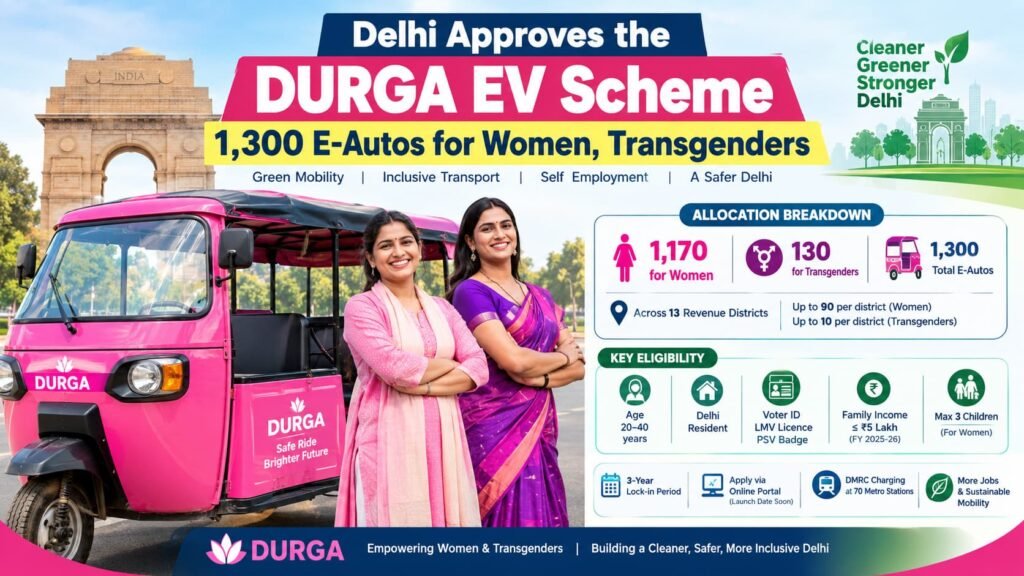
The DURGA (Delhi Upliftment and Rozgar for Women/Transgender Green E-Auto) scheme is a Delhi government initiative that will initially register 1,300 pink electric autos for women and transgender beneficiaries.
- Total e-autos: 1,300
- Women’s allocation: 1,170
- Transgender allocation: 130
- Age requirement: 20–40 years
- Maximum family income: ₹5 lakh for FY 2025-26
- Initial allocation per revenue district: Up to 90 for women and 10 for transgender beneficiaries
- Lock-in period: 3 years
- Application mode: Dedicated online portal
- Purpose: Employment, women’s safety, inclusive mobility, and clean transportation
Delhi Cabinet Approves DURGA EV Scheme
The Delhi Cabinet, chaired by Chief Minister Rekha Gupta, has approved the Upliftment and Rozgar for Women/Transgender Green E-Auto (DURGA) scheme.
The initiative is designed to give women and transgender individuals an opportunity to become owners and drivers of electric autos, creating a route to self-employment while supporting Delhi’s transition towards cleaner urban transportation.
According to the information provided by the Delhi government, the first phase will cover 1,300 pink electric autos. The initiative has a dual focus: providing economic opportunities to beneficiaries and improving the safety, accessibility, and inclusiveness of public transport.
Chief Minister Rekha Gupta has highlighted the connection between safe transportation and economic empowerment as an important objective of the initiative.
1,300 Pink Electric Autos in the First Phase
The first phase of the DURGA scheme will have a clearly divided allocation.
Allocation at a Glance
- 1,170 e-autos will be reserved for women.
- 130 e-autos will be allocated to transgender beneficiaries.
- The allocation will cover Delhi’s 13 revenue districts.
- For women, the allocation is capped at up to 90 e-autos per district.
- For transgender beneficiaries, the cap is up to 10 e-autos per district.
This district-wise structure is intended to distribute the initial fleet across the capital rather than concentrating the permits in a limited number of areas.
Who Can Apply for the DURGA EV Auto Scheme?
The scheme includes specific eligibility conditions for both women and transgender applicants.
Eligibility for Women Applicants
Women applying for the scheme must meet the following requirements:
- Must be a resident of Delhi.
- Must be between 20 and 40 years old.
- Must possess a valid Voter ID card.
- Must hold a valid Light Motor Vehicle (LMV) driving license.
- Must possess a valid Public Service Vehicle (PSV) badge.
- Family income for financial year 2025-26 must not exceed ₹5 lakh.
- The applicant or her family must not own a registered transport vehicle or three-wheeler.
- Women with more than three children are not eligible under the stated criteria.
Eligibility for Transgender Applicants
Transgender applicants must meet a separate documentation requirement in addition to the common eligibility conditions.
They must:
- Be between 20 and 40 years old.
- Be a resident of Delhi.
- Possess a valid Voter ID card.
- Hold a valid LMV driving license.
- Possess a valid PSV badge.
- Have a valid transgender certificate issued by the Delhi District Magistrate’s office.
The supplied information does not specify whether every other condition applicable to women applicants will be identical for transgender applicants, so applicants should check the official scheme guidelines when the application portal becomes operational.
Why Are Women With More Than Three Children Ineligible?
One of the notable eligibility conditions is that women with more than three children will not be considered for the scheme.
However, the information supplied for this article does not state the government’s reason for introducing this restriction. Therefore, no specific policy rationale can be attributed to the government without further documentation.
Other eligibility conditions include the applicant’s age, Delhi residency, required driving and PSV credentials, family income limit, and restrictions on ownership of registered transport vehicles or three-wheelers.
How Will Applicants Apply for DURGA E-Autos?
Applications are expected to be submitted through a dedicated online portal being developed by the Delhi Transport Department.
The government has not yet announced the formal launch date of the application portal based on the information provided.
Once the portal goes live, eligible applicants will be able to submit their applications digitally and follow the selection process through the designated platform.
Important Application Points
- The online application portal is still being developed.
- The formal launch date has not yet been announced.
- Applicants should keep their identity, driving, and PSV documents ready.
- Eligibility conditions must be satisfied before applying.
- The final application and selection procedure should be checked against the official notification when released.
Three-Year Lock-In Period for DURGA E-Autos
The scheme includes a mandatory three-year lock-in period.
During this period, the e-auto cannot be:
- Sold
- Transferred
- Otherwise disposed of
The lock-in provision is intended to support stable employment and prevent beneficiaries from immediately selling or transferring the vehicles after receiving them under the scheme.
This also gives the initiative a longer-term employment dimension rather than treating the e-autos simply as short-term vehicle allocations.
DURGA E-Autos to Support Last-Mile Connectivity
The scheme is also expected to connect with Delhi’s existing public transportation network.
Electric autos can play an important role in last-mile connectivity, particularly for commuters travelling between residential areas, commercial locations, and mass-transit stations.
As part of the infrastructure supporting electric mobility, the Delhi Metro Rail Corporation (DMRC) has made space available for EV charging facilities at parking lots of 70 metro stations, according to the information provided.
This charging infrastructure could help support the operation of electric autos and strengthen the connection between e-auto services and Delhi’s wider public transportation system.
How Will the Scheme Create Employment?
The DURGA scheme is primarily focused on creating self-employment opportunities for women and transgender individuals. However, its economic impact could extend beyond the direct beneficiaries.
The operation of around 1,300 electric autos is expected to generate associated employment opportunities in areas such as
- EV repair workshops
- Vehicle servicing
- Charging infrastructure
- Battery-related services
- Battery recycling
- Other supporting mobility services
The socio-economic impact of the initiative is also expected to be assessed periodically.
Pink E-Autos Will Carry Distinctive DURGA Branding
The electric autos introduced under the scheme will carry DURGA branding and distinctive identification elements.
The branding is intended to make the vehicles easily recognizable to passengers and potentially strengthen confidence in the service.
The distinctive identity could also help commuters identify vehicles operating under the initiative while reinforcing the scheme’s focus on women and transgender-led mobility services.
Clean Mobility Meets Economic Empowerment
Delhi approves the DURGA EV Scheme at a time when electric mobility is becoming an increasingly important part of urban transportation.
Unlike a conventional employment programme, the initiative combines several objectives in a single EV-focused model: self-employment, public transportation, women’s safety, last-mile connectivity, and cleaner mobility.
By putting women and transgender individuals at the centre of electric-auto operations, the scheme also seeks to make Delhi’s public transport ecosystem more inclusive.
The use of electric autos is expected to support the broader goal of developing a more sustainable urban transport system while reducing reliance on conventional fossil-fuel-powered three-wheelers.
Key Facts About Delhi’s DURGA EV Scheme
| Category | Details |
|---|---|
| Scheme name | DURGA |
| Full form | Delhi Upliftment and Rozgar for Women/Transgender Green E-Auto |
| First-phase e-autos | 1,300 |
| Women beneficiaries | 1,170 |
| Transgender beneficiaries | 130 |
| Revenue districts | 13 |
| Women’s district cap | Up to 90 |
| Transgender district cap | Up to 10 |
| Applicant age | 20–40 years |
| Family income limit | ₹5 lakh for FY 2025-26 |
| Lock-in period | 3 years |
| Application method | Dedicated online portal |
| Vehicle type | Electric auto |
| Branding | DURGA |
What Makes the DURGA Scheme Significant for Delhi’s EV Market?
Delhi approves the DURGA EV Scheme with an approach that goes beyond simply increasing the number of electric vehicles on city roads.
The scheme connects EV adoption with employment and social inclusion, creating a model in which beneficiaries operate electric autos themselves.
For Delhi’s EV ecosystem, the programme could also contribute to demand for charging, servicing, repairs, and battery-related services as the initial fleet becomes operational.
The integration with metro-station charging infrastructure could further strengthen the relationship between electric autos and mass public transportation.
What Happens Next?
The immediate next step is the launch of the dedicated online application portal by the Delhi Transport Department.
Until the portal officially opens, applicants should avoid relying on unofficial application links or unverified registration announcements.
Once launched, the portal is expected to provide information about the application procedure, documentation, selection and allocation process.
For prospective beneficiaries, having the required documents—including a valid Voter ID, LMV license, and PSV badge—ready could help simplify the application process once registrations begin.
Delhi’s Push Towards Inclusive Electric Mobility
The DURGA initiative brings together electric mobility, employment generation, women’s safety and inclusive public transportation under one programme.
With 1,300 pink e-autos planned in the first phase, the scheme gives women and transgender individuals a dedicated opportunity to participate directly in Delhi’s growing electric mobility ecosystem.
The three-year lock-in period, district-wise allocation, and proposed integration with public transport are designed to give the programme a structured framework.
As the online application portal and subsequent implementation details emerge, the scheme’s impact will ultimately depend on how effectively the e-autos are deployed, how beneficiaries are supported, and how successfully they are integrated into Delhi’s wider transport network.
For now, Delhi approves the DURGA EV Scheme, marking a significant development in the capital’s efforts to combine clean transportation with economic empowerment and more inclusive urban mobility.

Related Articles: