
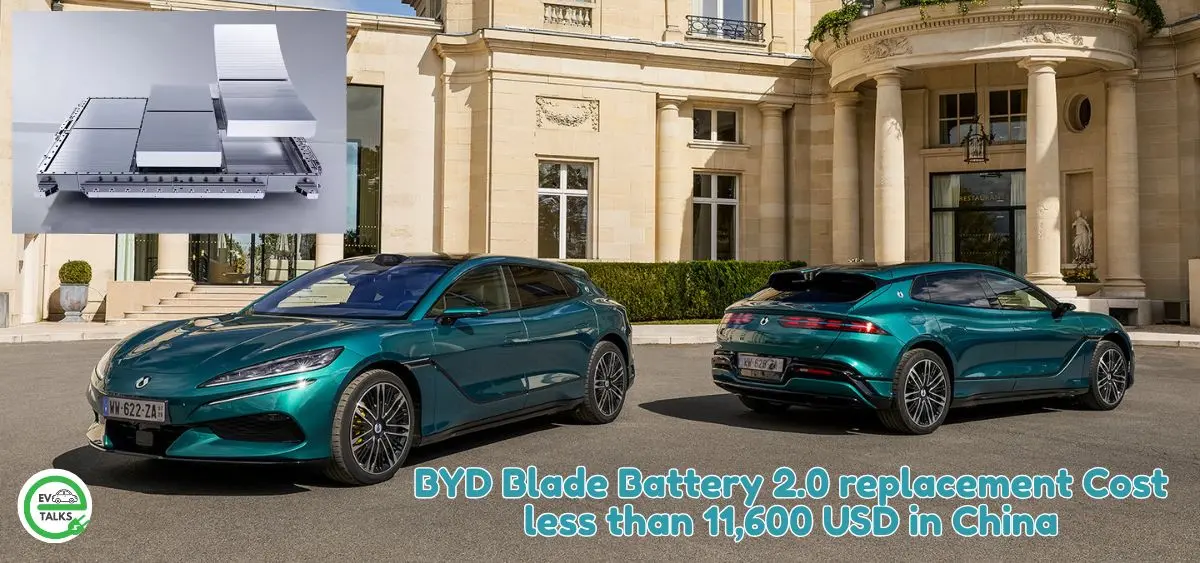

A new discussion in China’s EV market has grabbed attention after an owner of the premium BYD sub-brand Denza shared the replacement cost of the advanced battery pack used in the Denza Z9 GT EV. According to the owner, the BYD Blade Battery 2.0 replacement cost for the vehicle is only 78,700 yuan, which is approximately 11,600 USD.
The quotation reportedly came after the vehicle suffered undercarriage damage in a collision, forcing the replacement of the entire 122.5 kWh Lithium Iron Phosphate (LFP) battery pack. The quoted amount did not include labour or consumable costs.
Large Battery Pack at Lower-than-Expected Cost
The Denza Z9 GT is one of BYD’s latest premium electric grand tourers and is available in both EV and plug-in hybrid variants. In China, the model is priced between 269,800 yuan and 369,800 yuan (around 39,600 to 54,300 USD).
What makes the news significant is that the BYD Blade Battery 2.0 replacement accounts for only about 21% of the vehicle’s retail price. Traditionally, EV batteries often contribute nearly 40% to 50% of a car’s total value.
The pricing also translates to roughly 642 yuan or 94 USD per kWh, highlighting how aggressively BYD is reducing battery costs through large-scale production.
Advanced Flash Charging Technology
The Denza Z9 GT uses BYD’s latest Blade Battery 2.0 technology and supports ultra-fast Flash Charging. The company claims the EV can charge from 10% to 70% in just five minutes and from 10% to 97% in nine minutes. Even in freezing temperatures as low as -30°C, charging is reportedly only three minutes slower.
The vehicle also offers a maximum CLTC-certified driving range of up to 1,036 km.
New Battery Costs Less Than Older Generation
Interestingly, the newer BYD Blade Battery 2.0 replacement appears cheaper than older-generation Denza battery packs. A Denza N7 owner shared that replacing the SUV’s smaller 91 kWh LFP battery costs around 84,290 yuan (approximately 12,400 USD).
Despite having a larger capacity and more advanced flash-charging capabilities, the Z9 GT’s latest-generation battery is reportedly less expensive. This development highlights BYD’s growing advantage in battery manufacturing and cost optimization.
The latest BYD Blade Battery 2.0 replacement pricing could further strengthen consumer confidence in EV ownership by reducing concerns about long-term battery replacement expenses.

Related Articles:









