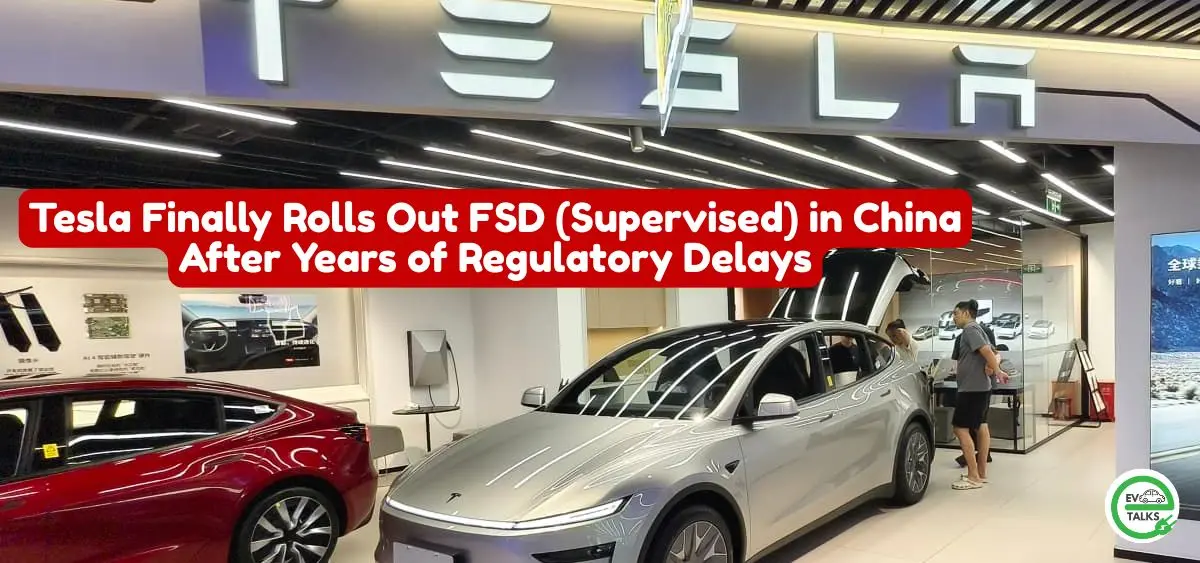

In a major step for the global electric vehicle industry, Tesla has officially confirmed that its advanced driver-assistance software is now available in China. The announcement marks the first time Tesla launched FSD in China after years of delays linked to regulatory approvals, data security concerns, and local compliance requirements.
The company added China to a list of 10 international markets where its “Full Self-Driving (Supervised)” technology is now available. The move comes at a critical time as Chinese EV makers have rapidly expanded their own autonomous driving systems during Tesla’s prolonged wait for approval.
Years of Delays Finally End
Tesla first unveiled its FSD technology in the United States in 2020 and had planned to introduce it in China as early as 2024. However, the company repeatedly faced delays due to strict Chinese regulations surrounding autonomous driving systems and vehicle data collection.
Elon Musk had previously stated that approval could arrive before the end of 2024, but regulatory clearance continued to be postponed. The uncertainty created confusion among Tesla owners in China, who until now only had access to Autopilot and Enhanced Autopilot systems.
Now, Tesla launched FSD (Supervised) in China as part of a broader international expansion strategy, although the software still awaits complete fleet-wide approval from China’s Ministry of Industry and Information Technology (MIIT). Industry sources expect final nationwide clearance by the third quarter of 2026.
Tesla’s China Strategy and Pricing
Tesla has adopted a China-specific strategy to meet local requirements. The company continues to offer FSD as a one-time purchase package priced at 64,000 yuan (around $9,400), unlike several international markets where Tesla shifted to subscription-only access earlier in 2026.
To comply with Chinese cybersecurity laws, Tesla established a dedicated AI training data center in Shanghai. All driving and behavioral data collected from Chinese vehicles will remain stored within the country. Tesla has also partnered with Baidu to support localized mapping and navigation services.
In addition, Tesla recently hired nearly 90 smart-driving test engineers across major cities, including Beijing, Shanghai, and Guangzhou, to accelerate local software validation. The company also introduced localized AI voice assistance features powered by Chinese AI models from ByteDance and DeepSeek.
Competition in China Intensifies
The timing of the rollout is significant because Chinese automakers have already made substantial progress in autonomous driving technology. Companies like XPeng, Xiaomi, BYD, and Geely have introduced advanced urban driving features, often at lower prices than Tesla models.
Some domestic firms are even testing Level 4 autonomous systems and robotaxi operations. Meanwhile, Chinese regulators continue to classify Tesla’s software as a Level 2 driver-assistance system, meaning drivers must remain fully attentive and ready to take control at all times.
Although fully autonomous capability remains under development, Tesla launched FSD (Supervised) in China to strengthen its position in the world’s largest EV market. With competition increasing and Tesla’s market share declining in recent years, the rollout could play a crucial role in the company’s long-term growth strategy in China.
As the company expands testing and awaits broader approvals, the launch signals a new chapter for Tesla’s ambitions in autonomous driving. Industry analysts believe Tesla launched FSD (Supervised) in China at a pivotal moment when the race for self-driving leadership is becoming increasingly competitive worldwide.

Related Articles: