
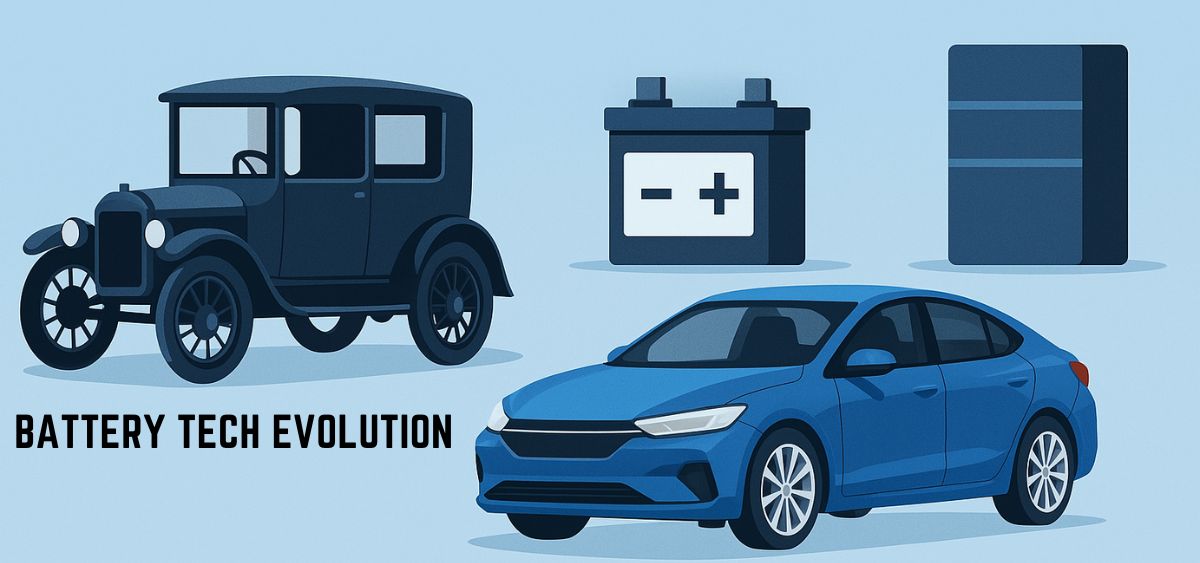

What if the battery powering your EV today would have seemed impossible just a few decades ago? The Battery Tech Evolution has transformed electric mobility from heavy, short-range vehicles into sophisticated machines capable of rapid charging, impressive range, and intelligent energy management. But the biggest surprise is what comes next. LFP batteries are reshaping costs, sodium-ion technology is entering commercial applications, and solid-state batteries are racing toward the next generation of EVs. From Volta’s first battery to today’s high-tech EV packs, every breakthrough has changed what electric vehicles can achieve. So, how did we get here—and what happens next?
How Have EV Batteries Evolved?
EV battery technology has evolved from heavy lead-acid batteries with limited range to sophisticated lithium-ion packs using LFP, NMC and other chemistries, supported by advanced battery-management systems, liquid cooling, high-power charging and increasingly integrated vehicle structures.
The biggest change is not simply higher capacity. Modern EV batteries are lighter, more energy-dense, safer, more digitally controlled and cheaper to manufacture than earlier generations. In 2025, global EV battery deployment reached about 1.2 TWh, almost 30% higher than in 2024, while LFP batteries accounted for more than 55% of global EV battery deployment.
At the same time, the industry is no longer betting on one chemistry. LFP is expanding because of cost and durability advantages, NMC remains important where energy density matters, sodium-ion batteries are moving toward wider commercialisation, and solid-state technology is progressing toward automotive applications.
Key Takeaways
- The Voltaic pile of 1800 established the foundation of modern battery technology.
- Lead-acid batteries enabled early electric vehicles but were constrained by weight and energy density.
- NiMH batteries became important in hybrids and helped bridge the gap toward modern EV batteries.
- Lithium-ion changed the automotive industry by offering substantially higher energy density.
- Today’s EV market is increasingly divided between LFP and nickel-based lithium-ion chemistries such as NMC.
- In 2025, LFP represented more than 55% of global EV battery deployment.
- Modern battery packs increasingly use cell-to-pack and cell-to-chassis designs, reducing the need for traditional modules.
- Sodium-ion is entering the scale-up phase, particularly for lower-cost vehicles, two- and three-wheelers, and stationary storage.
- Solid-state batteries remain an emerging technology rather than a mainstream replacement for lithium-ion.
- Battery management, thermal management, charging strategy, and software are now just as important as chemistry.
- Recycling and second-life applications are becoming increasingly important as the EV battery population grows.
The Early History of Battery Technology
The history of the battery begins well before the modern EV.
In 1800, Italian scientist Alessandro Volta introduced the Voltaic pile, widely regarded as the first true battery. It used alternating zinc and copper discs separated by an electrolyte-soaked material to generate an electrical current.
Volta’s work provided scientists with a practical source of continuous electrical power and laid the foundation for electrochemistry.
The technology then developed through several important stages.
| Year | Battery milestone | Why it mattered |
|---|---|---|
| 1800 | Voltaic pile | First practical continuous source of electrical current |
| 1836 | Daniell cell | Improved reliability and reduced hydrogen buildup |
| 1859 | Lead-acid battery | First practical rechargeable battery |
| 1881 | Faure lead-acid improvement | Increased performance and enabled easier production |
| Late 19th century | Dry-cell development | Made batteries more portable |
| Early 20th century | Automotive lead-acid | Became important for vehicle starting and electrical systems |
| Late 1980s–1990s | NiMH | Improved rechargeable energy storage and entered hybrid vehicles |
| 1991 | Commercial lithium-ion | Opened the modern high-energy rechargeable battery era |
| 2000s onwards | Automotive lithium-ion | Enabled today’s mass-market EV industry |
| 2020s | LFP, advanced NMC, structural packs | Lower cost, improved safety and better packaging |
| 2020s onwards | Sodium-ion and solid-state development | Expands the next-generation battery technology pipeline |
The supplied historical material correctly identifies the Voltaic pile, Daniell cell and Planté’s lead-acid battery as important milestones in the development of rechargeable energy storage.
EV Batteries Then: Why Early Electric Cars Had Limited Range
Electric vehicles are much older than many people realise.
Electric carriages appeared in the 19th century, and early electric vehicles benefited from the simplicity of electric motors. However, battery technology was not advanced enough to provide the combination of range, weight, charging convenience and cost needed for mass-market transportation.
Lead-acid batteries were the dominant technology.
They were rechargeable and relatively inexpensive, but they were extremely heavy for the amount of energy they stored.
That created a fundamental problem:
More battery meant more range, but more battery also meant more vehicle weight.
The cycle worked against efficiency.
Early EVs therefore tended to have limited range and modest performance compared with what consumers expect today.
The General Motors EV1 provides a useful example. Its first generation used lead-acid batteries, while the later second generation adopted nickel-metal hydride technology. The move demonstrated how quickly improvements in battery chemistry could affect usable electric-vehicle performance.
However, battery limitations were only part of the problem.
Early EV adoption was also restricted by limited charging infrastructure, electricity-grid availability, and the rapid improvement of petrol-powered vehicles.
The Rise of Nickel-Metal Hydride Batteries
Nickel-metal hydride, or NiMH, became an important transitional technology.
Compared with lead-acid batteries, NiMH offered higher energy density and became particularly important in hybrid vehicles.
NiMH helped demonstrate that rechargeable batteries could provide practical automotive performance without the weight penalty associated with older lead-acid technology.
The technology also played a significant role in early modern electrified vehicles.
However, NiMH still could not deliver the combination of energy density, weight, packaging flexibility and cost that manufacturers increasingly wanted for fully electric cars.
That opened the door for lithium-ion.
The Lithium-Ion Revolution
The commercialisation of lithium-ion batteries in the early 1990s transformed portable electronics and eventually transportation.
Lithium-ion cells offered a major advantage: much more energy could be stored for a given mass and volume compared with older rechargeable chemistries.
The evolution was built on decades of research into lithium-based electrochemistry. Stanley Whittingham, John Goodenough and Akira Yoshino were awarded the 2019 Nobel Prize in Chemistry for foundational work that contributed to modern lithium-ion batteries.
The automotive story developed gradually.
The Nissan Altra EV, introduced in 1998, was an early vehicle to use lithium-ion batteries. Later, the Tesla Roadster helped demonstrate how lithium-ion cells could be packaged into a high-performance electric car.
Lithium-ion subsequently became the dominant battery family for modern EVs.
But “lithium-ion” is not one battery chemistry.
That distinction is increasingly important for EV buyers.
EV Battery Cell Types & Evolution: LFP vs. NMC
Today’s most important EV battery comparison is often between LFP and nickel-based lithium-ion chemistries such as NMC.
LFP: Lithium Iron Phosphate
LFP batteries use lithium iron phosphate as the cathode material.
Their major advantages include:
- Lower material costs
- No cobalt in the cathode
- Strong thermal stability
- Good cycle-life characteristics
- Suitability for high-volume, cost-sensitive EVs
- Strong compatibility with frequent charging
The trade-off has traditionally been lower energy density compared with high-nickel chemistries.
That gap, however, has been narrowing.
The IEA reports that LFP accounted for more than 55% of global EV battery deployment in 2025, up from nearly 50% in 2024.
NMC: Nickel-Manganese-Cobalt
NMC batteries use combinations of nickel, manganese, and cobalt.
Their major advantage is energy density.
That can make NMC attractive for:
- Long-range passenger cars
- Premium EVs
- Vehicles where battery packaging space is limited
- Applications requiring high energy from a relatively compact pack
The trade-off is greater dependence on nickel and cobalt supply chains and typically higher material costs than LFP.
LFP vs NMC at a Glance
| Factor | LFP | NMC |
|---|---|---|
| Energy density | Lower | Higher |
| Cost potential | Lower | Generally higher |
| Cobalt | None in cathode | Used |
| Thermal stability | Strong | Requires careful thermal management |
| Cycle-life potential | Generally strong | Strong, depending on design and use |
| Long-range packaging | Less efficient | Advantage |
| High-volume affordable EVs | Strong fit | Also used |
| Market direction | Rapidly expanding | Remains important |
The important lesson for buyers is that there is no universally superior battery chemistry. The right chemistry depends on vehicle size, range target, climate, charging requirements, and price.
Battery Tech Evolution Is Also About Battery Architecture
Chemistry is only one part of the evolution.
Battery manufacturers have also redesigned how cells are arranged inside the vehicle.
Traditionally, cells were grouped into modules, which were then assembled into a battery pack.
Newer architectures increasingly use:
Cell-to-Pack
Cell-to-pack technology removes some intermediate module structures.
This can:
- Reduce unused space
- Increase pack-level energy density
- Lower component count
- Improve packaging efficiency
Cell-to-Chassis
Cell-to-chassis approaches go further by integrating the battery structure with the vehicle platform.
This can potentially reduce vehicle mass and improve space utilisation, although it also introduces engineering and repair considerations.
The IEA reports that prismatic cells now account for more than 60% of EV and most stationary-storage batteries globally, with cell-to-pack and cell-to-chassis designs becoming increasingly important.
This is one of the less visible but highly significant parts of the Battery Tech Evolution.
What Makes a Modern EV Battery “Smart”?
A modern battery pack is not simply a box containing hundreds or thousands of cells.
It is a highly monitored electrical system.
The Battery Management System (BMS) continuously manages important parameters such as:
- Cell voltage
- Pack voltage
- Current
- Temperature
- State of charge
- State of health
- Cell balancing
- Charging limits
- Discharging limits
- Fault detection
The BMS communicates with other vehicle systems and helps keep the battery within safe operating limits.
Thermal management is equally important.
Modern EVs may use liquid cooling and heating systems to keep cells within a suitable temperature window during driving and fast charging.
This matters because battery performance depends heavily on temperature.
In practical terms, the battery’s lifespan is determined not only by its chemistry but also by how it is charged, how hot or cold it becomes, how often it operates at extreme states of charge, and how the vehicle manages the cells.
EV Batteries Now: More Range, Faster Charging and Lower Costs
Modern EV batteries are dramatically different from early automotive batteries.
The biggest improvements include:
a) Higher Energy Density
More energy can be stored in a smaller and lighter package.
b) Better Thermal Management
Liquid cooling, heating systems, and improved pack design allow batteries to operate more consistently.
c) Faster Charging
High-voltage platforms and improved cell designs have reduced charging times significantly.
However, advertised peak charging power should not be confused with real-world charging speed.
A vehicle may briefly reach a very high charging rate, but the battery will normally taper power as its state of charge increases.
d) Better Software
Battery software can predict energy consumption, pre-condition the pack and optimise charging.
e) Better Packaging
Structural battery designs can use more of the vehicle’s available space for actual energy storage.
f) Lower Battery Costs
Battery prices have continued to fall, although the decline is no longer uniform.
The IEA reports that average battery prices declined 8% in 2025, while lithium prices had begun rising again in early 2026 from their previous lows.
This means battery economics are improving, but raw-material markets remain an important variable.
How Long Do Modern EV Batteries Last?
Battery lifespan should not be judged only by the number of years quoted in a warranty.
Battery degradation depends on:
- Chemistry
- Cell design
- Temperature
- Charging frequency
- Fast-charging use
- State-of-charge habits
- Vehicle software
- Driving conditions
- Time and mileage
A modern EV battery is designed to remain useful for many years, but capacity gradually declines rather than suddenly disappearing.
For buyers, battery warranty terms are therefore important.
When comparing EVs, look beyond the headline range and check:
- Battery warranty duration
- Mileage limit
- Minimum guaranteed battery capacity, if specified
- Warranty exclusions
- Fast-charging provisions
- Availability of battery diagnostics
- Manufacturer service support
For a used EV, battery health is often more informative than simply looking at vehicle age.
Fast Charging: The Battery Evolution Beyond Range
EV development has moved from the question “How far can it travel?” toward another important question:
“How quickly can it recover useful range?”
Modern fast-charging systems can deliver substantial energy during short stops.
However, charging performance depends on several variables:
| Factor | Effect on charging |
|---|---|
| Battery temperature | Cold or excessively hot cells may charge more slowly. |
| State of charge | Charging normally slows near high SOC |
| Charger power | A higher-rated charger can reduce charging time if the vehicle supports it |
| Battery voltage architecture | Higher-voltage systems can support higher charging power. |
| Cell chemistry | Influences power capability and thermal behaviour |
| Pack cooling | Helps manage heat during high-power charging |
| Charging curve | Determines how long high power is actually maintained |
This is why two EVs with the same battery capacity can have very different charging experiences.
India: Why Battery Technology Matters More Than Ever
India’s EV market makes battery technology especially important because buyers face a combination of high temperatures, mixed road conditions, long commuting distances, and rapidly expanding urban mobility.
The IEA says India’s electric car sales increased 75% in 2025 to about 165,000, representing nearly 4% of total car sales. India also remained the world’s second-largest electric two-wheeler market, while electric three-wheeler sales approached 800,000 in 2025.
The wider Indian EV market is much larger when two-wheelers and three-wheelers are included.
That makes battery innovation relevant across several vehicle categories:
- Electric scooters need compact, durable, and affordable batteries.
- Electric motorcycles require a balance between power, range and weight.
- Electric cars need higher energy density and fast-charging capability.
- Electric three-wheelers prioritise uptime, durability and operating cost.
- Electric buses and trucks require high-cycle-life batteries and dependable thermal management.
India’s policy environment is also evolving.
The PM E-DRIVE scheme has been extended through 31 March 2028 for applicable segments, while its implementation and eligibility rules have been amended over time.
The scheme’s official dashboard recorded more than 9.5 lakh e-2W registrations/temporary registrations combined under the 2026-27 PM E-DRIVE reporting framework as of 20 September 2026, illustrating the scale of supported electric mobility activity.
For consumers, however, battery chemistry remains a vehicle-specific consideration rather than something that should be chosen solely because it is receiving government support.
Sodium-Ion Batteries: The Next Affordable Alternative?
Sodium-ion batteries are one of the most important developments in the current battery tech evolution.
Instead of relying on lithium as the primary charge-carrying element, sodium-ion technology uses sodium-based chemistry.
The attraction is straightforward:
Sodium is abundant and can potentially reduce exposure to lithium supply constraints.
The technology is moving beyond laboratory demonstrations.
According to the IEA, the first sodium-ion battery-powered electric car was introduced in China in late 2023, and major battery manufacturers, including CATL and BYD are scaling the technology.
Modern sodium-ion cells can reach up to around 175 Wh/kg, compared with up to roughly 205 Wh/kg for LFP and 265 Wh/kg for NMC in the IEA’s 2025 comparison.
That makes sodium-ion particularly interesting for:
- Entry-level EVs
- Urban cars
- Electric two-wheelers
- Electric three-wheelers
- Commercial fleets
- Stationary energy storage
Sodium-ion is therefore unlikely to simply “replace lithium-ion”.
It is more useful to think of it as another tool for manufacturers to match battery chemistry to vehicle requirements.
Solid-State Batteries: How Close Are They?
Solid-state batteries are among the most discussed future EV technologies.
Instead of using a conventional liquid electrolyte, a solid-state design uses a solid electrolyte.
Potential benefits include:
- Higher energy density
- Improved safety characteristics
- Greater packaging flexibility
- Potentially faster charging
- Compatibility with lithium-metal anodes
However, solid-state batteries are not yet a universal replacement for conventional lithium-ion packs.
Manufacturing scale, cost, durability, interface stability, and performance consistency remain major challenges.
The U.S. Department of Energy identifies solid-state batteries as one of several next-generation battery approaches being developed to improve performance, safety, and potentially cost while reducing dependence on critical materials.
Therefore, claims that solid-state batteries will immediately deliver dramatically longer range or eliminate battery-safety concerns should be treated cautiously.
The technology is promising, but mass production and real-world durability are just as important as laboratory performance.
What About Lithium-Sulphur and Other Future Batteries?
The next generation extends beyond sodium-ion and solid-state batteries.
Lithium-Sulphur
Lithium-sulphur batteries use sulphur as a major cathode material and have the theoretical potential for high specific energy.
Their challenges include cycle life and chemical stability.
Silicon-Enhanced Anodes
Silicon can store substantially more lithium than graphite by mass.
The challenge is that silicon expands and contracts significantly during cycling.
Manufacturers are therefore increasingly exploring graphite-silicon blends rather than simply replacing graphite completely.
Semi-Solid and Hybrid Designs
Between conventional liquid-electrolyte lithium-ion and fully solid-state batteries, manufacturers are also exploring semi-solid and hybrid approaches.
These technologies could provide incremental improvements without requiring an immediate complete redesign of existing manufacturing systems.
The larger trend is clear:
Battery development is becoming evolutionary as well as revolutionary.
Battery Recycling and the Circular EV Economy
Battery sustainability cannot stop when an EV reaches the end of its first vehicle life.
Recycling can recover valuable materials and reduce pressure on primary mining.
The IEA notes that battery recycling currently plays an important role, particularly through manufacturing scrap, but the contribution from end-of-life EV batteries remains limited because the large wave of EV batteries has not yet reached retirement age.
This will change as today’s EV fleet ages.
India is also developing its battery-waste framework.
The Battery Waste Management Rules, 2022, along with subsequent amendments through 2025, establish the regulatory framework for battery-waste management and extended producer responsibility.
Future battery sustainability will increasingly involve:
- Longer first-life use
- Battery repair and remanufacturing
- Second-life energy storage
- Material recovery
- Responsible mineral sourcing
- Improved battery traceability
The best battery is not simply one that stores the most energy. Increasingly, it must also fit into a circular material system.
Battery Technology Comparison: Then vs. Now
| Feature | Early EV Batteries | Modern EV Batteries |
|---|---|---|
| Dominant technology | Lead-acid | Lithium-ion |
| Common modern chemistries | — | LFP, NMC, and others |
| Energy density | Low | Much higher |
| Weight | Very high for usable energy | Much lower per kWh |
| Battery monitoring | Basic | Advanced BMS |
| Thermal management | Limited | Sophisticated cooling/heating |
| Charging | Slow | AC and high-power DC fast charging |
| Packaging | Conventional modules | Module, cell-to-pack and structural designs |
| Range potential | Limited | Often several hundred kilometres depending on vehicle |
| Software control | Minimal | Extensive |
| Recycling | Established for lead-acid | Developing rapidly for Li-ion |
| Future direction | Mature technology | LFP, sodium-ion, silicon, solid-state and other designs |
Benefits of Modern EV Battery Technology
The Battery Tech Evolution has delivered several practical improvements for EV users.
1. More Usable Range
Higher energy density allows manufacturers to offer more range without proportionally increasing vehicle weight.
2. Lower Energy Cost Per Kilometre
Improved efficiency and regenerative braking can reduce running costs.
3. Faster Charging
Modern cells, pack cooling and high-voltage architectures can significantly reduce charging downtime.
4. Better Durability
Chemistry and thermal-management improvements can support longer useful battery life.
5. Better Safety Management
Modern packs include sensors, contactors, monitoring systems and software protections that early batteries did not have.
6. Greater Choice
Consumers can now choose between different vehicle sizes, battery capacities and chemistry strategies.
Challenges That Still Remain
Battery technology has improved enormously, but important challenges remain.
- Raw Material Supply: Lithium, graphite, nickel and other materials remain strategically important.
- Supply-Chain Concentration: The IEA highlights significant concentration in battery components and materials, particularly in China.
- Extreme Temperatures: Hot and cold conditions can affect charging performance, efficiency and degradation.
- Fast-Charging Stress: High-power charging produces additional thermal and electrochemical demands.
- Recycling Capacity: The industry must scale recycling alongside the growing EV fleet.
- Repairability: Large integrated battery packs can make repair and replacement more complex.
- Upfront Vehicle Cost: Although battery costs have fallen substantially, the battery remains one of the most important components influencing EV pricing.
Ownership Tips to Protect EV Battery Life
EV owners can take several practical steps to reduce unnecessary battery stress:
- Use the manufacturer’s recommended charging limits.
- Avoid leaving the vehicle at very high or very low charge for extended periods.
- Use DC fast charging when needed, but do not assume maximum-power charging is always the best everyday strategy.
- Avoid repeatedly charging a hot battery immediately after demanding driving when the vehicle recommends cooling first.
- Keep battery and vehicle software updated.
- In extremely hot Indian conditions, use scheduled charging and thermal pre-conditioning where supported.
- For a used EV, request a battery-health report if available.
- Check the battery warranty before purchasing a second-hand EV.
Most importantly, don’t judge an EV battery only by its advertised range.
Charging curve, thermal management, warranty, battery health, and real-world efficiency can be equally important.
Expert Insight from Electric Vehicle Talks
The most important development in the battery tech evolution is that the industry is moving away from the idea of a single “perfect” EV battery.
LFP is proving that a battery does not need maximum energy density to be commercially successful. Its combination of cost, durability and thermal characteristics makes it particularly relevant to mass-market vehicles.
NMC remains important where packaging efficiency and range are priorities.
Sodium-ion could occupy applications where cost, cold-weather performance and material availability matter more than maximum range.
Solid-state technology could eventually move the industry toward higher energy density, but its commercial impact will depend on manufacturing economics and long-term reliability rather than laboratory demonstrations alone.
For Indian consumers, this distinction matters.
A buyer using an EV mainly for urban commuting may gain more from a durable, affordable LFP or future sodium-ion battery than from paying for maximum energy density. A highway-focused driver may place greater value on energy density, charging speed and a strong charging network.
The future will therefore be chemistry-specific, vehicle-specific and usage-specific.
The battery industry is also becoming increasingly software-defined. BMS algorithms, thermal controls, charging strategies and battery-health diagnostics can influence the real-world experience almost as much as the underlying cell chemistry.
That is why the next stage of EV development is not simply about inventing a new cell.
It is about making the entire battery system smarter, safer, cheaper, and easier to manufacture and recycle.
People Also Ask
1. What is Battery Tech Evolution?
Battery Tech Evolution refers to the development of battery chemistry, cell design, manufacturing, thermal management, charging and software from early rechargeable batteries to modern EV and next-generation energy-storage systems.
2. What battery technology do most EVs use today?
Most modern EVs use lithium-ion batteries. The two major chemistry families are LFP and nickel-based chemistries such as NMC. LFP represented more than 55% of global EV battery deployment in 2025.
3. Are LFP batteries better than NMC?
Neither is universally better. LFP generally offers cost and durability advantages, while NMC provides higher energy density. Vehicle design and intended usage determine which chemistry is more suitable.
4. Are sodium-ion batteries ready for EVs?
Yes, sodium-ion batteries have already entered automotive applications, particularly in China. However, they currently have lower energy density than leading LFP and NMC cells, limiting their suitability for some long-range EVs.
5. Will solid-state batteries replace lithium-ion batteries?
Solid-state batteries could become important in premium and long-range applications, but conventional lithium-ion technology remains dominant. Manufacturing scale, cost and durability must improve before solid-state batteries can become mainstream.
6. How long does an EV battery last?
There is no single lifespan for every EV battery. Degradation depends on chemistry, temperature, charging behaviour, mileage and battery management. Warranty terms and battery-health data are useful indicators when comparing vehicles.
7. Can EV batteries be recycled?
Yes. EV batteries can be processed to recover valuable materials. Recycling capacity is expanding, although the industry is still preparing for the much larger volume of end-of-life EV batteries expected as today’s fleet ages.
Battery Tech Evolution FAQs
What was the first battery?
Alessandro Volta’s Voltaic pile, introduced in 1800, is widely recognised as the first true battery. It provided a continuous electrical current and became a foundation for modern electrochemistry.
When did lithium-ion batteries become commercially available?
Commercial lithium-ion batteries entered the market in the early 1990s, initially transforming portable electronics before becoming a foundational technology for modern EVs.
What is the difference between an EV battery and a normal car battery?
A conventional internal-combustion car typically uses a small 12V lead-acid or similar battery for starting and electrical systems. An EV uses a much larger high-voltage traction battery to power its electric motor, alongside a smaller low-voltage system.
Why are LFP batteries becoming popular?
LFP batteries offer a combination of lower material costs, good thermal stability, long cycle-life potential and the absence of cobalt in the cathode. Their market share has expanded rapidly in recent years.
What is battery energy density?
Energy density describes how much energy a battery stores relative to its mass or volume. Higher energy density can enable greater vehicle range without requiring a proportionally larger battery.
What is a battery management system?
A BMS is the electronic control system that monitors and manages battery voltage, temperature, current, state of charge, cell balancing and safety limits.
Why does battery temperature matter?
Battery temperature affects charging speed, power output, efficiency, and degradation. Modern EVs therefore use thermal-management systems to heat or cool the battery when necessary.
Conclusion
The history of EV battery technology is a story of continuous trade-offs.
Lead-acid batteries made early electric transportation possible but were too heavy for widespread modern mobility. NiMH improved the situation and became important in hybrids. Lithium-ion then changed the equation by combining high energy density with rechargeable performance.
But lithium-ion itself continues to evolve.
LFP is rapidly expanding. NMC remains important for energy-dense applications. Silicon-enhanced anodes are improving conventional cells. Sodium-ion batteries are moving into commercial applications, while solid-state batteries continue to progress toward higher-energy automotive systems.
At the same time, battery architecture, software, thermal management, charging technology and recycling are becoming just as important as chemistry.
The 2026 EV battery landscape is therefore not about one technology replacing another overnight. It is about matching the right battery to the right vehicle, application, and consumer requirement.
For EV buyers, the practical lesson is simple: don’t judge a vehicle only by its battery capacity or claimed range. Look at chemistry, charging speed, charging curve, thermal management, warranty, battery-health support, and expected usage.
The battery tech evolution is far from over. The next major gains may come not from a single breakthrough, but from thousands of improvements across chemistry, manufacturing, software, charging and recycling.
For more practical EV technology explainers, ownership guidance, battery developments, charging updates and electric-mobility news, explore Electric Vehicle Talks.

Related Articles:









