


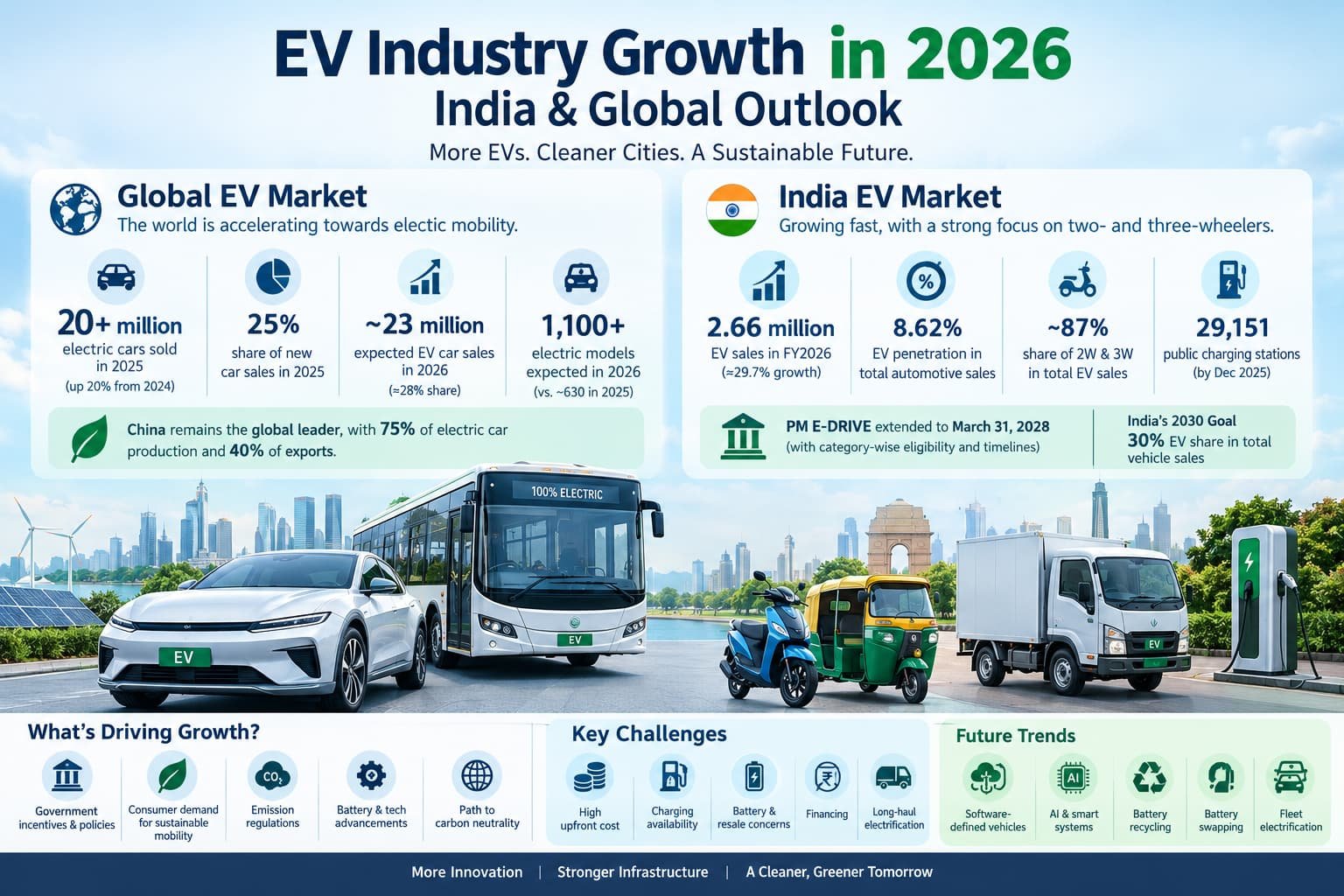
EV industry growth has moved beyond an early-adopter phase and into a much larger global market. In 2025, global electric car sales exceeded 20 million, meaning roughly one in every four new cars sold worldwide was electric. India is also accelerating: FY2026 EV sales reached about 2.66 million units, with two- and three-wheelers accounting for nearly 87% of the country’s EV volumes.
The important story in 2026, however, is no longer simply whether EVs will grow. It is where growth will happen, which vehicle segments will electrify first, how charging and batteries will evolve, and whether policy and financing can keep pace with demand.
EV Industry Growth: Key Takeaways
- Global electric car sales crossed 20 million units in 2025, up 20% year over year.
- Electric cars represented 25% of global new-car sales in 2025.
- The IEA expects global electric car sales to reach around 23 million in 2026, or approximately 28% of new-car sales.
- China remains the world’s largest EV market and manufacturing centre.
- India sold approximately 2.66 million EVs in FY2026, up from 2.05 million in FY2025.
- India’s EV sales penetration reached 8.62% of total automotive sales in FY2026.
- India’s electric two- and three-wheelers remain the core of domestic EV adoption.
- Public charging infrastructure in India reached 29,151 stations by December 2025, according to IBEF’s compilation of government data.
- PM E-DRIVE has been extended to March 31, 2028, although eligibility and timelines differ by vehicle category.
- Battery affordability, financing, charging utilisation, resale value, and long-distance electrification remain important industry challenges.
What Is Driving EV Industry Growth in 2026?
The global EV industry is being shaped by several forces simultaneously: vehicle affordability, government regulations, battery costs, manufacturing scale, charging infrastructure, and consumer demand.
The latest IEA data shows how dramatically the market has changed. Global electric car sales exceeded 20 million in 2025, increasing 20% from 2024. Around 5% of the world’s total car stock was electrified by the end of 2025.
The market is also becoming more diverse. The IEA estimates that more than 1,100 electric car models could be available globally in 2026, based on announced launches. This is significant because consumers are no longer choosing from a narrow group of premium EVs.
That transition toward greater model availability is particularly important for emerging markets, where upfront affordability is often more important than maximum range or premium performance.
Global EV Market Growth: What Does 2026 Look Like?
The latest Global EV Outlook 2026 provides a more useful picture than older forecasts that simply extrapolated extremely high growth rates.
| Global EV indicator | Latest position |
|---|---|
| Electric car sales, 2025 | More than 20 million |
| Growth vs. 2024 | About 20% |
| Share of new car sales | 25% |
| Estimated global EV car sales, 2026 | Around 23 million |
| Expected 2026 sales share | Around 28% |
| Global BEV models available in 2025 | About 630 |
| Potential electric models in 2026 | More than 1,100 |
The 2026 forecast is not uniform across countries.
Europe experienced a strong rebound in 2025, with electric car sales rising by more than 30% to approximately 4.2 million. China remained dominant, with more than 13 million electric cars sold and an electric-car sales share approaching 55%.
Emerging markets are becoming increasingly important. Outside China, Europe, and the United States, electric car sales reached nearly 2 million in 2025, almost 50% higher than the previous year.
China Remains the Manufacturing Powerhouse
China’s importance goes beyond domestic sales.
Nearly 22 million electric cars were produced globally in 2025, with China accounting for approximately 75% of global electric-car production. Chinese manufacturers also represented about 40% of global electric-car exports.
This manufacturing scale has consequences for the rest of the industry. It increases competition, accelerates technology deployment, and puts pressure on automakers worldwide to reduce costs.
EV Industry Growth in India: Where Does the Market Stand?
India’s EV market has entered a higher-volume phase, but its development looks very different from China’s or Europe’s.
According to IBEF’s latest FY2026 data, India sold 2,658,798 EVs in FY2026, compared with approximately 2.05 million in FY2025. That represents around 29.67% year-over-year growth, while EV penetration reached 8.62% of total automotive sales.
The NITI Aayog report provides useful historical context. India’s EV sales increased from approximately 50,000 units in 2016 to 2.08 million in 2024, while EV penetration reached 7.66% in 2024 based on its methodology.
Electric Vehicle Sales in India Year-wise
| Year | Approx. EV sales in India |
|---|---|
| 2016 | 50,000 |
| 2020 | 1.25 lakh |
| 2021 | 3.32 lakh |
| 2022 | 10.25 lakh |
| 2023 | 15.32 lakh |
| 2024 | 20.08 lakh |
| FY2025 | 20.5 lakh |
| FY2026 | 26.59 lakh |
This distinction matters when discussing the current EV market size in India. Sales volume, registered vehicle stock, market value, and penetration are different measurements and should not be mixed.
Which EV Segment Is Growing Fastest in India?
India’s EV transition is primarily a two- and three-wheeler story.
IBEF reports that two- and three-wheelers together represented nearly 87% of FY2026 EV volumes. In March 2026 alone, electric two-wheeler sales reached nearly 199,500 units.
The NITI Aayog report similarly found that India has performed relatively strongly in electric two- and three-wheelers, while electric cars and especially long-haul electric trucks remain less developed.
| Segment | Current growth position in India | Main opportunity |
|---|---|---|
| Electric 2W | Very strong | Urban commuting, delivery |
| Electric 3W | Very strong | Passenger and commercial mobility |
| Electric cars | Growing | Private ownership, fleets |
| Electric buses | Expanding | Public transport |
| Electric trucks | Early stage | Freight and logistics |
The structure of India’s vehicle fleet explains much of this pattern. NITI Aayog notes that two-wheelers make up a very large proportion of India’s vehicles, making them a particularly important part of India’s electrification strategy.
Why Are Electric 2-Wheelers and 3-Wheelers So Important?
For many Indian consumers, the economics of an electric scooter, motorcycle, or three-wheeler can be easier to justify than those of a premium electric car.
Two-wheelers typically have:
- Lower battery requirements
- Lower electricity consumption
- Shorter daily travel distances
- Easier home charging
- Lower purchase prices than electric cars
- High exposure to petrol prices
Three-wheelers also have an important commercial advantage: high daily utilization can make fuel savings more meaningful.
This is why India’s EV industry growth cannot be judged solely by electric-car sales.
What Is the Role of PM E-DRIVE?
India’s policy framework has changed significantly since the FAME era.
FAME I operated from 2015 to 2019, while FAME II operated from 2019 to 2024. PM E-DRIVE was introduced in 2024 with a planned outlay of ₹10,900 crore.
Importantly, PM E-DRIVE is no longer simply a 2024–2026 story.
The official PM E-DRIVE portal states that the scheme has been extended until March 31, 2028, although the e-3W L5 component closed on December 26, 2025. The scheme covers different categories, including e-2Ws, e-3Ws, e-ambulances, e-trucks, e-buses, and charging infrastructure.
The official portal also records amendments made during 2026, including extensions and changes affecting electric two-wheelers, buses, and trucks.
What Does PM E-DRIVE Support?
The scheme includes:
- Demand incentives for eligible electric vehicles
- Support for electric buses
- Support for electric ambulances
- Support for electric trucks
- Charging infrastructure
- Testing-agency upgrades
The official PM E-DRIVE portal says the scheme provides ₹4,391 crore for the procurement of 14,028 electric buses and ₹2,000 crore for charging infrastructure.
Important: Buyers should check current eligibility, vehicle category, battery requirements, and the applicable date before assuming a particular EV qualifies for an incentive.
How Fast Is EV Charging Infrastructure Growing in India?
Charging infrastructure is one of the biggest determinants of future EV industry growth.
IBEF reports that India will have 29,151 public charging stations by December 2025, with Karnataka leading the states in its cited government-data compilation.
But simply counting charging stations does not tell the whole story.
The NITI Aayog report identifies a more complicated problem: India faces both inadequate charging infrastructure and low utilization of some existing public charging facilities. Power connections, land availability, tariffs, utilization rates, and coordination between agencies can affect charging-station viability.
This is an important 2026 insight:
India does not simply need more chargers; it needs chargers in the right places, with reliable power, appropriate charging speeds and commercially sustainable utilisation.
What Are India’s New EV Charging Rules?
The Ministry of Power’s 2024 EV charging guidelines were designed to make charging infrastructure more accessible and interoperable.
The guidelines apply to private, semi-public, and public charging locations, including housing societies, offices, hospitals, bus depots, commercial facilities, railway stations, airports, petrol pumps, highways, and expressways.
The framework also provides for faster electricity connections for charging stations and establishes provisions around electricity tariffs and land access.
The Ministry of Power has indicated planning benchmarks, including charging stations in urban areas and along highways, while PM E-DRIVE provides dedicated support for charging infrastructure.
For EV owners, however, home charging remains one of the biggest practical advantages, particularly for two-wheelers and private cars with predictable daily usage.
Battery Technology Is Becoming the Next Major Battleground
Battery technology remains central to EV industry growth because it influences:
- Purchase price
- Driving range
- Charging speed
- Vehicle weight
- Battery longevity
- Safety
- Resale value
- Recycling economics
The industry is not moving toward one universal battery chemistry.
1. LFP Batteries
Lithium-iron-phosphate batteries have become increasingly important because of their cost, durability, and reduced dependence on nickel and cobalt compared with some other lithium-ion chemistries. LFP vs. NMC Battery
2. Higher-Voltage Architectures
800V electrical architectures are increasingly associated with high-performance EVs and faster charging because they can deliver high charging power while controlling current levels.
3. Solid-State Batteries
Solid-state technology remains an important long-term development, but it should not be presented as a technology that has already replaced mainstream lithium-ion batteries.
4. Sodium-Ion Batteries
Sodium-ion technology is receiving growing attention because sodium is more abundant than lithium. For cost-sensitive applications where energy density requirements are less demanding, it could become strategically relevant.
NITI Aayog specifically highlights the need for research into new battery chemistries, lower battery prices, and reduced dependence on imported critical materials.
What Are the Biggest Challenges to EV Industry Growth?
EV adoption is increasing, but several structural problems remain.
1. High Upfront Cost
EVs can offer lower running and maintenance costs, but their purchase price can still be higher than comparable ICE vehicles.
This is particularly significant for commercial vehicles, where financing costs directly affect business viability.
NITI Aayog’s stakeholder consultations found financing to be a major challenge for electric buses and trucks because of their higher upfront costs and uncertainty around residual values and performance data.
2. Charging Availability
Charging coverage is improving, but infrastructure remains uneven.
The challenge is particularly relevant for:
- Apartment residents
- Highway travelers
- Rural users
- Commercial fleets
- Long-distance trucks
3. Battery and Resale Concerns
Consumers increasingly want transparent information about battery health.
Battery degradation affects both ownership confidence and used-EV valuation. NITI Aayog has therefore discussed battery passports and better battery-health information as potential tools for improving residual-value transparency.
4. Financing
An EV’s total cost of ownership may be attractive, but a higher EMI can still discourage buyers.
This makes EV-specific financing, leasing, battery-as-a-service, and fleet financing increasingly relevant. Know about the BAAS in Electric Vehicles guide
5. Long-Haul Electrification
India’s transition is much less advanced in heavy-duty electric trucking.
NITI Aayog reported that only 280 electric trucks above 3.5 tonnes were sold in India in 2024, illustrating how early the long-haul segment remained.
What Does EV Industry Growth Mean for Indian Consumers?
The consumer market is gradually moving from “Should I buy an EV?” to more practical questions:
- Which EV fits my daily distance?
- Can I charge at home?
- What is the battery warranty?
- How much will electricity cost?
- What happens to resale value?
- Is fast charging available on my regular routes?
- How much will I save compared with petrol or diesel?
- What incentives are available in my state?
These are much better questions than simply comparing claimed range figures.
EV Ownership Cost: Why Total Cost of Ownership Matters
An EV should be evaluated using total cost of ownership (TCO) rather than purchase price alone.
| Cost factor | EV | Petrol/Diesel vehicle |
|---|---|---|
| Upfront price | Often higher | Often lower |
| Energy cost per km | Generally lower | Generally higher |
| Routine maintenance | Usually lower | Usually higher |
| Engine-related maintenance | Not applicable | Applicable |
| Home charging | Convenient where available | Not applicable |
| Public energy/fuel | Charging price varies. | Fuel price varies. |
| Battery replacement risk | Long-term consideration | Engine/transmission wear instead |
| Resale | Still developing | More established |
For a buyer covering a high annual distance, energy savings can have a greater impact than for someone driving only a few kilometers per week.
How Should You Evaluate an EV in 2026?
Instead of choosing an EV based only on advertised range, check:
- Real-world range: Look at the expected range under Indian traffic, air-conditioning, and highway conditions.
- Charging curve: Maximum charging power is not the whole story. How long the vehicle can sustain high charging power matters.
- Battery warranty: Check both years and kilometers, along with the manufacturer’s battery-health conditions.
- Service network: A technologically advanced EV is less useful if authorized service support is difficult to access.
- Home charging: If you can charge overnight at home, an EV becomes considerably more convenient.
- Ground clearance and durability: Indian roads, monsoon conditions, and speed breakers make physical durability important.
- Resale and battery health: Ask whether battery-health reports or diagnostics are available when buying a used EV.
Future Development Trends of Electric Vehicles
The next stage of EV industry growth will involve much more than larger batteries.
- Software-Defined Vehicles: EV platforms provide automakers with opportunities to update vehicle functions through software and connected services.
- Artificial Intelligence: AI is increasingly being integrated into vehicle interfaces, driver assistance, energy management, and manufacturing.
- Battery Recycling: As the EV fleet ages, recovering lithium, nickel, cobalt, copper, and other materials will become increasingly important.
- Vehicle-to-Grid Technology: V2G could allow compatible EVs to return electricity to the grid. However, large-scale deployment requires compatible vehicles, chargers, grid systems, and appropriate market rules.
- Battery Swapping: Battery swapping remains particularly relevant for commercial two- and three-wheelers where downtime has a direct financial cost.
- Electrification of Fleets: Fleet vehicles, buses, delivery vehicles, and urban freight could provide some of the most measurable benefits because high daily utilization increases the value of lower operating costs.
What Is the Global EV Outlook Beyond 2030?
The long-term trajectory remains positive, but the IEA emphasizes that adoption will differ significantly between markets.
Under the IEA’s Current Policies Scenario, the global EV fleet across vehicle types, excluding two- and three-wheelers, exceeds 450 million vehicles by 2035, more than five times the number at the end of 2025. Under its Stated Policies Scenario, EV deployment grows further.
The important takeaway is that policy, charging infrastructure, and vehicle economics will determine how evenly that growth is distributed.
Markets with weak infrastructure or limited policy support may see slower adoption, while markets where EVs already offer competitive economics can continue growing even as subsidies decline.
Expert Insight from Electric Vehicle Talks
The most important change in EV industry growth is that the market is becoming less dependent on a single growth driver.
A few years ago, subsidies and early adopters dominated the conversation. In 2026, manufacturing scale, battery economics, charging utilization, financing, fleet economics, and software are becoming equally important.
India has a particularly distinctive opportunity.
The country’s enormous two-wheeler and three-wheeler market gives electrification a natural starting point. At the same time, the next major opportunities are likely to come from electric buses, urban freight, commercial fleets, and eventually long-haul trucks.
NITI Aayog’s analysis reinforces this point: high-use vehicles such as buses, trucks, and urban freight vehicles can provide substantial emissions benefits, while their concentrated operating routes can make charging infrastructure easier to deploy.
For consumers, the practical lesson is simple: do not buy an EV because the industry is growing; buy one when the vehicle, charging setup, financing, and usage pattern make sense for you.
For the industry, the next competitive advantage will increasingly come from delivering a complete ecosystem rather than merely selling a vehicle.
People Also Ask
Is the EV industry growing in 2026?
Yes. Global electric-car sales exceeded 20 million in 2025, while the IEA expects around 23 million electric cars to be sold globally in 2026. India’s FY2026 EV sales reached approximately 2.66 million units.
What is the current EV market size in India?
There is no single universally applicable figure because “market size” can mean annual sales, vehicle stock, or market revenue. In FY2026, India recorded approximately 2.66 million EV sales, representing 8.62% of total automotive sales.
What is India’s EV target for 2030?
NITI Aayog’s 2025 report states that India seeks a 30% share of EVs in total vehicle sales by 2030. The target should not be interpreted as meaning 30% of passenger-car sales alone.
Which EV segment is biggest in India?
Electric two-wheelers and three-wheelers dominate India’s EV volumes. Together, they represented nearly 87% of FY2026 EV sales according to IBEF.
How many EV charging stations are there in India?
IBEF reports 29,151 public charging stations as of December 2025, based on government data. The number continues to change as new chargers are installed.
Is PM E-DRIVE still available in 2026?
Yes, but its eligibility and timelines vary by vehicle category. The official PM E-DRIVE portal says the scheme has been extended to March 31, 2028, with some categories subject to separate closing dates.
Will EVs become cheaper in the future?
Greater manufacturing scale, battery innovation, and increased competition can reduce costs, but actual retail prices will depend on battery materials, tariffs, taxation, exchange rates, technology, and manufacturer strategy.
EV Industry Growth: FAQs
1. What is EV industry growth?
EV industry growth refers to the expansion of electric mobility across vehicle sales, manufacturing, batteries, charging infrastructure, software, financing and related services.
2. Why is EV adoption growing in India?
India’s growth is being supported by rising electric two- and three-wheeler adoption, operating-cost advantages, government policies, local manufacturing, expanding charging infrastructure, and increasing consumer awareness.
3. What are the biggest barriers to EV adoption in India?
The main barriers include upfront cost, financing, charging availability, uneven infrastructure, battery-health uncertainty, resale concerns, and limited electrification of some commercial and heavy-duty segments.
4. Is EV ownership cheaper than petrol or diesel ownership?
It can be, particularly for drivers with high annual mileage and access to affordable home charging. The actual result depends on purchase price, financing, electricity rates, fuel prices, maintenance, and resale value.
5. What battery technology will dominate future EVs?
There will probably not be a single dominant chemistry for every application. LFP is important for cost-sensitive vehicles, while other lithium-ion chemistries, sodium-ion, and eventually solid-state technologies may serve different requirements.
6. What will drive India’s next phase of EV growth?
Commercial fleets, electric buses, urban freight, two- and three-wheelers, better financing, domestic battery manufacturing, and strategically deployed charging infrastructure are likely to be important growth areas.
Conclusion
The EV industry growth story in 2026 is no longer a prediction—it is a measurable global market shift.
More than 20 million electric cars were sold globally in 2025, while India crossed 2.6 million EV sales in FY2026. Yet the next phase will be more complex than simply increasing sales numbers.
India’s biggest opportunity lies in matching electrification with the realities of its transport system: two-wheelers, three-wheelers, buses, urban freight, and eventually heavy-duty trucks. At the same time, charging networks must become more reliable, financing must become more accessible, and battery health and recycling systems must become more transparent.
The global market is also becoming increasingly competitive. China continues to dominate EV manufacturing, model availability is expanding rapidly, and battery and charging technologies are progressing quickly.
For consumers, the best approach is to focus on real-world range, charging access, battery warranty, running costs, service support, and total cost of ownership, rather than chasing a headline specification.
The electric-mobility transition is therefore entering a more practical stage: from proving that EVs work to building an ecosystem in which they work better, cost less to operate, and become easier to own.
For more research-driven updates on EV news, electric cars, scooters, charging infrastructure, battery technology, and EV ownership, continue exploring Electric Vehicle Talks.

Related Articles:









