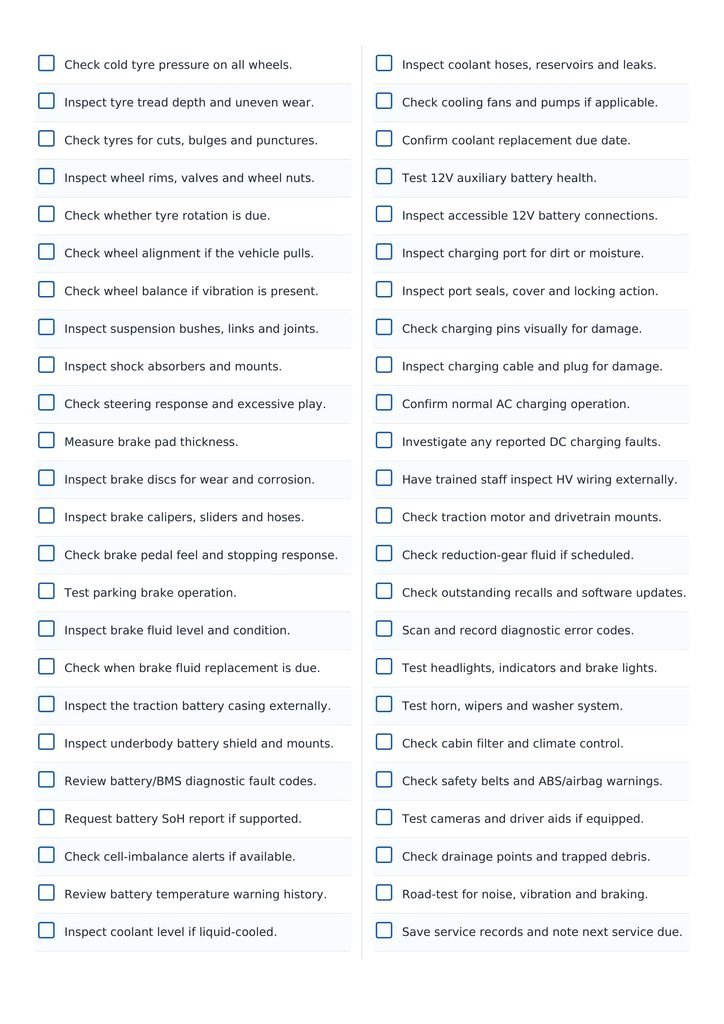
Electric vehicles require less routine maintenance than petrol and diesel vehicles, but they add additional maintenance needs. A proper EV Service Checklist covers battery health, cooling systems, brakes, tyres, suspension, the 12V auxiliary battery, charging components, and software updates.
For EV owners in India, following a structured maintenance routine can help prevent unexpected breakdowns, protect battery performance, improve driving safety, and control long-term ownership costs.
Imagine preparing for a weekend trip in your electric car. The battery shows sufficient charge, the estimated range looks comfortable, and everything seems ready. But when you press the start button, the vehicle refuses to enter drive mode.
The problem might not be the expensive high-voltage battery. It could be a weak 12V auxiliary battery that went unnoticed during routine servicing.
Similarly, an EV may experience charging interruptions because of a damaged charging connector or reduced efficiency because of incorrect tyre pressure.
These situations explain why preventive maintenance matters even when an electric motor has relatively few moving parts.
This guide explains what to inspect every month, every 3 months, every 6 months, and every 12 months, including the five essential checks every EV owner should discuss with a service technician.
Important: The timelines below are practical inspection recommendations, not a universal manufacturer service schedule. Always follow your vehicle’s official maintenance manual, including whichever comes first: its specified time or kilometre interval.
What Is an EV Service Checklist?
An EV Service Checklist is a structured list of inspections and maintenance activities designed to keep an electric vehicle safe, efficient, and reliable.
Unlike conventional vehicles, battery-electric vehicles do not require routine engine-oil changes, spark-plug replacements, fuel-filter changes, or exhaust-system maintenance.
However, EVs still have components that require inspection, maintenance, or occasional replacement.
These include:
- High-voltage traction battery and Battery Management System (BMS)
- Battery and motor cooling systems, where fitted
- 12V auxiliary battery and low-voltage electrical systems
- Brake pads, discs, hydraulic lines, and brake fluid
- Tyres, wheels, steering, and suspension
- Charging port, charging cable, and onboard charger
- Software, sensors, and electronic control systems
- Cabin air filter, air conditioning, lights, and wipers
An effective checklist distinguishes between simple checks an owner can perform and technical inspections that require trained EV service personnel. EV Battery FAQs
Why Is Regular EV Servicing Important?
The biggest advantage of an electric vehicle is mechanical simplicity. However, fewer moving parts do not eliminate wear, ageing, environmental exposure, or electronic faults.
Benefits of Following an EV Service Checklist
1. Protects battery performance: Regular diagnostic checks can identify abnormal battery-system warnings, cooling faults, and charging irregularities before they become more serious.
2. Improves safety: Brake, tyre, steering, and suspension inspections are particularly important because these components affect vehicle control.
3. Helps maintain driving efficiency: Incorrect tyre pressure, wheel misalignment, and dragging brakes can increase energy consumption.
4. Reduces unexpected breakdowns: Identifying a weak auxiliary battery or deteriorating electrical connection can help prevent inconvenient failures.
5. Supports warranty and resale documentation: Proper service records demonstrate maintenance history and can be valuable when selling a used EV.
6. Helps control long-term expenses: Preventive servicing may identify relatively inexpensive problems before they cause more costly damage.
The key distinction is that EV maintenance focuses less on traditional engine servicing and more on electrical diagnostics, vehicle safety, thermal management, and general wear components.
EV Service Checklist for Every 3, 6, and 12 Months
The following schedule is suitable as a preventive maintenance guide for electric cars in India. Electric scooters and motorcycles require some additional checks, discussed later.
| Inspection | Monthly | 3 Months | 6 Months | 12 Months |
|---|---|---|---|---|
| Tyre pressure and condition | Check | Check | Check | Check |
| Brakes | Basic check | Inspect | Detailed check | Inspect |
| Charging port and cable | Visual check | Inspect | Inspect | Test if needed. |
| 12V auxiliary battery | Monitor | If needed | Test | Test |
| Battery diagnostics | Monitor alerts | If needed | If needed | Review |
| Coolant system, if fitted | Visual check | Inspect | Inspect | Inspect |
| Steering and suspension | Monitor | Check | Inspect | Inspect |
| Software updates | Check alerts. | Check | Check | Check |
| Cabin filter and AC | Monitor | Inspect | Inspect | Service as needed |
This table is an additional owner-maintenance framework. It does not replace model-specific manufacturer service intervals.
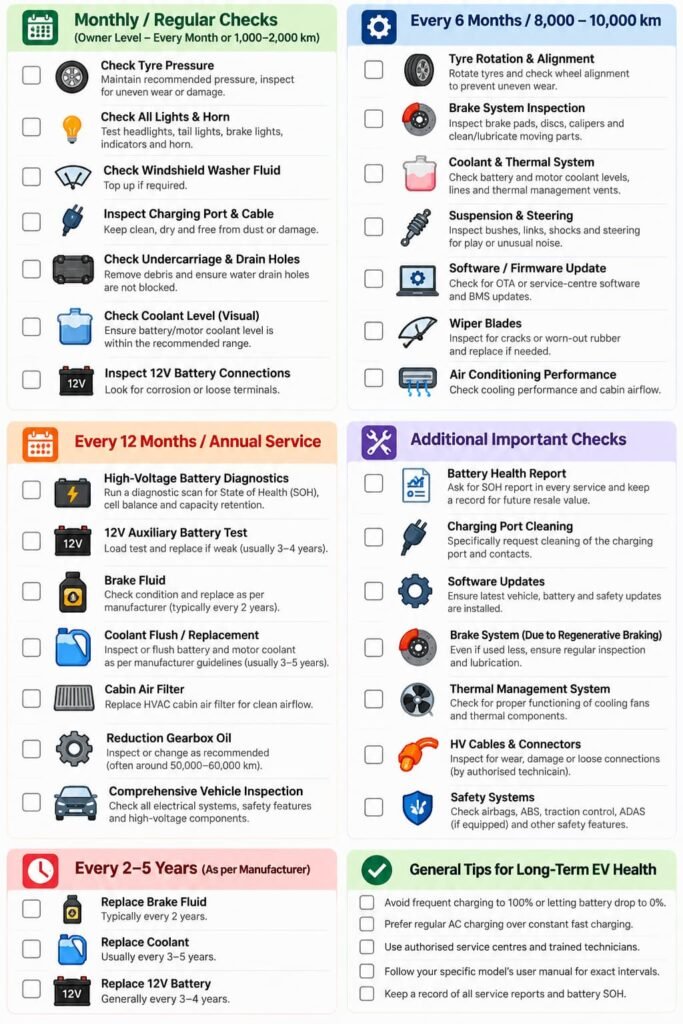
1. Monthly EV Maintenance Checklist: What Can Owners Check?
Several maintenance tasks require no specialist diagnostic equipment. EV Maintenance FAQs
- Tyres: Check cold tyre pressure against the vehicle manufacturer’s recommendation. Inspect tread, cuts, bulges, and uneven wear.
- Lights and horn: Verify headlights, brake lights, indicators, reversing lights, and horn operation.
- Charging equipment: Look for damaged insulation, bent or discolored connector surfaces, moisture, or other visible abnormalities.
- Wipers and washer fluid: Check visibility-related equipment and top up washer fluid when needed.
- Dashboard warnings: Record battery, brake, charging, or electrical-system alerts.
- Vehicle underside: After rough-road driving, look for visible damage or loose protective panels without touching high-voltage components.
Check tyre pressure more frequently before highway trips or when driving conditions are demanding.
2. Every 3 Months: Basic EV Safety and Performance Checks
A three-month review is particularly useful for new EV owners, high-mileage drivers, and vehicles exposed to challenging road conditions.
What Should Be Checked?
- Battery and electrical warnings: Review warning messages, unusual range behavior, and charging errors. If a fault is present, request an authorized diagnostic scan.
- Charging equipment: Check the connector housing, charging-port flap, seals, and cable condition. Any damaged or overheating connector needs professional attention.
- Brakes and tires: Inspect brake operation, tire wear, wheel condition, and parking-brake response.
- Suspension and motor noise: Listen for rattling, vibration, or abnormal sounds during acceleration and braking.
- Software: Check whether the manufacturer has issued an applicable software update or service campaign.
- Recommended outcome: A documented basic safety inspection and a list of any developing problems.
A three-month workshop visit is not mandatory unless specified by the manufacturer or justified by symptoms.
3. Every 6 Months: EV Performance and Safety Inspection
At six months, a more detailed inspection can help identify problems caused by regular usage.
Essential 6-Month EV Service Checklist
- 12V battery test: Have the auxiliary battery tested using the appropriate equipment. Check for weak performance and terminal corrosion where accessible.
- Brake inspection: Examine brake-pad thickness, disc condition, callipers, hydraulic lines, and parking-brake operation.
- Battery cooling system: Inspect coolant levels, hoses, reservoirs, and visible leaks where the EV uses liquid cooling.
- Tyre rotation and alignment: Rotate tyres according to manufacturer recommendations. Perform alignment when uneven wear, pulling, or steering symptoms indicate a need.
- Suspension and steering: Inspect bushes, ball joints, shock absorbers, wheel bearings, and steering components.
- Charging and diagnostics: Review recurring charging faults, diagnostic error codes, and available software updates.
Owners should also report any sudden change in charging time, braking behaviour, or vehicle range.
A full battery capacity test or automatic brake-fluid replacement is not necessary at every six-month inspection.
4. Every 12 Months: Comprehensive EV Service Checklist
An annual inspection provides an opportunity to assess the vehicle’s overall condition and maintenance history.
What Should an Annual EV Service Include?
| Component | Recommended inspection |
|---|---|
| Traction battery | Review available BMS diagnostics, faults, and battery health information. |
| Cooling system | Inspect levels, leaks, hoses, and thermal-system operation. |
| Brakes | Inspect pads, discs, calipers, and brake-fluid condition |
| Auxiliary battery | Test battery health and charging-system operation. |
| Motor and drivetrain | Check external damage, mounts, unusual sounds, and leaks. |
| Gear reduction unit | Inspect fluid or replace only when scheduled. |
| Charging system | Examine port condition and investigate charging faults. |
| Suspension and steering | Inspect mechanical wear and abnormal play. |
| Cabin filter and HVAC | Check airflow, odor, filtration, and cooling performance. |
| Software | Check recalls, updates, and recorded system faults. |
| Underbody protection | Inspect the battery shield and exposed areas for damage. |
| Safety systems | Check lights, seatbelts, warning indicators, and braking response. |
Annual servicing does not automatically mean replacing every fluid or opening the battery pack.
Important: High-voltage battery enclosures should not be opened as part of ordinary routine servicing. Any internal inspection must follow the manufacturer’s approved procedures.
5 Most Important Things to Check During EV Servicing
Owners often focus on the problem that brought them to the workshop. However, five additional areas deserve particular attention.
1. Ask for an EV Battery Health Report
The high-voltage battery is one of the most valuable components in an electric vehicle.
Its condition affects available driving range, performance, charging capability, and potentially resale value.
What Is Battery State of Health (SoH)?
State of Health (SoH) is an estimate of a battery’s condition relative to an appropriate reference, usually its original usable energy capacity.
For example, an estimated 90% capacity-based SoH generally suggests that the battery retains around 90% of its reference usable capacity under the relevant measurement conditions.
It is different from State of Charge (SoC), which indicates how much charge is currently available.
During servicing, ask whether the authorised workshop can provide:
- Battery SoH, if supported by the vehicle’s diagnostic system
- Relevant BMS fault codes
- Battery temperature or cooling-related warnings
- Cell imbalance or voltage-related alerts, where available
- A written diagnostic summary
Expert tip: Do not assume every service centre can provide a precise numerical SoH report. Diagnostic capabilities differ by manufacturer and model, and SoH methods are not universally standardised.
Keeping consistent battery diagnostic records may help establish maintenance history, although an SoH number alone cannot establish complete battery safety or remaining lifespan.
2. Check the EV Battery Coolant Level
Many modern electric cars use liquid cooling to control battery, motor, or power-electronics temperatures.
Thermal management is particularly important during Indian summers, demanding highway driving, and repeated DC fast charging.
A low coolant level or defective cooling component can affect system operation.
Ask the technician to inspect:
- Coolant reservoir level, where fitted
- Hoses and connections
- Signs of leakage
- Cooling pumps and fans, where applicable
- Thermal-management fault codes
Not every EV uses the same cooling architecture. Some electric scooters use air cooling, while electric cars may have multiple cooling circuits.
Never use ordinary water or an unspecified coolant in a high-voltage thermal system. Coolant chemistry and replacement intervals vary significantly between models.
3. Inspect Brake Fluid Even With Regenerative Braking
Regenerative braking helps slow an EV by using the motor to recover energy.
This reduces reliance on conventional friction brakes, but it does not eliminate them.
Brake fluid can absorb moisture over time, while brake discs and callipers may deteriorate through corrosion or lack of regular use.
During servicing, check brake-fluid condition, hydraulic lines, brake-pad thickness, disc condition, and calliper operation.
Some manufacturers specify brake-fluid replacement approximately every two years, while others recommend longer intervals or testing before replacement.
Follow your vehicle’s schedule rather than treating two years as a universal rule.
4. Test the 12V Auxiliary Battery
A surprising number of electric-car electrical problems can involve the smaller auxiliary battery.
In many EVs, the low-voltage system powers control electronics, vehicle access systems, and components required to activate the high-voltage electrical system.
Consequently, a weak auxiliary battery can sometimes prevent an EV from becoming drive-ready even when the main battery has sufficient charge.
Request a battery-health test and check relevant warning codes.
Also inspect connections where the design permits.
Auxiliary-battery technology varies between vehicles, so replacement should depend on condition, age, manufacturer requirements, and diagnostic findings—not an assumed universal lifespan.
5. Check Software Updates and Charging Port Condition
Modern EVs increasingly depend on software for battery management, charging, thermal control, and vehicle operation.
An approved software update may address known faults, improve system behaviour, or introduce features.
Ask whether any outstanding updates or safety recalls apply to your vehicle.
Also request a visual inspection of the charging port, connector, locking mechanism, and seals.
Owners can keep the exterior charging-port area clean and dry according to the manual, but should not insert tools, liquids, or objects into electrical contacts.
Professional cleaning or repair of charging contacts should be handled by trained personnel.
3 Additional Checks Before Approving EV Service
1. Avoid Unnecessary Service Add-ons
Do not automatically approve additional services such as wheel alignment, wheel balancing, or air-filter replacement unless they are required.
Wheel alignment may be necessary if your EV pulls to one side or shows uneven tyre wear. Wheel balancing may be required if you notice vibrations or after tyre fitting.
Always ask the service advisor to explain why an additional service is necessary before approving extra charges.
2. Check the Cabin Air Filter or Air Purifier Filter
If your EV has a cabin air filter or built-in air purifier, ask the technician to inspect the filter during servicing.
Dust, pollution, and heavy traffic conditions in India can cause filters to become dirty more quickly.
Replace the filter according to the manufacturer’s recommended schedule or earlier if its condition requires it. Not every service visit requires a new filter.
3. Verify Your Complaints on the Job Card
Before servicing begins, carefully review the job card prepared by the service advisor.
Make sure every issue you reported—such as charging problems, reduced range, unusual noises, brake concerns, or software errors—is clearly recorded.
Ask the advisor to explain the proposed work and obtain your approval before additional paid repairs are performed.
Before taking delivery, verify that your reported complaints have been addressed and check the final service invoice.
EV Service Cost in India: How Much Should Owners Budget?
EV maintenance costs depend on vehicle category, model, mileage, service location, and replacement requirements.
Routine servicing is often simpler than in combustion-engine vehicles because several traditional engine-maintenance items disappear.
However, tyres, suspension parts, air-conditioning repairs, brake components, and electronic repairs can still be expensive.
Illustrative EV Maintenance Costs
| Maintenance item | Indicative budget in India |
|---|---|
| Basic inspection or diagnostic visit | ₹0–₹2,000 |
| Cabin filter or routine consumables | ₹500–₹3,000 |
| Wheel alignment and balancing | ₹600–₹2,000 |
| Brake-fluid replacement | ₹800–₹2,500 |
| Coolant or reduction-gear fluid service | Model-dependent |
| Tyres, suspension, or major repairs | Quotation-dependent |
These are broad planning allowances, not verified manufacturer tariffs or guaranteed 2026 market prices. Labour-free service, warranty coverage, consumables, and regional charges can substantially change the bill.
EV Service vs Petrol Car Maintenance
| Maintenance requirement | Electric car | Petrol car |
|---|---|---|
| Engine oil and oil filter | Not required | Required |
| Spark plugs | Not required | Required |
| Engine air filter | Not applicable | Typically required |
| Brake servicing | Required | Required |
| Tyre replacement | Required | Required |
| Cooling-system maintenance | Model-dependent | Required |
| Battery and electrical diagnostics | High importance | Also relevant |
| Software updates | Increasingly important | Model-dependent |
The long-term financial advantage comes from eliminating several recurring engine-related tasks, not from avoiding all vehicle maintenance.
Owners should request an itemised estimate before approving additional work.
Does EV Maintenance Cost Vary by Car Model?
Yes. Electric vehicle maintenance costs vary depending on vehicle size, battery technology, tyre specifications, spare-parts availability, service intervals, and driving conditions.
For example, compact electric cars such as the Tata Tiago EV and Tata Tigor EV may have different routine servicing and tyre replacement expenses compared with larger electric SUVs such as the Tata Nexon EV.
However, a smaller electric car does not automatically guarantee the lowest maintenance cost.
Before buying an EV, compare its official service schedule, battery warranty, estimated maintenance expenses, and authorised service network. EV Maintenance FAQs
How to Reduce EV Maintenance Costs in India
Regular maintenance and good driving habits can help electric car owners reduce unnecessary servicing expenses.
- Maintain correct tyre pressure: Check tyre pressure regularly to improve efficiency and prevent uneven tyre wear.
- Follow recommended charging habits: Avoid keeping the battery at extremely low charge levels for extended periods. Follow the manufacturer’s recommended charging limits.
- Prefer AC charging for daily use: Home AC charging is convenient for everyday use, while DC fast charging is useful for longer journeys.
- Avoid aggressive acceleration: Smooth driving helps reduce tyre wear and unnecessary energy consumption.
- Check coolant and brake fluid: Follow the manufacturer’s inspection and replacement schedules to maintain cooling-system and braking performance.
- Park in shaded areas: Avoid prolonged exposure to extreme heat whenever possible.
- Use compatible charging equipment: Damaged or unsuitable chargers and connectors can create safety risks.
- Keep software updated: Install manufacturer-approved updates to address known issues and maintain system functionality.
- Maintain service records: Preserve invoices, diagnostic reports, and repair details for warranty and resale purposes.
EV Maintenance Challenges in Indian Conditions
Indian driving conditions create maintenance demands that generic international checklists may overlook.
Extreme Summer Temperatures
High ambient temperatures can increase cooling-system workload. Investigate repeated thermal warnings or abnormal charging restrictions rather than assuming they are normal.
Monsoon Water and Flooding
Floodwater can damage charging connections, electrical systems, bearings, or underbody components.
Do not attempt to charge or restart an EV that has experienced significant flooding until qualified personnel have assessed it.
Dust, Potholes, and Uneven Roads
Dust can affect cabin filtration and cooling airflow. Potholes may damage tyres, wheel alignment, suspension, and battery underbody protection.
An underbody inspection is especially advisable after a severe impact.
High-Mileage Commercial Usage
Electric taxis, delivery vehicles, and buses may require more frequent inspections because of greater daily mileage, passenger loads, and intensive operation.
Commercial vehicle maintenance schedules must follow their specific manufacturer requirements.
Is the EV Service Checklist Different for Electric Scooters and Bikes?
Yes. Electric two-wheelers have several maintenance requirements that differ from electric cars.
| Component | Electric scooter or bike inspection |
|---|---|
| Battery | Check mounting, warnings, and approved connectors |
| Brakes | Inspect pads, drums, discs, cables, or hydraulic systems |
| Tyres | Check pressure, tread, and damage |
| Suspension | Inspect front forks, rear shocks, and seals |
| Drivetrain | Inspect belt, chain, or final drive where fitted |
| Electrical system | Check lights, switches, and charging equipment |
| Software | Review applicable updates and fault codes |
Removable batteries require particular care around damaged casings, moisture, locking mechanisms, and exposed connectors.
Also, battery-water top-ups apply only to certain serviceable flooded lead-acid systems, such as some older utility vehicles. Never add water to a sealed lithium-ion EV battery.
Common EV Service Mistakes to Avoid
Even experienced vehicle owners can overlook maintenance because electric vehicles seem mechanically simple.
The most common mistakes include:
- Ignoring service reminders because the EV drives normally.
- Treating reduced dashboard range as definite proof of battery degradation.
- Replacing coolant, brake fluid, or gearbox fluid without checking the official schedule.
- Ignoring tyre pressure or uneven wear.
- Assuming regenerative braking eliminates brake servicing.
- Installing unapproved software or electrical accessories.
- Allowing unqualified technicians to handle high-voltage components.
- Failing to retain digital service records and invoices.
One particularly important distinction is that reduced driving range can result from weather, air-conditioning, tyre pressure, driving speed, or battery condition. A range estimate alone is not a battery-health test.
Expert Insight from Electric Vehicle Talks
The next major improvement in EV ownership will not simply be longer battery range or faster charging. It will be better visibility into vehicle condition.
As India’s EV market develops, preventive diagnostics, transparent service records, and accessible battery-health information could become increasingly valuable.
Our practical recommendation is to request a documented inspection summary rather than relying only on a verbal assurance that everything is working.
What Should Be Included in an EV Service Report?
Ask the workshop to record:
- Odometer reading and service date.
- Reported faults and diagnostic findings.
- Battery SoH or available BMS information, where supported.
- Auxiliary-battery test results.
- Brake inspection results and fluid-service status.
- Tyre condition, pressure, and alignment findings.
- Cooling and charging-system observations.
- Completed repairs, applicable updates, and the next service due date.
This creates a useful maintenance record without requiring unnecessary replacement work.
A strong EV service experience should answer three questions: Is the vehicle safe? Are its main systems functioning correctly? What maintenance is genuinely due?
People Also Ask: EV Service Checklist
1. How often should an electric vehicle be serviced in India?
EV service frequency depends on the manufacturer’s time and mileage requirements. Some electric cars require scheduled visits approximately every 6 or 12 months, while others follow different maintenance intervals.
Owners should also conduct regular tyre, lighting, charging-equipment, and warning-indicator checks between scheduled visits.
2. Is battery health checked during every EV service?
Not necessarily. Service centres may review battery warnings and diagnostic codes without performing a full capacity-based SoH test.
Owners can request a battery-health report, but numerical results and testing methods depend on the manufacturer’s available diagnostic systems.
3. Do electric cars require coolant replacement?
Some electric cars use specialised liquid cooling systems and require coolant inspection or scheduled replacement.
However, coolant type, cooling-system architecture, and replacement intervals vary. Never assume that all EVs require a coolant change after three or five years.
4. Can an EV run without a healthy 12V battery?
Many electric cars rely on their low-voltage electrical systems to operate essential electronics and activate high-voltage functions.
A weak auxiliary battery may therefore prevent normal operation even when the traction battery is charged.
5. Do EV brakes last longer than petrol-car brakes?
Regenerative braking can reduce friction-brake wear considerably.
Actual brake life depends on driving conditions, vehicle design, road environment, and maintenance. Brake-fluid ageing, disc corrosion, and calliper faults can still occur.
6. What should I check before buying a used electric car?
Inspect service history, battery diagnostics, charging performance, tyre condition, brakes, accident records, underbody protection, and outstanding recalls.
A battery-health assessment is particularly useful where a suitable, reliable test is available.
FAQs About EV Service Checklist
1. What is the most important part of an EV Service Checklist?
Safety-critical brakes, tyres, steering, and suspension deserve priority. Battery, charging, thermal-management, and low-voltage electrical diagnostics are also essential.
No single inspection can replace a complete vehicle-safety assessment.
2. Does an EV need a gearbox oil change?
Some EVs use a reduction-gear assembly containing lubricant. Inspection or replacement requirements differ between manufacturers.
Check the official service schedule before authorising a gearbox or reduction-fluid change.
3. Can EV servicing be done at a local garage?
General tasks such as tyre servicing may be possible at a competent workshop.
High-voltage repairs, battery diagnostics, and manufacturer-specific software work require appropriately trained technicians and equipment. Check warranty conditions before selecting a service provider.
4. Does frequent DC fast charging increase EV maintenance requirements?
Frequent fast charging can increase battery thermal demands, but its long-term effects depend on battery chemistry, temperature control, charging strategy, and vehicle design.
It does not automatically mean that additional coolant changes or battery servicing are required.
5. What are the warning signs that an EV needs immediate inspection?
Important warning signs include persistent battery or brake alerts, abnormal heating, unusual smells, coolant leakage, damaged charging connectors, and significant changes in braking or steering.
Stop driving or charging when there is a serious safety concern and contact qualified assistance.
6. Can regular servicing improve EV resale value?
Documented servicing can help prospective buyers evaluate maintenance history and vehicle condition.
However, resale value also depends on battery performance, age, mileage, accident history, model demand, and warranty coverage.
Conclusion: EV Service Checklist
Electric vehicles make everyday driving simpler, quieter, and potentially less expensive to maintain. But their long-term reliability still depends on responsible ownership.
A practical EV Service Checklist should combine regular owner inspections with manufacturer-scheduled servicing and timely attention to developing faults.
Battery diagnostics, cooling-system condition, brake-fluid health, the 12V auxiliary battery, software updates, and charging equipment are particularly important areas to discuss during a service visit.
The objective is not to replace more components. It is to maintain the right components at the right time.
As battery technology, diagnostic tools, and charging systems continue to improve, maintaining an EV should become increasingly transparent and predictable.
For more practical EV ownership advice, charging guides, maintenance insights, and electric vehicle technology updates, explore Electric Vehicle Talks

Related Articles: