
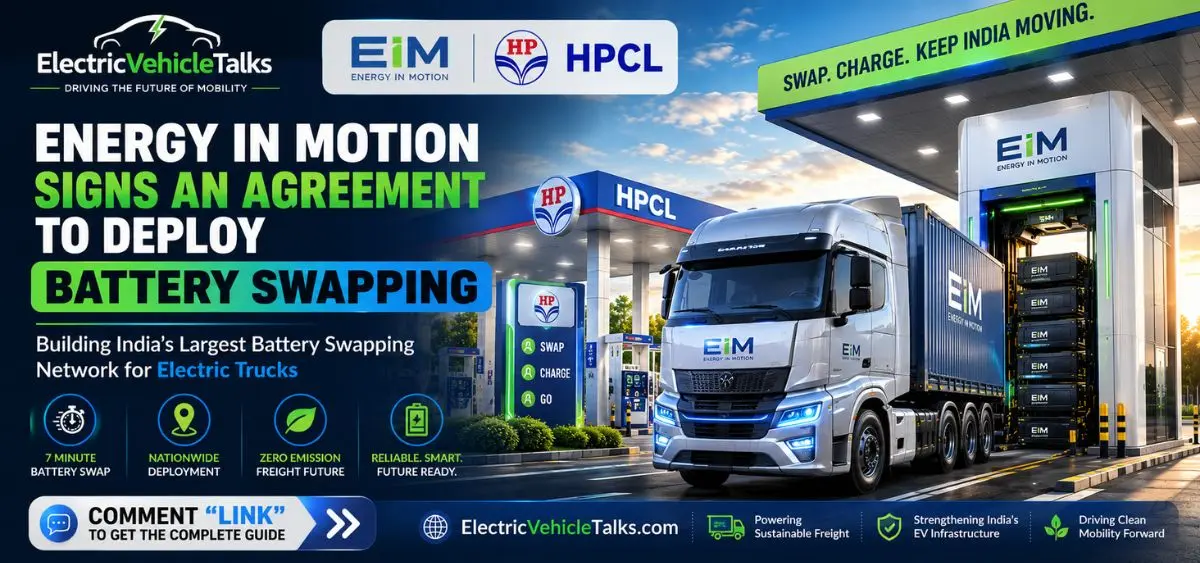

Energy in Motion signs an agreement with Hindustan Petroleum Corporation Limited (HPCL) to build one of India’s largest battery swapping and fast-charging networks for heavy electric commercial vehicles. The partnership is designed to accelerate zero-emission freight transport by deploying charging infrastructure at HPCL’s fuel retail outlets located on major highways and freight corridors. The initiative aims to solve two of the biggest challenges facing electric trucking—charging time and long-distance route reliability.
HPCL Partnership to Build Nationwide Swap-and-Charge Network
Under the strategic collaboration, HPCL will provide space, power connectivity, safety infrastructure, and 24-hour operational support through its network of more than 25,000 fuel stations across India. Meanwhile, Energy in Motion (EIM) will own and operate the automated battery swapping equipment, battery inventory, and digital management platform.
The first phase of deployment will take place over the next 18 to 24 months along high-density freight routes, including Mumbai–Pune, Delhi–Jaipur, and Chennai–Bengaluru. The integrated “swap-and-charge” hubs are expected to improve charging accessibility for heavy electric trucks operating on India’s busiest logistics corridors.
How the Battery Swapping Model Will Work
The Energy in Motion signs agreement initiative follows a shared operational model where each partner contributes its expertise.
- Energy in Motion (EIM): Supplies battery-swapping hardware, manages battery inventory, and enables remote monitoring, digital payments, and real-time station availability.
- HPCL: Provides highway retail space, electrical connectivity, safety systems, driver facilities, and round-the-clock operational support.
- Fleet Operators: Drivers can replace depleted batteries with fully charged packs in approximately seven minutes, significantly reducing vehicle downtime compared to conventional charging.
Expansion Plans and Battery Supply Strengthened
EIM currently operates six heavy-duty battery swapping stations across the Delhi-NCR region and the Jawaharlal Nehru Port Authority (JNPA), each capable of handling up to 840 battery swaps daily. The company now plans to expand its network to 40 operational swap-and-charge stations by March 2027.
Supporting this expansion, EIM has also secured a battery supply agreement with CATL for 500 MWh (0.5 GWh) of lithium iron phosphate (LFP) battery cells and pack kits. These batteries will power the company’s Ashwa series of heavy-duty electric tractors and truck platforms, including the flagship 55-ton Ashwa e-tractor.
Why Battery Swapping Matters for Electric Freight
Heavy commercial electric vehicles require large battery packs that typically take considerable time to recharge and often depend on expensive megawatt-scale charging infrastructure. The Energy in Motion signs agreement strategy addresses this challenge by enabling battery replacement instead of waiting for charging, improving fleet utilization and reducing delays on long-distance routes.
Battery swapping also supports standardized battery management, centralized energy storage, and improved battery lifecycle management, making the technology increasingly attractive for commercial fleet operators.
With EIM’s technology expertise combined with HPCL’s nationwide retail network, the Energy in Motion agreement marks an important step toward building a dependable charging ecosystem that could accelerate the adoption of electric heavy commercial vehicles across India’s freight industry.

Related Articles:









