
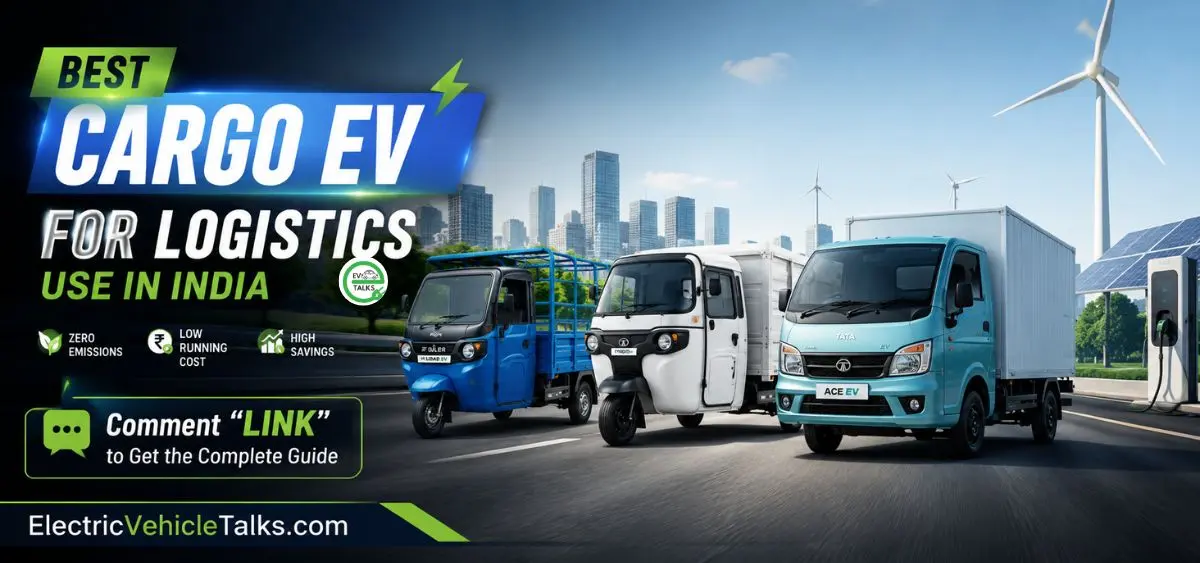

The Best Cargo EV for logistics depends on your daily payload, delivery distance, charging availability, and business model. For most small businesses in India, the Tata Ace EV remains the best all-round electric mini truck, while the Mahindra Treo Zor and Euler HiLoad EV dominate the three-wheeler cargo segment for urban deliveries.
As India’s logistics industry rapidly embraces electric mobility, choosing the right cargo EV is no longer just about reducing fuel costs. It’s about improving delivery efficiency, minimizing downtime, meeting sustainability goals, and preparing for a future where electric transportation will become the industry standard.
Whether you run a grocery distribution business, an e-commerce delivery fleet, a dairy supply chain, or a wholesale operation, selecting the right electric cargo vehicle can significantly improve profitability over the vehicle’s lifetime.
Why Are Cargo EVs Becoming the Future of Indian Logistics?
India’s logistics ecosystem is undergoing a major transformation. Rising diesel prices, stricter emission norms, government support for EVs, and the explosive growth of e-commerce have accelerated demand for electric commercial vehicles.
Major companies such as Amazon, Flipkart, BigBasket, Blinkit, Zepto, and numerous regional logistics providers are increasingly integrating electric cargo vehicles into their fleets. This shift is driven by several practical advantages:
- Lower operating costs
- Reduced maintenance requirements
- Zero tailpipe emissions
- Better urban drivability
- Lower noise pollution
- Compliance with future green mobility regulations
For small businesses, these benefits translate into higher profitability and a stronger competitive edge.
Top 6 Best Cargo EVs for Logistics in India
| Vehicle | Payload | Certified Range | Approx. Price (Ex-showroom) | Best For |
|---|---|---|---|---|
| Tata Ace EV | 600 kg | 154 km | ₹10.2–11.4 lakh | FMCG, wholesale, e-commerce |
| Mahindra Treo Zor | 550 kg | 125 km | ₹3.1–3.9 lakh | City deliveries |
| Euler HiLoad EV | 700 kg | Up to 150 km | ₹3.9–4.2 lakh | Heavy urban logistics |
| Storm EVT 1250 | 1,250 kg | 140+ km | Lease-based | Bulk logistics |
| Switch IEV4 | 1,700 kg | 130 km | Lease-based | Medium commercial transport |
| Tata Ace EV 1000 | 1,000 kg | 161 km | Lease-based | Regional cargo operations |
1. Tata Ace EV
The Tata Ace platform has long been trusted by Indian businesses, and its electric version builds on that reputation with lower operating costs and refined performance.
Key Specifications
| Specification | Details |
|---|---|
| Payload | 600 kg |
| Battery | 21.3 kWh |
| Range | 154 km (ARAI) |
| Charging Time | Around 6–7 hours |
| Fast Charging | Available |
| Price | ₹10.20–11.43 lakh |
Why It Stands Out
For small businesses making 80–120 km of deliveries daily, the Tata Ace EV strikes an excellent balance between payload, range, reliability, and nationwide service support.
Ideal applications include:
- FMCG distribution
- Grocery delivery
- E-commerce logistics
- Pharmaceutical transport
- Beverage distribution
Pros
- Proven Tata reliability
- Extensive service network
- Comfortable cabin
- Excellent resale confidence
- Lower maintenance than diesel models
Considerations
- Higher upfront investment than three-wheelers
- Better suited to medium-load operations than very heavy-duty hauling
2. Mahindra Treo Zor
When affordability is the top priority, the Mahindra Treo Zor continues to be one of India’s most practical electric cargo vehicles.
Specifications
| Feature | Details |
|---|---|
| Payload | 550 kg |
| Range | 125 km |
| Battery | Lithium-ion |
| Price | ₹3.13–3.90 lakh |
Best Use Cases
- Courier businesses
- Local kirana suppliers
- Milk distribution
- Vegetable vendors
- Hyperlocal delivery
Its compact size allows easy navigation through congested Indian streets, making it especially suitable for Tier 1 and Tier 2 cities.
3. Euler HiLoad EV
Among the top cargo EVs for logistics, the Euler HiLoad EV is engineered for businesses requiring higher payload capacity without sacrificing efficiency.
Specifications
| Feature | Details |
|---|---|
| Payload | 700 kg |
| Range | Up to 150 km |
| Battery | Advanced lithium-ion |
| Price | ₹3.94–4.20 lakh |
Why Businesses Choose It
Compared with many three-wheelers, the HiLoad EV carries heavier cargo while maintaining excellent maneuverability.
Ideal for:
- E-commerce hubs
- Construction materials
- Wholesale markets
- Beverage suppliers
- Furniture deliveries
Businesses with multiple daily trips particularly benefit from its higher payload, reducing the number of delivery cycles required.
4. Storm EVT 1250
For businesses transporting bulky goods, the Storm EVT 1250 offers a significant leap in carrying capacity.
Technical Highlights
| Feature | Specification |
|---|---|
| Payload | 1,250 kg |
| Range | 140+ km |
| Battery | 6.6 kWh Lithium-ion |
| Charging | 6 hours |
| Fast Charging | 30 minutes |
| Motor | PMS Motor |
| Peak Power | 30 kW |
| Torque | 140 Nm |
| Cargo Volume | 260 ft³ |
Its large cargo area makes it well suited for furniture, industrial supplies, appliances, and large-scale logistics operations. Businesses that prefer lower upfront costs may also find leasing options attractive.
5. Switch IEV4
Businesses looking for the best EV cargo van in India should consider the Switch IEV4.
Unlike smaller delivery vehicles, the IEV4 is designed for medium-duty logistics where higher payload and faster turnaround are priorities.
Specifications
| Feature | Details |
|---|---|
| Payload | 1,700 kg |
| Battery | 32.2 kWh |
| Range | 130 km |
| Fast Charging | 55 minutes |
| Standard Charging | 4 hours |
| Peak Power | 60 kW |
| Torque | 230 Nm |
This vehicle is ideal for:
- Warehouse distribution
- Cold-chain logistics
- Manufacturing supply chains
- Institutional deliveries
Its higher payload can reduce the number of trips needed each day, improving fleet productivity.
6. Tata Ace EV 1000
For businesses ready to scale, the Tata Ace EV 1000 offers a larger payload while retaining the practicality of the Ace platform.
Specifications
| Feature | Details |
|---|---|
| Payload | 1,000 kg |
| Range | 161 km |
| Battery | 21.3 kWh LFP |
| Fast Charging | Around 1 hour 45 minutes |
| Standard Charging | 7 hours |
| Motor | AC Induction |
| Peak Power | 27 kW |
The use of Lithium Iron Phosphate (LFP) battery technology enhances durability and thermal stability, making it well suited to India’s diverse climate conditions.
How to Choose the Best Cargo EV for Logistics
Choosing the right cargo EV involves more than comparing range figures. Small businesses should evaluate the following:
- Daily Distance: Choose a vehicle with at least 20–30% more range than your average daily route to account for traffic, weather, and battery aging.
- Payload Requirements: Avoid overloading. Select a vehicle whose rated payload comfortably exceeds your usual cargo weight.
- Charging Availability: Businesses with overnight parking can maximize savings by charging during off-peak hours using AC charging.
- Service Network: A wide service network minimizes downtime and ensures faster repairs, particularly important for commercial vehicles.
- Total Cost of Ownership: Consider electricity costs, maintenance, financing, insurance, and expected battery life—not just the purchase price.
What Does It Cost to Own a Cargo EV in India?
One of the biggest reasons businesses are switching to electric commercial vehicles is the Total Cost of Ownership (TCO). While the upfront purchase price of an EV may be higher than a diesel or CNG vehicle, the savings over five to seven years can be substantial.
For businesses making daily deliveries, lower running costs often offset the initial investment within a few years.
Estimated Running Cost Comparison
| Vehicle Type | Approx. Running Cost/km | Maintenance | Engine Oil | Emissions |
|---|---|---|---|---|
| Diesel Cargo Vehicle | ₹5–8 | High | Required | High |
| CNG Cargo Vehicle | ₹3–5 | Moderate | Required | Moderate |
| Electric Cargo Vehicle | ₹0.8–2 | Low | Not Required | Zero Tailpipe Emissions |
Expert Tip: If your business covers more than 80–100 km per day, the savings from an electric cargo vehicle can become significant over its lifetime.
What Factors Affect Cargo EV Performance?
Not every electric cargo vehicle performs the same under real-world conditions. Before purchasing, consider these key performance factors:
1. Payload Capacity
Heavier loads reduce driving range. Always choose a vehicle that comfortably handles your typical cargo rather than operating near its maximum payload every day.
2. Battery Chemistry
Most modern cargo EVs in India use either the following or
- Lithium Iron Phosphate (LFP): Known for safety, long life, and thermal stability.
- Lithium-ion (NMC): Offers higher energy density and lighter weight.
For Indian operating conditions, LFP batteries are increasingly preferred because they tolerate high temperatures better and typically deliver longer cycle life.
3. Regenerative Braking
Many electric cargo vehicles recover energy while slowing down, especially in stop-and-go city traffic. This helps improve efficiency and slightly extends driving range.
4. Motor Efficiency
Electric motors deliver maximum torque from zero RPM, making them particularly effective when carrying heavy loads or climbing flyovers.
Charging Insights for Small Businesses
Charging strategy plays a crucial role in maximizing fleet uptime and profitability.
a) AC Charging
Most cargo EV owners rely on overnight AC charging at their warehouse, shop, or home.
Advantages
- Lower electricity cost
- Battery-friendly
- Ideal for vehicles parked overnight
- Minimal infrastructure investment
b) DC Fast Charging
Businesses operating multiple shifts or covering long distances may benefit from fast charging.
Advantages
- Reduced downtime
- Enables additional delivery trips
- Useful for high-utilization fleets
However, frequent DC fast charging should be balanced with regular AC charging to support long-term battery health.
How Much Does Charging Cost?
Electricity remains significantly cheaper than diesel for commercial transportation.
Estimated Charging Cost
| Battery Size | Electricity Required | Approximate Charging Cost* |
|---|---|---|
| 7 kWh | 7 Units | ₹50–70 |
| 20–22 kWh | 20–22 Units | ₹150–200 |
| 30–35 kWh | 30–35 Units | ₹220–300 |
*Costs vary depending on state electricity tariffs and charging provider.
For many small businesses, overnight charging at commercial premises offers the lowest operating cost.
Government Support for Electric Cargo Vehicles
India continues to promote commercial EV adoption through a combination of central and state initiatives.
Key Support Measures
- Production Linked Incentive (PLI) Scheme for advanced battery manufacturing
- State EV policies offering tax benefits and registration fee exemptions
- Reduced operating costs due to lower electricity prices compared with fossil fuels
- Expansion of public charging infrastructure
- Green mobility initiatives by municipalities and urban development authorities
Although the original FAME II subsidy program has concluded, many states continue to provide incentives for electric commercial vehicles. Buyers should always verify the latest benefits available in their state before making a purchase.
EV Charging Infrastructure in India Is Improving
Charging availability was once a major concern, but the situation is changing rapidly.
Today, India has thousands of public charging points across highways, cities, industrial parks, and logistics hubs. Oil marketing companies, private charging operators, and vehicle manufacturers are actively expanding charging networks.
Fleet operators are also investing in:
- Depot charging
- Warehouse charging
- Solar-powered charging stations
- Battery management software
This growing ecosystem is making electric logistics increasingly practical for businesses of all sizes.
Common Mistakes Buyers Should Avoid
Purchasing the wrong vehicle can increase operating costs instead of reducing them.
Here are the most common mistakes:
a) Buying Only Based on Price
The cheapest vehicle isn’t always the most economical over five years. Consider reliability, warranty, service support, and battery performance.
b) Ignoring Payload Requirements
Regular overloading shortens component life and reduces driving range.
c) Overestimating Range
Always expect real-world range to be lower than laboratory-certified figures due to traffic, air conditioning, weather, and payload.
d) Ignoring Charging Infrastructure
Businesses should identify where vehicles will charge before placing an order.
e) Not Evaluating Service Network
Commercial vehicles generate revenue only when they’re on the road. A strong after-sales network is essential for minimizing downtime.
Cargo EV vs Diesel Mini Truck
| Factor | Electric Cargo Vehicle | Diesel Cargo Vehicle |
|---|---|---|
| Fuel Cost | Very Low | High |
| Maintenance | Low | High |
| Noise | Quiet | Loud |
| Torque | Instant | Gradual |
| Emissions | Zero Tailpipe | High |
| City Restrictions | Future Ready | Increasingly Restricted |
| Long-Term Ownership Cost | Lower | Higher |
For businesses focused on city logistics, electric vehicles already offer a compelling economic advantage.
Sustainability Benefits Beyond Cost Savings
Switching to electric logistics is about more than reducing fuel expenses.
Every electric cargo vehicle helps:
- Improve urban air quality
- Reduce greenhouse gas emissions
- Lower noise pollution
- Decrease dependence on imported fossil fuels
- Support India’s clean energy transition
As renewable energy adoption grows, the environmental benefits of electric logistics will continue to increase.
Future Trends in India’s Cargo EV Market
The next few years are expected to bring significant advancements in commercial electric mobility.
Emerging Trends
- Longer-range battery technologies
- Faster charging capabilities
- Connected fleet management systems
- AI-powered route optimization
- Vehicle telematics
- Battery swapping for commercial fleets
- Increased localization of battery manufacturing
- Expansion of electric light commercial vehicles
Industry analysts expect electric commercial vehicles to capture a growing share of last-mile delivery as businesses prioritize lower operating costs and sustainability.
Expert Insight from Electric Vehicle Talks
At Electric Vehicle Talks, our analysis of India’s commercial EV market indicates that the biggest advantage of cargo EVs is no longer just environmental sustainability—it’s business profitability.
For small businesses, the most important decision isn’t choosing the vehicle with the highest advertised range. It’s selecting one that matches daily operating needs, payload requirements, charging availability, and after-sales support.
If your daily operations involve predictable city routes of 70–120 km, an electric cargo vehicle can significantly reduce running costs while improving driving comfort and reducing maintenance downtime. Businesses planning for long-term growth should also consider battery warranty, fleet management tools, and service accessibility rather than focusing solely on the purchase price.
As charging infrastructure expands and battery technology continues to improve, electric cargo vehicles are becoming an increasingly practical investment for India’s logistics sector.
For more expert buying guides and EV industry insights.
People Also Ask (PAA)
1. Which is the best cargo EV for logistics in India?
The Tata Ace EV is widely regarded as the best cargo EV for logistics in India due to its balance of payload capacity, driving range, reliability, and nationwide service network. For three-wheeler applications, the Mahindra Treo Zor and Euler HiLoad EV are excellent choices for last-mile deliveries.
2. Which electric cargo vehicle offers the highest payload?
Among the vehicles covered in this guide:
- Switch IEV4 – Up to 1,700 kg payload
- Storm EVT 1250 – 1,250 kg payload
- Tata Ace EV 1000 – 1,000 kg payload
These vehicles are better suited for businesses transporting heavier goods or operating medium-duty logistics routes.
3. Are electric cargo vehicles cheaper to run than diesel vehicles?
Yes. In most cases, electric cargo vehicles have significantly lower running and maintenance costs.
Typical savings come from:
- Lower energy cost per kilometre
- Fewer moving parts
- No engine oil changes
- Reduced brake wear due to regenerative braking
- Lower servicing requirements
For businesses with predictable daily routes, the total cost of ownership often becomes lower than diesel over the vehicle’s lifecycle.
4. How far can a cargo EV travel on a single charge?
The real-world driving range depends on factors such as payload, traffic, driving style, terrain, and weather.
Typical ranges include the following:
| Vehicle | Certified Range |
|---|---|
| Tata Ace EV | 154 km |
| Tata Ace EV 1000 | 161 km |
| Mahindra Treo Zor | 125 km |
| Euler HiLoad EV | Up to 150 km |
| Storm EVT 1250 | 140+ km |
| Switch IEV4 | 130 km |
Businesses should select a vehicle with a range comfortably exceeding their daily delivery distance.
5. Is charging infrastructure sufficient for commercial EVs in India?
India’s charging ecosystem has expanded rapidly in recent years. Public charging stations are now available in many metropolitan cities, industrial zones, and along major highways. Additionally, many fleet operators install dedicated charging points at warehouses or depots, making overnight charging convenient and cost-effective.
6. Which cargo EV is best for small businesses?
For most small businesses:
- Mahindra Treo Zor is ideal for affordable city deliveries.
- Tata Ace EV is best for businesses needing higher payload and broader versatility.
- Euler HiLoad EV is suitable for companies making frequent deliveries with heavier cargo.
The best choice depends on your average payload, route length, and budget.
7. Is now the right time to invest in a cargo EV?
For businesses with regular urban delivery operations, the answer is increasingly yes. Improvements in battery technology, expanding charging infrastructure, and lower operating costs have made cargo EVs a practical long-term investment. Companies adopting electric logistics today can also strengthen their sustainability credentials while reducing fuel-related expenses.
FAQs about the Best Cargo EV for logistics use in India
1. Which is the best electric cargo vehicle in India for e-commerce deliveries?
The Tata Ace EV is one of the strongest options for e-commerce and FMCG deliveries because it combines dependable performance, a practical driving range, and a widespread service network.
2. What is the average battery life of a cargo EV?
Most modern lithium-ion and LFP battery packs are designed to last 8–10 years or well over 150,000–200,000 km, depending on usage, charging habits, and maintenance.
3. Can cargo EVs handle Indian road conditions?
Yes. Leading manufacturers design their commercial EVs with reinforced suspension systems, durable chassis, and adequate ground clearance to cope with urban roads and varied operating environments. However, buyers should always evaluate vehicle suitability for their specific routes.
4. Do electric cargo vehicles require less maintenance?
Yes. Since EVs have fewer mechanical components than diesel vehicles, they generally require less routine maintenance. There are no engine oil changes, fewer filters, and reduced wear on braking systems due to regenerative braking.
5. What should I consider before buying a cargo EV?
Key considerations include:
- Daily driving distance
- Typical payload
- Charging availability
- Battery warranty
- Service network
- Total cost of ownership
- Financing or leasing options
- Business growth plans
Selecting a vehicle that aligns with your operational needs is more important than simply choosing the one with the highest advertised range.
6. Are electric cargo vehicles suitable for rural logistics?
Yes, provided charging access is available. Businesses operating in rural areas with fixed delivery routes and overnight parking can benefit from electric cargo vehicles. However, route planning and charging infrastructure should be assessed carefully before purchase.
Conclusion
The transition to electric commercial vehicles is no longer a distant vision—it’s becoming a strategic business decision for companies across India. Whether you’re a small retailer, an e-commerce seller, a courier service, or a regional distributor, choosing the best cargo EV for logistics can lower operating costs, reduce maintenance, and improve delivery efficiency while supporting cleaner urban mobility.
Each vehicle featured in this guide serves a different business need. The Tata Ace EV stands out as the most balanced choice for many small enterprises, while the Mahindra Treo Zor and Euler HiLoad EV continue to lead the three-wheeler segment. Businesses with larger payload requirements can look toward options like the Switch IEV4 or Storm EVT 1250.
As battery technology advances, charging networks expand, and government support for electric mobility continues, cargo EVs are expected to play an increasingly important role in India’s logistics ecosystem. Investing in the right vehicle today can position businesses for long-term operational savings and future-ready growth.
For more in-depth EV buying guides, industry news, charging insights, and expert analysis, explore Electric Vehicle Talks and stay informed about the latest developments shaping the future of sustainable mobility.

Related Article:-
Electric Cargo Auto vs CNG Cargo Auto: Which Saves More in India?
Electric Loader vs. Diesel Loader in India: Which Saves More Money?
Best Electric Loaders for Business in India – Price, Range & Payload
Best electric cargo three-wheelers in India: Price, Range & Features Compared.









