
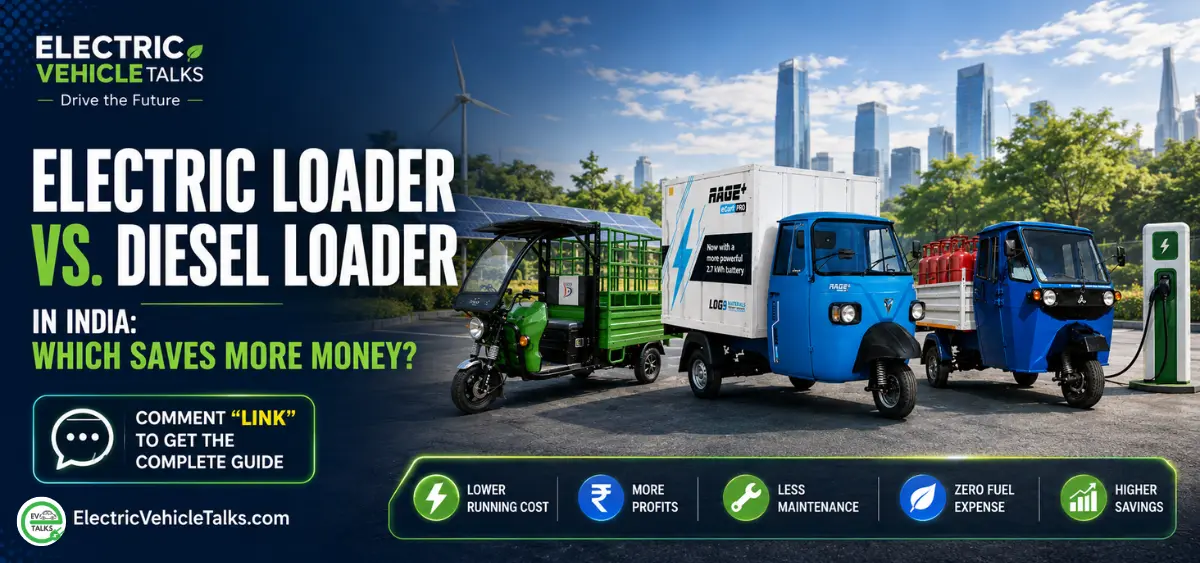

When comparing an electric loader vs. diesel loader, the right choice depends on your daily operating distance, payload requirements, and business model. Electric loaders offer significantly lower running costs, quieter operation, and zero tailpipe emissions, making them ideal for urban deliveries. Diesel loaders, on the other hand, continue to dominate heavy-duty applications where long operating hours, high payloads, and instant refueling are essential.
As India’s logistics, e-commerce, and commercial transportation sectors continue to expand, businesses are increasingly evaluating whether switching to electric commercial vehicles is financially worthwhile. Rising diesel prices, stricter emission norms, and government support for electric mobility have made this comparison more relevant than ever.
Whether you’re a fleet owner, small business operator, or entrepreneur planning to buy your first commercial vehicle, understanding the real-world differences between electric and diesel loaders can help you make a smarter long-term investment.
Why Is the Electric Loader vs. Diesel Loader Comparison Important?
Commercial vehicles directly impact business profitability. Every rupee spent on fuel, servicing, and maintenance affects overall operating margins.
An electric loader may cost slightly more initially, but its lower operating expenses can generate substantial savings over several years. Meanwhile, diesel loaders still provide unmatched flexibility for continuous operations and demanding work environments.
The decision should be based on your daily usage rather than simply the purchase price.
Electric Loader vs Diesel Loader in India: Quick Comparison
| Feature | Electric Loader | Diesel Loader |
|---|---|---|
| Purchase Price | ₹1.12 lakh–₹4.20 lakh | ₹2.40 lakh–₹2.50 lakh |
| Running Cost | ₹0.50–₹1/km | ₹3–₹4/km |
| Maintenance | Very Low | Moderate to High |
| Fuel Type | Electricity | Diesel |
| Charging/Refueling | 4–8 hours charging | 5-minute refueling |
| Tailpipe Emissions | Zero | High |
| Noise | Very Low | Loud |
| Ideal Usage | Urban & last-mile delivery | Heavy-duty & long-distance work |
| Government Incentives | Available in many states | None |
How Do Electric and Diesel Loaders Work?
1. Electric Loaders
Electric loaders use an electric motor powered by rechargeable batteries, typically lithium-ion or lead-acid, depending on the model. Unlike internal combustion engines, electric motors deliver maximum torque instantly.
This means the vehicle starts smoothly even when carrying heavy cargo, making stop-and-go city deliveries much more efficient.
Popular applications include:
- E-commerce deliveries
- Grocery distribution
- FMCG transportation
- Parcel logistics
- Municipal waste collection
- Vegetable transport
2. Diesel Loaders
Diesel loaders rely on compression ignition engines that generate continuous power for demanding commercial applications.
They remain popular for:
- Construction material transport
- Agriculture
- Brick and cement delivery
- Water can supply
- Industrial logistics
- Long-distance cargo movement
Their biggest advantage is uninterrupted operation because refueling takes only a few minutes.
Electric Loader vs Diesel Loader Performance Comparison
Performance isn’t just about speed—it includes torque, payload, drivability, and operating efficiency.
1. Electric Loader Performance
Electric motors produce instant torque from zero RPM. This makes electric loaders surprisingly responsive when starting from traffic signals or carrying heavy loads in city environments.
Advantages include:
- Smooth acceleration
- No engine vibration
- Better control in traffic
- Minimal noise
- Regenerative braking in many models
However, continuous high-speed driving and steep inclines can reduce driving range.
2. Diesel Loader Performance
Diesel engines generate consistent power throughout long operating hours.
Advantages include:
- Better highway capability
- Higher sustained payload handling
- Reliable on steep roads
- Suitable for continuous commercial operations
- No charging downtime
For businesses operating in remote regions or multiple shifts, diesel still provides operational convenience.
Electric Loader vs Diesel Loader in India: Price Comparison
One of the first questions buyers ask is about the purchase price.
Typical Electric Loader Price
| Category | Approximate Price |
|---|---|
| Entry-level Electric Loader | ₹1.12–₹1.60 lakh |
| Mid-range Models | ₹1.60–₹2.80 lakh |
| Premium High-Payload Models | ₹3.00–₹4.20 lakh |
Several states also provide EV incentives, reducing the effective acquisition cost.
Typical Diesel Loader Price
| Model Category | Approximate Price |
|---|---|
| Standard Diesel Loader | ₹2.40–₹2.50 lakh |
Although diesel models often have a competitive purchase price, they incur significantly higher operating expenses over time.
Electric Loader vs Diesel Loader Running Cost Analysis
Running cost is where electric commercial vehicles create the biggest financial advantage.
Estimated Cost per Kilometer
| Expense | Electric | Diesel |
|---|---|---|
| Energy/Fuel Cost | ₹0.50–₹1/km | ₹3–₹4/km |
For businesses covering 70–100 km daily, these savings accumulate rapidly.
Example Calculation
Assuming:
- Daily distance: 80 km
- Working days: 26 per month
| Category | Diesel | Electric |
|---|---|---|
| Monthly Distance | 2,080 km | 2,080 km |
| Cost per km | ₹3.50 | ₹0.50 |
| Monthly Energy Cost | ₹7,280 | ₹1,040 |
| Monthly Savings | — | ₹6,240 |
Annual savings exceed ₹74,000 on fuel and electricity costs alone, excluding maintenance benefits.
Maintenance Comparison
Maintenance often determines the long-term profitability of a commercial vehicle.
1. Electric Loader Maintenance
Electric vehicles have far fewer moving parts than diesel engines.
Routine maintenance generally includes the following:
- Brake inspection
- Suspension check
- Tire replacement
- Battery health monitoring
- Electrical diagnostics
There is no need for the following:
- Engine oil
- Oil filters
- Clutch replacement
- Exhaust servicing
- Fuel injectors
- Timing belts
2. Diesel Loader Maintenance
Diesel loaders require regular servicing to maintain engine performance.
Common maintenance tasks include:
- Engine oil changes
- Fuel filter replacement
- Air filter servicing
- Clutch repairs
- Injector cleaning
- Exhaust maintenance
- Engine diagnostics
Over several years, these recurring expenses significantly increase the total cost of ownership.
Which Loader Is Better for Different Businesses?
Choose an Electric Loader If You:
- Deliver goods within city limits
- Operate below 100 km daily
- Want lower operating costs
- Have overnight charging access
- Run e-commerce or retail logistics
- Prefer environmentally friendly transportation
Electric loaders are especially suitable for courier companies, grocery distributors, pharmaceutical deliveries, and small businesses looking to reduce operating expenses.
Choose a Diesel Loader If You:
- Frequently travel over 120 km daily
- Operate in remote or rural areas
- Need continuous multi-shift operations
- Carry heavy construction materials
- Lack of reliable charging infrastructure
Diesel loaders remain a practical choice where uninterrupted availability and higher payload capability are the top priorities.
Electric Loader vs. Diesel Loader in India: Cost 5-Year Ownership Analysis
While the purchase price often influences buying decisions, the Total Cost of Ownership (TCO) provides a much clearer picture of long-term profitability. For commercial vehicle owners, recurring expenses such as fuel, maintenance, insurance, and repairs usually outweigh the initial investment over several years.
The table below illustrates an estimated five-year ownership comparison for a loader operating approximately 80 km per day for 26 working days per month.
| Cost Component | Electric Loader | Diesel Loader |
|---|---|---|
| Purchase Price | ₹1.80–₹3.50 lakh | ₹2.40–₹2.50 lakh |
| Fuel/Energy (5 Years) | ₹60,000–₹1.20 lakh | ₹4.00–₹5.00 lakh |
| Maintenance | Low | High |
| Engine Oil & Filters | Not Required | Required Regularly |
| Major Repairs | Minimal | Moderate to High |
| Battery Replacement* | May be required after 4–7 years (depending on battery type and usage) | Not Applicable |
| Estimated Total Ownership Cost | Lower | Higher |
Note: Battery lifespan varies by battery chemistry, charging habits, operating conditions, and manufacturer specifications. Many modern lithium-ion batteries can last well beyond five years with proper maintenance.
Key Takeaway
Although an electric loader may require a slightly higher investment for certain premium variants, its substantially lower operating costs can offset the price difference within two to three years for businesses with regular daily usage.
Charging Infrastructure: Is Owning an Electric Loader Practical in India?
One of the biggest concerns among commercial vehicle buyers is charging availability. Fortunately, India’s EV charging ecosystem has expanded significantly over the past few years.
Today, charging options include the following:
- Home charging using a standard AC connection
- Dedicated commercial charging stations
- Fleet charging depots
- Workplace charging
- Battery swapping networks (available in selected cities)
Many logistics companies now install overnight charging systems at warehouses, allowing vehicles to start each day with a full battery.
Typical Charging Time
| Charging Type | Approximate Time |
|---|---|
| Standard AC Charger | 6–8 Hours |
| Fast Charger (Supported Models) | 2–4 Hours |
| Battery Swapping | 5–10 Minutes |
For businesses operating within city limits, overnight charging is often sufficient for the next day’s operations.
Battery Technology: What Buyers Should Know
Battery technology has improved rapidly, making electric commercial vehicles more reliable than ever before.
a) Lead-Acid Batteries
Advantages:
- Lower purchase price
- Widely available
- Easier replacement
Limitations:
- Shorter lifespan
- Longer charging time
- Higher weight
- Lower efficiency
b) Lithium-Ion Batteries
Advantages:
- Longer lifespan
- Faster charging
- Better energy efficiency
- Lower maintenance
- Higher driving range
Although lithium-ion-equipped loaders cost more initially, they usually provide better long-term value for commercial users.
Government Incentives Supporting Electric Loaders in India
The Indian government continues to encourage EV adoption through a combination of central and state-level initiatives. While subsidy structures evolve, electric commercial vehicles benefit from policy support aimed at reducing operating costs and improving fleet electrification.
Depending on the state, buyers may receive benefits such as the following:
- Road tax exemptions
- Registration fee waivers
- Purchase incentives
- Lower financing costs
- Support for commercial fleet electrification
Several state EV policies also encourage businesses to transition from diesel-powered commercial vehicles to cleaner electric alternatives.
Environmental Impact: Why Electric Loaders Matter
Commercial transportation contributes significantly to urban air pollution. Replacing diesel loaders with electric alternatives can help improve local air quality and reduce greenhouse gas emissions, especially when charged using cleaner energy sources.
1. Electric Loaders
Benefits:
- Zero tailpipe emissions
- Lower noise pollution
- Reduced urban air pollution
- Lower carbon footprint over the vehicle’s lifecycle (particularly with renewable electricity)
2. Diesel Loaders
Challenges:
- Carbon dioxide emissions
- Nitrogen oxides (NOx)
- Particulate matter
- Higher noise levels
For businesses focused on sustainability and ESG (Environmental, Social, and Governance) goals, electric loaders are becoming an increasingly attractive choice.
Common Mistakes Buyers Make
Choosing the wrong commercial vehicle can increase operating costs and reduce business efficiency. Avoid these common mistakes:
- Selecting a vehicle based only on purchase price
- Ignoring the daily running distance
- Overestimating payload requirements
- Not evaluating charging availability
- Choosing lead-acid batteries when high daily usage demands lithium-ion technology
- Ignoring maintenance costs over the vehicle’s lifetime
- Not considering resale value and future regulatory changes
A careful assessment of your operational needs will help maximize return on investment.
Future Trends in India’s Electric Commercial Vehicle Market
India’s electric commercial vehicle segment is expected to grow rapidly over the coming decade, driven by:
- Rising fuel prices
- Expansion of e-commerce
- Urban logistics demand
- Fleet electrification initiatives
- Advancements in battery technology
- Increasing charging infrastructure
- Government support for cleaner mobility
Manufacturers are also introducing:
- Higher-capacity batteries
- Longer driving ranges
- Connected fleet management systems
- Telematics and remote diagnostics
- Fast-charging capability
- Improved payload capacity
These developments are making electric loaders increasingly competitive with diesel models for a wider range of commercial applications.
Expert Insight from Electric Vehicle Talks
From an industry perspective, the debate around electric loader vs. diesel loader is no longer about which technology is universally better—it is about choosing the right solution for the right application.
For urban logistics, e-commerce deliveries, and businesses operating predictable daily routes, electric loaders already offer a compelling business case through lower operating costs, reduced maintenance, and cleaner mobility. Advances in battery technology and the steady expansion of charging infrastructure are further strengthening their position.
Diesel loaders, however, continue to play a crucial role in sectors requiring extended operating hours, heavy payloads, and dependable performance in remote locations where charging facilities remain limited.
At Electric Vehicle Talks, our recommendation is simple: evaluate your daily distance, payload requirements, charging access, and long-term operating costs before making a purchase decision. Looking beyond the sticker price often reveals which option delivers the best value over the vehicle’s lifetime.
People Also Ask
1. Which is better: an electric loader or a diesel loader?
Electric loaders are better for city-based, last-mile logistics with lower running costs, while diesel loaders are more suitable for heavy-duty, long-distance, or continuous operations.
2. What is the running cost of an electric loader in India?
Most electric loaders cost around ₹0.50–₹1 per km, depending on electricity tariffs, battery efficiency, and driving conditions.
3. How much does a diesel loader cost to operate?
A diesel loader typically costs ₹3–₹4 per km, including fuel. Additional maintenance expenses further increase the overall operating cost.
4. How long does an electric loader battery last?
Modern lithium-ion batteries generally last 4–7 years or more, depending on usage patterns, charging practices, and manufacturer specifications.
5. Can electric loaders carry heavy loads?
Yes. Many electric loaders support payloads ranging from 400 kg to 1,000 kg, making them suitable for most urban commercial applications.
6. Is charging infrastructure improving in India?
Yes. Public charging stations, private fleet charging hubs, and battery-swapping networks are expanding steadily across major cities and commercial corridors.
7. Are electric loaders eligible for government incentives?
Depending on current central and state EV policies, buyers may receive benefits such as road tax exemptions, registration fee waivers, and purchase incentives.
FAQs about Electric Loader vs. Diesel Loader
1. Are electric loaders suitable for rural areas?
They can perform well in rural regions with reliable electricity access and moderate daily travel distances. However, diesel loaders may still be more practical in areas with limited charging infrastructure.
2. Which loader has lower maintenance costs?
Electric loaders generally have much lower maintenance costs because they do not require engine oil changes, fuel filters, or many of the mechanical components found in diesel engines.
3. How much money can I save by switching to an electric loader?
A business operating around 80 km per day could save approximately ₹70,000–₹75,000 annually on energy costs alone, with additional savings from reduced maintenance.
4. Are electric loaders reliable for commercial use?
Yes. Modern electric loaders are designed for daily commercial operations and are widely used in e-commerce, retail distribution, municipal services, and last-mile logistics.
5. Which industries benefit most from electric loaders?
Industries such as e-commerce, courier services, FMCG distribution, grocery delivery, pharmaceuticals, food supply, and municipal waste management can benefit significantly from electric loaders due to their lower operating costs and efficient city performance.
Conclusion
If your operations involve predictable city routes, daily travel of up to 100 km, and regular access to charging, an electric loader can deliver significant savings through lower fuel and maintenance costs while supporting cleaner, quieter transportation. Over time, these advantages can improve profitability and align your business with India’s growing shift toward sustainable mobility.
Diesel loaders, meanwhile, continue to be a dependable solution for demanding applications that require extended operating hours, heavier payloads, and quick refueling in locations where charging infrastructure is still developing.
As battery technology advances, charging networks expand, and policy support for electric mobility strengthens, electric loaders are becoming an increasingly practical choice for commercial fleets across India. Businesses that evaluate total ownership costs rather than just the initial purchase price will be better positioned to make informed investment decisions.
For more expert insights, EV buying guides, charging information, and the latest updates on India’s electric mobility ecosystem, explore Electric Vehicle Talks and stay informed about the future of sustainable transportation.

Related Article:-
Electric Cargo Auto vs CNG Cargo Auto: Which Saves More in India?









