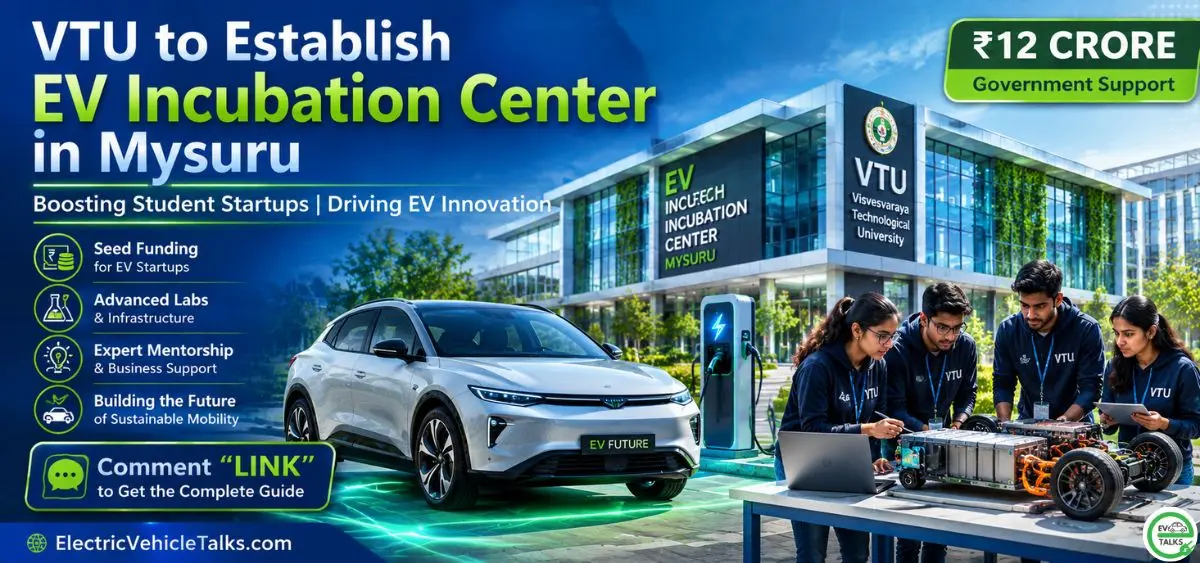

Visvesvaraya Technological University (VTU) is taking a significant step toward strengthening India’s electric mobility ecosystem by launching a dedicated EV Tech Incubation Centre in Choranahalli, Mysuru. The initiative is designed to help engineering students transform innovative electric vehicle ideas into successful startups through financial assistance, technical infrastructure, and expert mentorship. VTU to establish EV Incubation center
The VTU EV Incubation Centre initiative is expected to accelerate innovation in electric mobility while creating a strong bridge between academic research and commercial product development.

Karnataka Government Allocates ₹12 Crore
The Karnataka State Government has sanctioned approximately ₹12 crore to support the establishment of the new EV incubation facility. According to VTU Vice Chancellor S. Vidyashankar, the university will soon sign a Memorandum of Understanding (MoU) with the State Government to formally begin the project.
The incubation center will be located in Choranahalli, Mysuru, where existing infrastructure developed under the state’s skill development initiatives will be utilized to support startup activities and advanced EV research.
What the EV Incubation Centre Will Offer
The primary objective of the center is to remove the major barriers that student entrepreneurs often face while building technology-based startups.
Seed Funding
Students with promising EV ideas will receive early-stage financial assistance to develop prototypes and validate their concepts before commercial scaling.
Advanced Research Infrastructure
The facility will provide dedicated workspaces, modern laboratories, and specialized equipment for research in electric vehicles, battery systems, charging technologies, and power electronics.
Business and Technical Mentorship
Industry experts and academic mentors will guide startups through every stage of development, including product design, mechanical development, marketing strategies, business planning, and commercialization.
The VTU to establish EV Incubation center project aligns with Karnataka’s broader vision of becoming a leading Engineering Research and Development hub while promoting innovation in sustainable mobility and clean energy technologies.
How VTU Students Can Submit Their EV Startup Ideas
Even before the new incubation centre becomes operational, VTU already has an established entrepreneurship ecosystem through which students can present innovative EV concepts.
Apply Through VTUiNEC
Students can submit their proposals via the VTU Innovation and Entrepreneurship Center (VTUiNEC).
The application process generally includes:
- Monitoring official university notifications for incubation opportunities.
- Preparing a detailed project proposal explaining the EV innovation, such as battery management systems, charging infrastructure, motor technologies, or powertrain efficiency.
- Participating in an initial evaluation conducted by an expert review panel.
- Coordinating with their college’s entrepreneurship or placement cell for guidance.
Incubation Through the VRIF Technology Business Incubator
Students can also apply through the Visvesvaraya Research Innovation Foundation (VRIF) Technology Business Incubator (TBI), which regularly conducts startup incubation programs.
Typically, applicants are required to submit:
- A digital application form.
- A 60-second startup pitch video explaining their innovation.
- Basic technical details of their product or prototype.
Selected teams receive incubation support, mentoring, and opportunities to scale their technology.
What Students Should Prepare Before Applying
To improve their chances of securing incubation support, student teams should prepare:
- A clearly defined EV or battery-related problem statement.
- Prototype designs, CAD models, software architecture, or circuit schematics.
- A multidisciplinary team consisting of Mechanical, Electrical, Electronics, and Computer Science students wherever possible.
- A roadmap explaining product development and commercialization potential.
With dedicated funding, modern research infrastructure, and structured mentoring, the VTU EV Incubation center initiative is expected to become a major catalyst for student-led EV innovation. By empowering young engineers with the resources needed to build scalable mobility solutions, the university is positioning Mysuru as an emerging hub for electric vehicle startups while supporting Karnataka’s ambition to lead India’s next generation of sustainable transportation technologies.

Related Articles: