
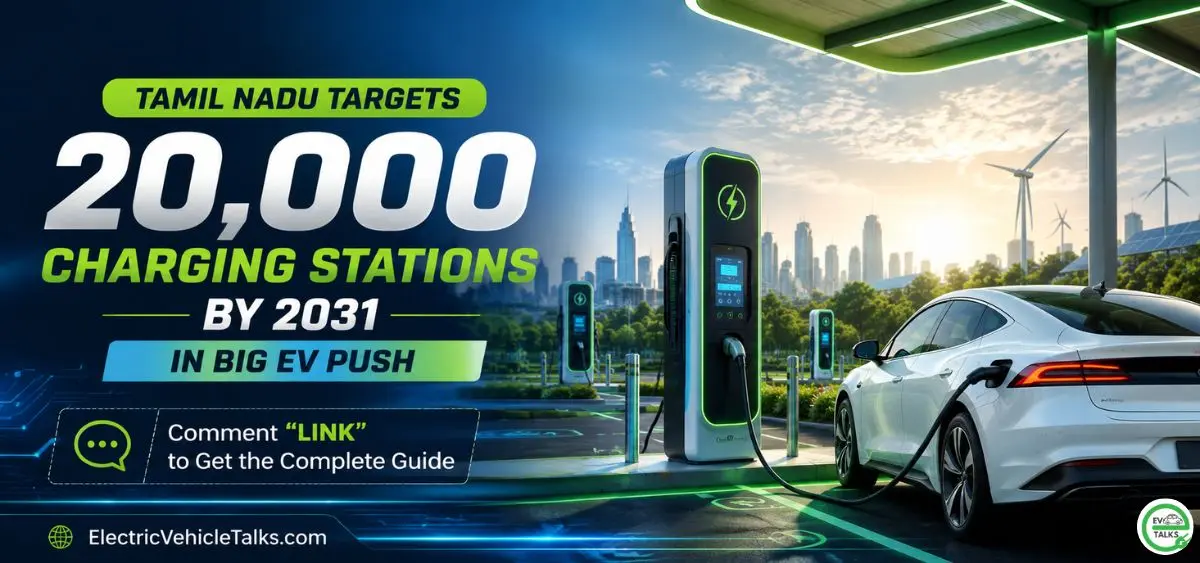

Tamil Nadu has announced an ambitious roadmap to significantly expand its electric vehicle (EV) charging network, reinforcing its position as one of India’s leading states for clean mobility. Under the state’s ‘Vetri Thamizhagam’ vision, the government aims to establish 20,000 public EV charging stations by 2031, making EV charging more accessible while encouraging private investment and reducing infrastructure costs. The initiative demonstrates how TN targets 20k charging stations by 2031 through policy reforms, improved electricity infrastructure, and public-private partnerships.
Tamil Nadu Accelerates EV Charging Infrastructure
To review the progress of public EV charging infrastructure, a high-level meeting chaired by the Chief Secretary was held on July 13, followed by a technical committee meeting led by TNPDCL Chairman and Managing Director J. Radhakrishnan. Representatives from ITDP India and Guidance Tamil Nadu also participated in discussions focused on expanding charging infrastructure across the state.
The meetings concluded with several policy decisions designed to simplify the installation of charging stations while making investments more attractive for businesses and institutions.
EV Sub-Meters to Simplify Charging Station Installation
One of the most significant decisions is the approval of EV sub-meters within existing High Tension (HT) and Extra High Tension (EHT) electricity connections.
Under the new framework:
- Businesses can install EV charging facilities without applying for a separate electricity service connection.
- Charging stations can operate within the sanctioned electrical load already available at the premises.
- Users will pay only the applicable EV electricity tariff based on actual power consumption.
- Fixed or minimum monthly demand charges will not apply in this arrangement.
This move is expected to reduce both the time and cost required to establish charging stations.
Lower Costs for Businesses and Institutions
The simplified electricity model is expected to benefit the following:
- Commercial establishments
- Manufacturing industries
- Educational institutions
- Hospitals
- Residential apartment complexes
- Corporate campuses
These organizations can now deploy EV charging infrastructure with significantly lower upfront investment, encouraging wider adoption across Tamil Nadu.
Separate EV Connections Also Permitted
For operators planning larger charging networks, the committee has also approved dedicated electricity service connections exclusively for EV charging stations.
Importantly, these new EV connections will not affect an establishment’s existing sanctioned load or electricity tariff category, providing greater flexibility for businesses expanding their charging infrastructure.
Tamil Nadu EV Policy 2023 to Be Strengthened
To further encourage investment, the High-Level Technical Committee has recommended amendments to the Tamil Nadu Electric Vehicle Policy 2023.
The proposed reforms include:
- Waiving fixed monthly demand charges for dedicated EV connections.
- Reducing minimum demand charges under the EV tariff category.
- Creating a more investor-friendly charging ecosystem.
- Encouraging greater participation from private companies.
These measures directly support the state’s long-term objective as TN targets 20k charging stations by 2031 while lowering financial barriers for charging station developers.
Public-Private Partnerships to Expand Charging Networks
Tamil Nadu is also promoting Public-Private Partnerships (PPPs) alongside TNEB and TNPDCL to rapidly expand charging infrastructure across cities, industrial hubs, state borders, and major highways.
By combining government support with private investment, the state aims to develop world-class charging infrastructure capable of supporting the rapid growth of electric vehicles.
National Highway Fast-Charging Corridors Planned
The state’s charging expansion also aligns with the Central Government’s PM E-Drive Scheme.
During the initial phase, 498 public EV charging stations are planned along major expressways and national highways.
Priority corridors include:
- Chennai–Nagercoil
- Chennai–Thoothukudi
- Chennai–Bengaluru
These highway fast-charging corridors are expected to improve long-distance EV travel while reducing range anxiety for motorists.
What This Means for EV Adoption
The latest policy reforms represent one of Tamil Nadu’s most comprehensive efforts to accelerate EV adoption. By reducing installation costs, simplifying electricity connections, supporting private investment, and expanding charging infrastructure across urban and highway networks, the state is creating a strong foundation for sustainable transportation.
As TN targets 20k charging stations by 2031, the initiative is expected to strengthen Tamil Nadu’s leadership in green mobility, attract new investments, and make electric vehicle ownership more practical for residents and businesses alike. With supportive policy changes and large-scale infrastructure expansion underway, TN targets 20k charging stations by 2031 as a key milestone in India’s transition toward cleaner and more sustainable transportation.

Related Articles:









