
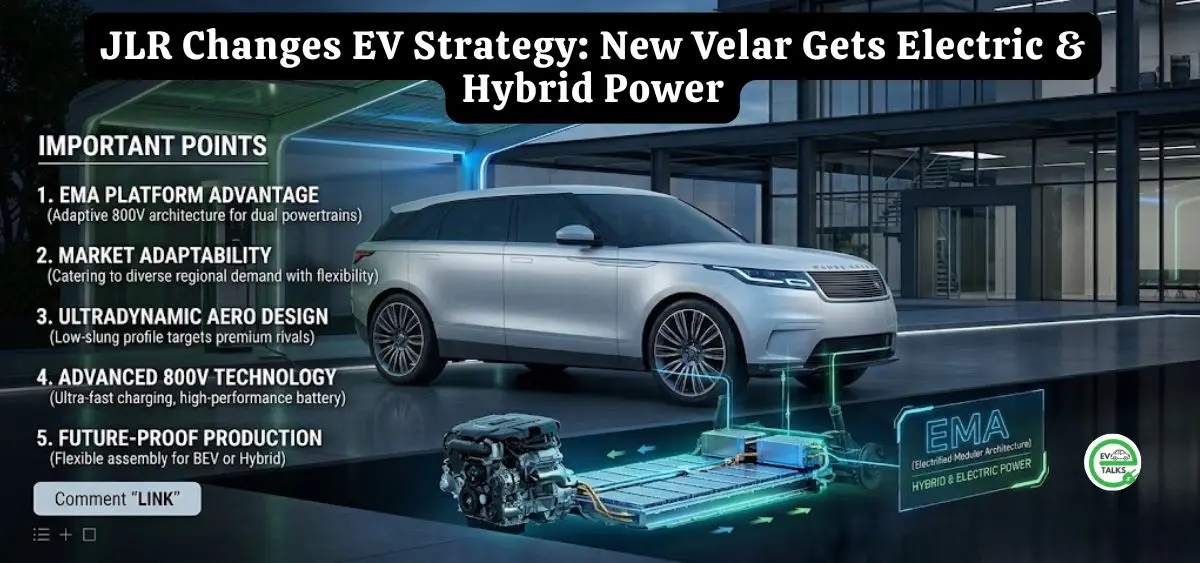

JLR Changes EV Strategy as the luxury automaker has officially revised its future vehicle roadmap, confirming that the next-generation Range Rover Velar successor will be available with both fully electric and hybrid powertrain options. The move represents a major shift from Jaguar Land Rover’s earlier plan of introducing upcoming midsize SUVs as purely electric models.
The decision highlights how premium automakers are adapting to changing global EV demand, charging infrastructure challenges, and evolving customer preferences. Instead of following a single-path electric-only approach, JLR is now focusing on a flexible powertrain strategy that can support different markets worldwide.

Why JLR Changed Its Electric Vehicle Roadmap
The global EV market has entered a period of adjustment, with slower-than-expected adoption in some regions and continued concerns around charging networks, battery costs, and consumer readiness. In response, JLR is creating a more adaptable product strategy to maintain growth and profitability.
Under the updated plan, Land Rover brands, including Range Rover, Defender, and Discovery, will follow a multi-powertrain approach, allowing customers to choose between electric and hybrid technologies. However, Jaguar’s future direction remains focused entirely on electric vehicles as part of its premium EV transformation.
JLR changes EV Strategy by giving customers more flexibility while reducing the risks associated with an EV-only transition. This approach allows the company to respond quickly to regional market conditions while continuing its long-term electrification goals.
Next-Generation Range Rover Velar: Electric First, Hybrid Later
The upcoming Range Rover Velar successor will become one of the first production vehicles based on JLR’s new Electrified Modular Architecture (EMA). The company originally designed EMA as an electric-only platform, but it has now been re-engineered to support hybrid propulsion systems as well.
The electric version of the new Velar is expected to arrive first, making its global debut within the next few months. A hybrid variant will follow at a later stage, although JLR has not yet revealed specific details about the hybrid technology.
By using a flexible platform, JLR can manufacture electric and hybrid versions on the same production line, improving efficiency and allowing faster adaptation to market demand.
Advanced EMA Platform and 800V Charging Technology
The new EMA platform will introduce several next-generation technologies aimed at improving performance, efficiency, and connectivity.
Expected technology highlights include:
- 800V electrical architecture for ultra-fast DC charging
- Advanced battery technology for longer driving range
- Tata’s Agratas battery cells expected for future EV models
- Software-defined vehicle architecture with over-the-air updates
- Advanced driver assistance systems
- Compatibility with both battery-electric and hybrid powertrains
The 800V system could significantly reduce charging times, helping JLR compete with other premium electric SUV manufacturers.
New Velar Design Moves Beyond Traditional SUVs
The upcoming Velar replacement is expected to feature a completely redesigned body style. Unlike the upright SUV design of traditional Range Rover models, prototype sightings suggest a lower, sleeker, and more aerodynamic silhouette.
The new model appears to blend elements of a coupe-style SUV and a performance crossover, focusing on improved efficiency while maintaining the luxury image associated with Range Rover.
This design direction positions the future Velar against premium electric crossovers such as the next-generation BMW iX3, Porsche Macan Electric, Mercedes-Benz GLC EV, and Audi Q6 e-tron.
JLR’s Flexible EV Strategy Expands Beyond Velar
The revised electrification approach will not be limited to the Velar successor. JLR’s upcoming “Baby Defender,” expected to arrive around 2027, will also use the flexible EMA platform.
The smaller Defender-inspired SUV is expected to offer both electric and hybrid power options while maintaining the brand’s focus on durability, adventure capability, and off-road performance.
JLR Changes EV Strategy with a broader vision that combines electrification with customer choice. The company believes a flexible approach will help it successfully navigate the transition toward cleaner mobility.
Future of Luxury Mobility at JLR
The next-generation Velar represents more than just a replacement for an existing SUV. It reflects a major transformation in how luxury vehicles are developed, combining electrification, advanced software, premium design, and adaptable powertrain technology.
As competition increases in the luxury electric SUV segment, JLR’s decision to offer both EV and hybrid options could help the company attract a wider range of buyers while continuing its journey toward a more sustainable future.
JLR changes its EV Strategy by balancing ambitious electrification plans with real-world market demands, creating a roadmap designed for flexibility, innovation, and long-term growth.

Related Articles:









