
BMW Expands US EV Plans with the successful completion of a $1.7 billion investment in its United States manufacturing network, marking one of the company’s biggest electric vehicle commitments in North America. The investment strengthens BMW’s production capabilities in South Carolina and prepares the company to manufacture the fully electric BMW iX5 locally for the first time.
The expansion focuses on modernizing Plant Spartanburg, one of BMW’s largest manufacturing facilities worldwide, while adding a new battery assembly plant in Woodruff. Together, these projects aim to accelerate BMW’s electric mobility strategy and establish a more localized EV supply chain in the U.S.

Breakdown of the $1.7 Billion Investment
The investment has been divided into two major projects designed to support future EV production.
- $1 billion has been invested in Plant Spartanburg to upgrade production lines capable of manufacturing battery-electric vehicles alongside conventional models.
- $700 million has been allocated to build the new Plant Woodruff, a dedicated high-voltage battery assembly facility.
BMW has also partnered with Envision AESC, which is developing a nearby 30 GWh battery cell manufacturing plant. The partnership will provide battery cells for the Woodruff facility, creating an efficient and localized battery supply network for future electric vehicles.
BMW iX5 to Lead the Next Generation of Electric SUVs
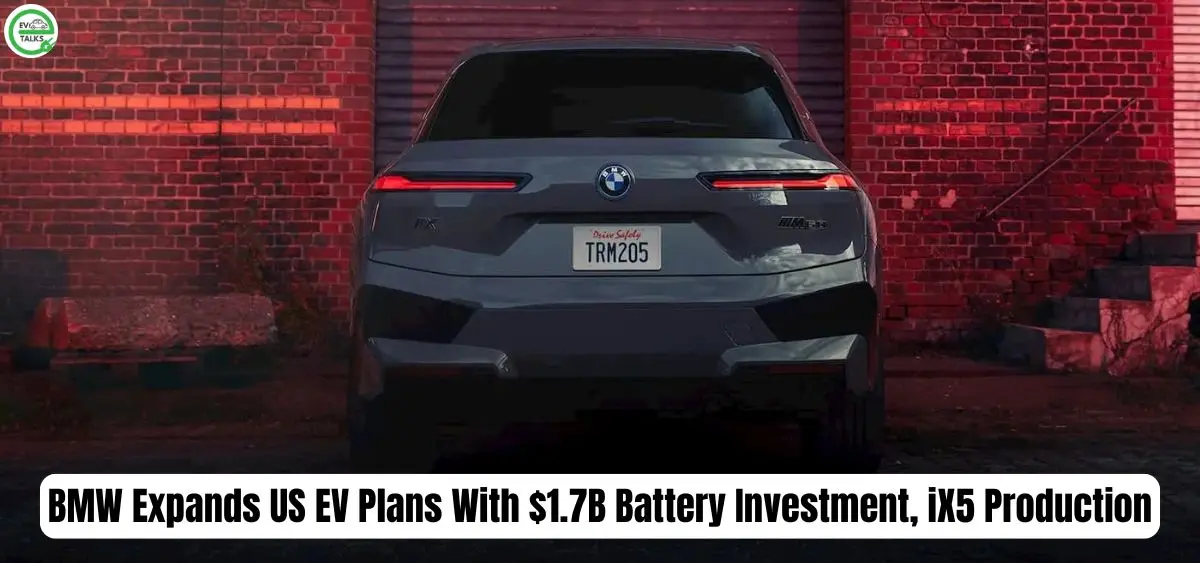
A major outcome of the investment is the launch of the all-electric BMW iX5, scheduled to enter production in late 2026.
The electric SUV is expected to have a starting price of just under $70,000 and deliver an estimated driving range of up to 525 miles on a single charge. The locally manufactured iX5 represents BMW’s first fully electric vehicle produced in the United States, highlighting how BMW Expands US EV Plans to meet growing demand while strengthening domestic manufacturing.
Flexible Manufacturing Strategy
BMW is introducing one of the automotive industry’s most flexible production systems at Plant Spartanburg.
The facility will become the first BMW plant globally capable of building the same vehicle model using five different drivetrain technologies on a single assembly line:
- Internal combustion engine (ICE)
- Battery-electric vehicle (BEV)
- Plug-in hybrid (PHEV)
- Diesel
- Hydrogen fuel cell
This flexible approach allows BMW to quickly adapt production based on customer demand and evolving market conditions.
More Electric BMW X Models Coming by 2030
BMW’s long-term strategy extends well beyond the iX5. The company plans to manufacture at least six fully electric BMW X models in the United States by 2030. Future additions are expected to include larger electric SUVs such as the BMW iX7 and BMW iX6, significantly expanding its premium EV lineup.
Market Challenges and Investor Concerns
Although BMW expands US EV Plans with a significant manufacturing investment, the company’s stock performance has remained under pressure.
BMW shares are currently trading around €58.2, reflecting a 21.05% decline over the past 30 days, a 39.58% year-to-date drop, and a 22.17% decline in total shareholder return over the past year. These figures suggest investor sentiment has weakened despite the company’s long-term EV strategy and expansion efforts.
At the same time, valuation metrics present a different picture. BMW trades at a price-to-earnings (P/E) ratio of 5.2x, well below the estimated fair value multiple of 9.6x, the automotive industry average of 14.9x, and the peer average of 36.3x. With €6.819 billion in net income, many analysts view the company as trading at a significant discount relative to its earnings potential, raising the question of whether the current valuation represents a long-term opportunity.
Strong Position Despite Changing EV Market
BMW’s latest investment comes at a time when several global automakers are slowing or revising their electric vehicle strategies due to softer EV demand and evolving government incentive policies.
However, BMW appears well-positioned to navigate these challenges. Plant Spartanburg produces around 400,000 vehicles annually, with approximately half exported to international markets. This global manufacturing footprint provides additional resilience against changing trade regulations and regional demand fluctuations.
By investing heavily in local production, advanced battery manufacturing, and flexible assembly technologies, BMW Expands US EV Plans while reinforcing its commitment to long-term electrification. The launch of the BMW iX5 and future electric BMW X models signals the company’s determination to remain a leading player in the premium electric vehicle market despite current market uncertainties.

Related Articles: