
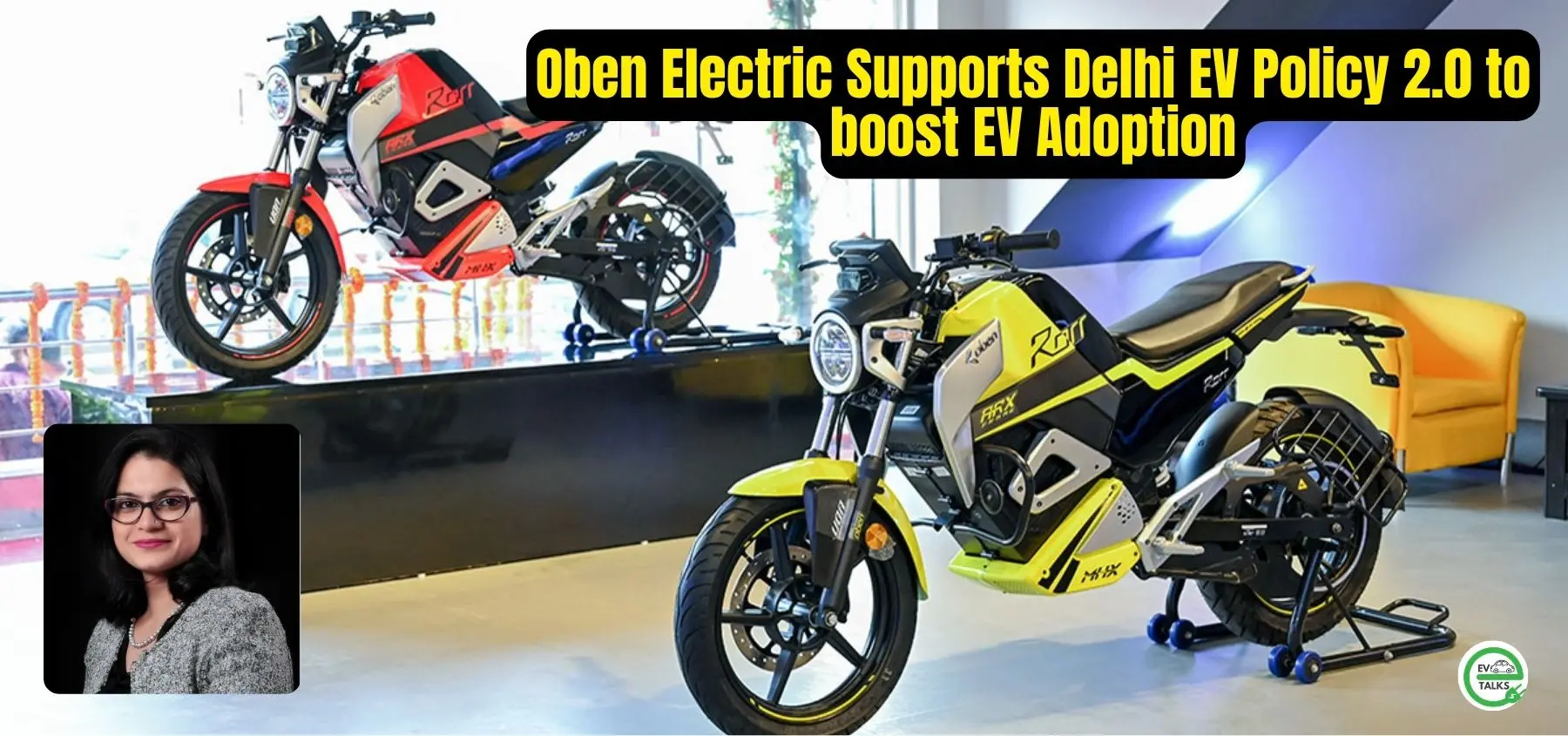

Delhi’s ambitious EV Policy 2.0, set to take effect from July 1, 2026, has received strong support from Indian electric motorcycle manufacturer Oben Electric. The company calls it a progressive and future-ready framework and believes the policy will accelerate electric vehicle adoption, strengthen the country’s EV ecosystem, and create a clear roadmap for India’s transition to sustainable mobility. Oben Electric supports Delhi EV Policy 2.0 because of its strong focus on electric two-wheelers, consumer incentives, charging infrastructure, and long-term industry growth.

Delhi EV Policy 2.0 Sets Bold Targets for Electric Mobility
The Delhi government’s updated EV policy aims to ensure that 95% of all new vehicle registrations are electric by 2027. To achieve this, the policy introduces a combination of strict regulations, attractive purchase incentives, and large-scale infrastructure expansion.
One of the biggest announcements is the complete phase-out of new petrol and CNG two-wheeler registrations from April 1, 2028, making electric two-wheelers the only eligible option for new registrations in the capital.
To encourage buyers, the policy offers direct purchase subsidies of ₹30,000 during the first year, reducing to ₹20,000 in the second year and ₹10,000 in the third year. Additionally, owners who scrap BS-IV or older four-wheelers while purchasing a new electric vehicle can receive a scrappage incentive of up to ₹1 lakh.
The policy also excludes tax concessions for strong hybrid vehicles, reinforcing Delhi’s commitment to pure battery-electric vehicles.
Oben Electric Welcomes the Policy Framework
Speaking on the announcement, Madhumita Agrawal, Founder and CEO of Oben Electric, described the revised policy as a major step toward accelerating EV adoption at scale.
According to her, the framework successfully combines a clear transition roadmap for the two-wheeler segment with consumer incentives, charging infrastructure expansion, and long-term ecosystem investments. These measures provide both consumers and manufacturers with the confidence needed to invest in electric mobility.
She also emphasized that manufacturers now have a greater responsibility to develop electric motorcycles capable of matching conventional petrol motorcycles in performance, safety, reliability, and overall ownership experience. Oben Electric supports Delhi EV Policy 2.0 because it encourages innovation while setting higher quality standards across the industry.
Strong Focus on Electric Two-Wheelers
Oben Electric believes the policy’s emphasis on electric motorcycles is particularly significant because two-wheelers remain India’s most widely used mode of personal transportation.
By accelerating the adoption of electric motorcycles, the company expects Delhi to reduce vehicle emissions, improve urban air quality, and make clean mobility more accessible to millions of daily commuters.
The company also noted that supportive government policies create a stable environment for continued investments in research, manufacturing, and advanced EV technologies.
Charging Infrastructure and Manufacturing Readiness
A key highlight of the Delhi EV Policy 2.0 is the planned expansion of public charging infrastructure. The government aims to install 32,000 public charging points across the city while making charging facilities mandatory at automobile dealerships.
Oben Electric believes this large-scale charging network will significantly reduce range anxiety and improve customer confidence in electric vehicles.
The company is also well-positioned to meet rising demand. Founded in 2020, Oben Electric manufactures performance electric motorcycles and key EV components in-house from its Bengaluru facility, which has an annual production capacity of 100,000 units. The company also holds more than 25 patents covering proprietary EV technologies.
Industry Sees Positive Momentum
The policy has also received support from other leading EV manufacturers, including executives from Ather Energy and Ultraviolette Automotive. Industry leaders believe the policy’s technology-focused approach rewards better performance, safety, range, and product quality rather than simply encouraging low-cost alternatives.
With stronger policy support, expanding charging infrastructure, and increasing domestic manufacturing, Oben Electric supports Delhi EV Policy 2.0 as an important milestone that can accelerate innovation, attract investments, strengthen India’s EV ecosystem, and position the country as a global leader in electric mobility.

Related Articles:









