
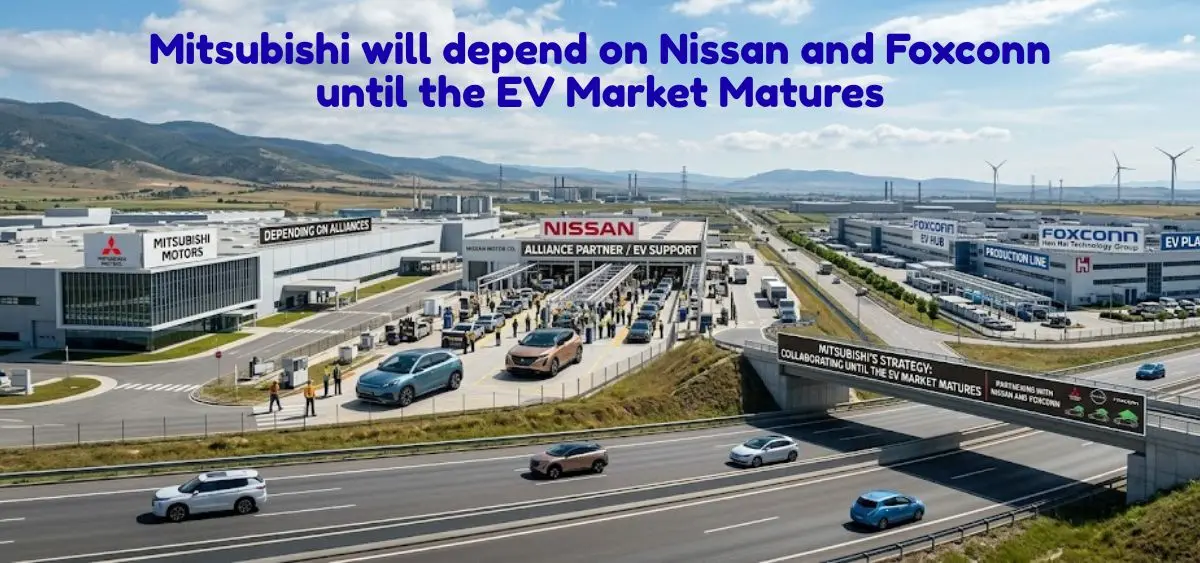

Mitsubishi will depend on Nissan and Foxconn as it pauses the independent development of its own battery electric vehicles (BEVs). The decision was announced by CEO Takao Kato during the company’s annual shareholders’ meeting on June 18, 2026. According to Kato, Mitsubishi is too small to bear the massive investment needed to develop dedicated EV platforms while global demand for electric vehicles remains uncertain.
This strategic shift allows the automaker to reduce financial risks while staying active in the EV market through trusted partners.

Why Mitsubishi Is Delaying In-House EV Development
The global EV market has slowed compared to earlier expectations. Several factors, including the end of key government incentives such as the U.S. federal EV tax credit, have affected EV demand in major markets.
In addition, automakers are facing rising research, development, and production costs. Some Japanese manufacturers have already reported multi-billion-dollar losses after delaying or canceling EV projects. To avoid similar financial pressure, Mitsubishi will depend on Nissan and Foxconn until the EV market becomes more stable and profitable.
Nissan and Foxconn Will Lead Mitsubishi’s EV Rollout
Instead of building its own EVs from scratch, Mitsubishi will introduce new electric models through strategic partnerships.
For North America, Nissan will supply a rebadged and redesigned version of the next-generation Nissan Leaf. The vehicle is expected to launch as the Eclipse Sportback EV in autumn 2026.
For Australia and New Zealand, Foxconn, through its Foxtron joint venture, will provide a flexible EV platform manufactured by Yulon Motor in Taiwan. This model is expected to arrive in late 2026.
Company Will Focus on Profitable Models
While expanding its EV lineup through partnerships, Mitsubishi will continue investing in its strongest product categories, including the Outlander PHEV, pickup trucks, and SUVs. These vehicles remain profitable and align with current consumer demand.
At the same time, Mitsubishi will depend on Nissan and Foxconn while continuing to build internal EV expertise. The company plans to strengthen its engineering capabilities so it can quickly resume developing proprietary electric vehicles once the global BEV market matures.
Outlook
For now, Mitsubishi will depend on Nissan and Foxconn as part of a practical, low-risk strategy that balances financial discipline with future growth. By leveraging partnerships today while preparing for tomorrow’s EV market, Mitsubishi aims to remain competitive without taking on the enormous costs of developing standalone electric vehicle platforms too early.

Related Articles:









