Your electric car may be saving you thousands on fuel, but it could also be losing value faster than you expect. In 2026, EV depreciation in India is being shaped by battery health, rapid technology upgrades, new-car price cuts, warranty coverage, and a still-developing used-EV market. The surprising part? Two identical electric cars of the same age can have dramatically different resale prices. So, what is your EV really worth, and can you protect it from steep depreciation? This guide reveals the real rates, tax rules, calculation methods, and expert strategies every Indian EV buyer and owner should know today.
EV Depreciation in India: Quick Answer
- EV depreciation is the difference between what an electric vehicle originally cost and what it is worth today.
- There is no universal market depreciation rate for every EV in India. Model demand, battery health, age, mileage, warranty, and new-EV price changes determine the actual resale value.
- For eligible business assets, electrically operated vehicles appear in the 40% written-down-value depreciation block under the Income-tax depreciation schedule. This does not apply to an EV bought exclusively for personal use.
- If an eligible asset is used for fewer than 180 days in its first financial year, the first-year tax deduction is normally restricted to 50% of the applicable amount.
- Insurance depreciation, tax depreciation, and real-world resale depreciation are three different calculations.
- An EV’s battery state of health, remaining battery warranty, and real-world range can matter more than its odometer reading.
- A certified battery report, complete service records, and a transferable warranty can materially improve buyer confidence.
- Avoid assuming that every EV automatically loses 20–30% in its first year. Such figures are market estimates, not statutory Indian rates.
What Is EV Depreciation in India?
EV depreciation in India is the reduction in an electric vehicle’s value as it ages. For owners, it is most visible when they sell or exchange the vehicle. For businesses, depreciation may also be an accounting and income-tax deduction. Insurers use another form of depreciation when determining the vehicle’s Insured Declared Value, or IDV, and settling claims.
These values are related, but they are not interchangeable.
| Type of depreciation | Primary purpose | Who determines it? | Does it equal the selling price? |
|---|---|---|---|
| Market depreciation | Estimates the vehicle’s resale value | Buyers, dealers, used-vehicle platforms, and market demand | Yes, approximately |
| Income-tax depreciation | Calculates an eligible business deduction | Income-tax law and asset classification | No |
| Accounting depreciation | Allocates asset cost over its useful life | Applicable accounting standards and company policy | No |
| Insurance depreciation | Helps calculate IDV and claim deductions | Policy terms and applicable insurance rules | No |
A private owner cannot claim a 40% income-tax deduction merely because the vehicle is electric. Conversely, a tax written-down value does not tell you what a dealer will pay for the EV.
That distinction is essential to understanding EV Depreciation in India in 2026.
Why EV Depreciation Matters More in 2026
India’s used-EV ecosystem is still younger than its petrol and diesel vehicle market. Buyers have decades of repair, pricing, and reliability data for combustion vehicles but comparatively limited evidence for older mass-market EVs.
At the same time, the market is changing rapidly. New electric cars and scooters are arriving with:
- Longer certified and real-world ranges
- Faster DC-charging capability
- Improved thermal management
- Longer or more comprehensive battery warranties
- Better software and connected features
- Lower prices in increasingly competitive segments
This innovation benefits new-EV buyers, but it can make an earlier model appear less capable. If a new version gains a larger battery or receives a significant price reduction, used examples may have to become cheaper to remain attractive. ACKO similarly identifies current new-vehicle pricing, range, charging capability, battery health, and warranty status as important resale considerations.
Government policy also affects the price benchmark. The supplied study, The Fiscal Impact of India’s EV Transition: Tax Revenue Losses Go Beyond Fuel, notes that EVs attract 5% GST and no compensation cess, compared with substantially higher indirect taxation on many ICE vehicles. These concessions lower the new-EV purchase-price anchor against which buyers judge used vehicles.
Do EVs Depreciate Faster Than Petrol or Diesel Cars?
Some EVs depreciate faster, but this is not a universal rule.
Early-generation EVs with limited range, slow charging, small batteries, or weak after-sales support are more exposed to rapid value loss. Premium models may also face sharp depreciation because their original prices are high and the pool of used buyers is comparatively small.
However, a popular mass-market EV with dependable service support, usable real-world range, and an active battery warranty may retain value better than an unpopular petrol or diesel model.
EV versus ICE depreciation factors
| Factor | Electric vehicle | Petrol or diesel vehicle |
|---|---|---|
| Major mechanical concern | Battery and power electronics | Engine, transmission, and emissions systems |
| Technology-obsolescence risk | Currently relatively high | Usually more gradual |
| Used-buyer diagnostic priority | Battery SoH, range, and charging | Engine, gearbox, clutch, and emissions |
| Effect of mileage | Important, but must be read with battery data | Strong indicator of mechanical wear |
| Warranty importance | Battery warranty can be decisive. | Powertrain warranty is valuable but less dominant. |
| Exposure to new-model price cuts | Often significant | Usually more established and predictable |
| Maintenance burden | Generally lower | More moving and serviceable components |
| Secondary-market maturity | Developing | Well established |
International averages frequently cited online—such as a 40–60% loss over five years—should not be presented as guaranteed Indian rates. They may be based on different incentives, leasing patterns, vehicle prices, and charging networks.
Indian values must be assessed model by model.
Why Do Some EVs Depreciate Faster?
1. Battery-condition uncertainty
The traction battery is the most valuable EV component and the hardest part for an ordinary buyer to assess. A used buyer wants to know:
- What is the battery’s current state of health?
- How much usable capacity remains?
- Does the car still deliver consistent range?
- Has it experienced overheating, flooding, or major repair?
- Is the battery warranty active and transferable?
Two identical three-year-old EVs can command different prices if one has a 92% state of health and the other has 78%.
2. Rapid improvement in range and charging
An older EV does not physically deteriorate when a better model launches, but its relative usefulness can decline. A new version with 450 km of range and rapid DC charging can weaken demand for an older version offering 250 km and slow charging.
This is technology depreciation rather than mechanical wear.
3. New-vehicle discounts and price cuts
Used buyers compare the asking price with what they can pay for a new vehicle today—not only with the first owner’s historic invoice.
A major manufacturer discount, tax benefit, corporate programme or variant-price reduction can therefore reset used prices almost immediately.
4. Limited demand for discontinued or uncommon models
A discontinued vehicle may be perfectly functional but harder to value. Uncertainty about spares, software support, trained technicians, and battery-pack availability can lead buyers and dealers to build a risk margin into their offers.
5. Weak charging usability
Used-EV demand is stronger when a model can be charged conveniently at home and has a common, practical public-charging interface. Slow charging, limited fast-charging capability, or poor route compatibility can reduce the addressable buyer pool.
6. Warranty restrictions
A long warranty adds value only if the second owner can use it. Buyers should check:
- Whether the battery warranty transfers
- The time and kilometre limits
- The minimum-capacity threshold, if specified
- Service and inspection requirements
- Commercial-use exclusions
- Conditions covering water ingress or physical damage
7. Accident, flood, and underbody damage
Battery packs are commonly mounted low in the vehicle. A major underbody impact or flood history may concern buyers even after repairs because battery enclosures, cooling circuits and high-voltage connectors require specialized inspection.
Why EV Batteries Matter So Much to Depreciation
Battery degradation is the gradual reduction in usable energy capacity. It does not mean the battery suddenly becomes unusable after its warranty ends.
Modern battery-management systems control temperature, charging power, and usable capacity to protect the pack. Battery life is influenced by chemistry, climate, time spent at very high or low charge, thermal management, driving demand, and charging behavior.
International energy guidance notes that modern EV batteries are designed for long service, with several manufacturers offering warranties around eight years or 100,000 miles. Battery-life modelling cited by the US Alternative Fuels Data Center suggests approximately 12–15 years in moderate climates and 8–12 years in harsher climates. Indian heat, parking conditions, and vehicle duty cycles make model-specific evidence particularly important.
Interpreting battery state of health
| Reported SoH | General interpretation | Recommended buyer action |
|---|---|---|
| 90% or above | Strong remaining capacity for an older EV | Confirm test method and real-world range. |
| 85–90% | Potentially normal, depending on age and use | Compare with an equivalent model. |
| 80–85% | Noticeable capacity loss | Price reduced range and warranty position |
| Below 80% | Requires closer examination | Obtain an OEM diagnosis and replacement-cost information. |
These are practical screening bands, not universal warranty standards. Manufacturers calculate SoH differently, so reports from two brands may not be directly comparable.
Frequent DC charging should not automatically disqualify a vehicle. The more important evidence is whether the battery repeatedly overheated, how well its cooling system performed, and what its present diagnostic report shows.
What Is the EV Depreciation Rate Under the Income-tax Rules?
The Income Tax Department’s depreciation table lists electrically operated vehicles—including battery-powered and fuel-cell vehicles—within the eligible plant-and-machinery schedule associated with a 40% written-down-value rate from AY 2018–19 onward. The official table is the appropriate starting point; eligibility still depends on ownership, business use, correct classification, and compliance with Section 32 and related rules.
Important conditions
- The vehicle must be owned wholly or partly by the taxpayer.
- It must be used for an eligible business or profession.
- Personal-use vehicles do not receive business depreciation.
- Mixed personal and business use requires reasonable allocation and evidence.
- The deduction is normally calculated on the relevant block’s written-down value.
- When an asset is put to use for fewer than 180 days, only half of the otherwise allowable first-year depreciation is generally available.
- Tax treatment should be confirmed with a chartered accountant, particularly for leased, hired, mixed-use, or commercial-fleet vehicles.
Some advisory websites state that every pure EV automatically receives 40% depreciation, but such shorthand omits critical conditions. One accounting source, for example, reports the 40% rate for FY2025–26; it should still be read alongside the official schedule and the taxpayer’s facts.
Business EV depreciation example
Assume an eligible electric car costs ₹15,00,000 and is used entirely for business for more than 180 days.
| Financial year | Opening WDV | Depreciation at 40% | Closing WDV |
|---|---|---|---|
| Year 1 | ₹15,00,000 | ₹6,00,000 | ₹9,00,000 |
| Year 2 | ₹9,00,000 | ₹3,60,000 | ₹5,40,000 |
| Year 3 | ₹5,40,000 | ₹2,16,000 | ₹3,24,000 |
If first put to use for fewer than 180 days, the Year 1 deduction would generally be restricted to 20% of the opening value, subject to the applicable law and circumstances.
This closing WDV is a tax figure. It does not mean the ₹15 lakh vehicle will sell for ₹3.24 lakh after three years.
What is the electric-scooter depreciation rate for income tax?
An electric scooter used as an eligible business asset may fall within the electrically operated vehicle category. However, the same ownership, use, and documentation conditions apply. A privately owned scooter used only for commuting does not qualify merely because it is electric.
Methods of Calculating EV Depreciation
1. Market-value method
This is the most useful formula for an owner:
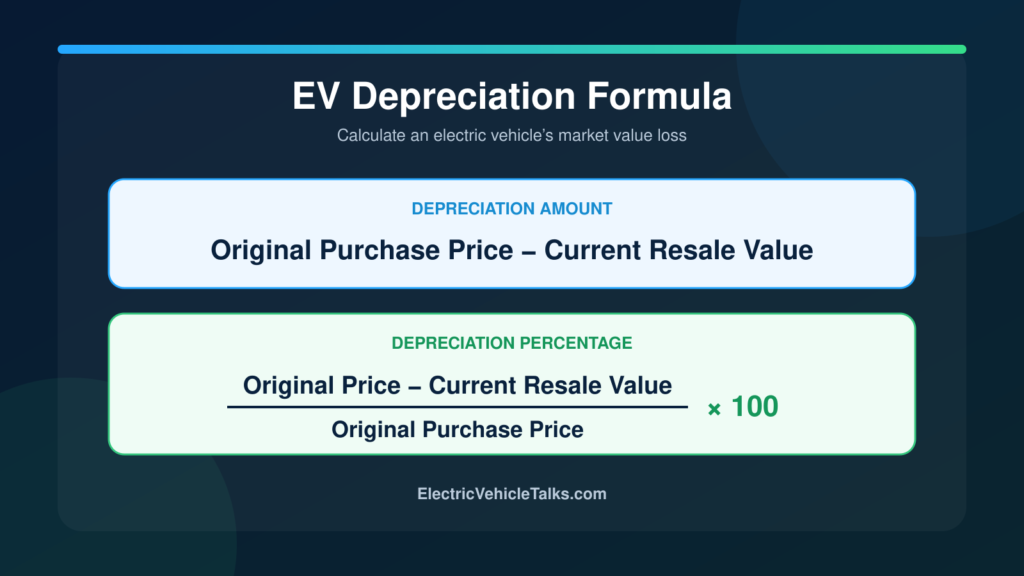
If an EV originally cost ₹20 lakh and is now worth ₹12 lakh:
- Depreciation amount: ₹8 lakh
- Depreciation percentage: 40%
- Value retained: 60%
ACKO uses a similar comparison to demonstrate how two same-age EVs can differ substantially because of mileage, SoH, and remaining warranty.
2. Written-down-value method
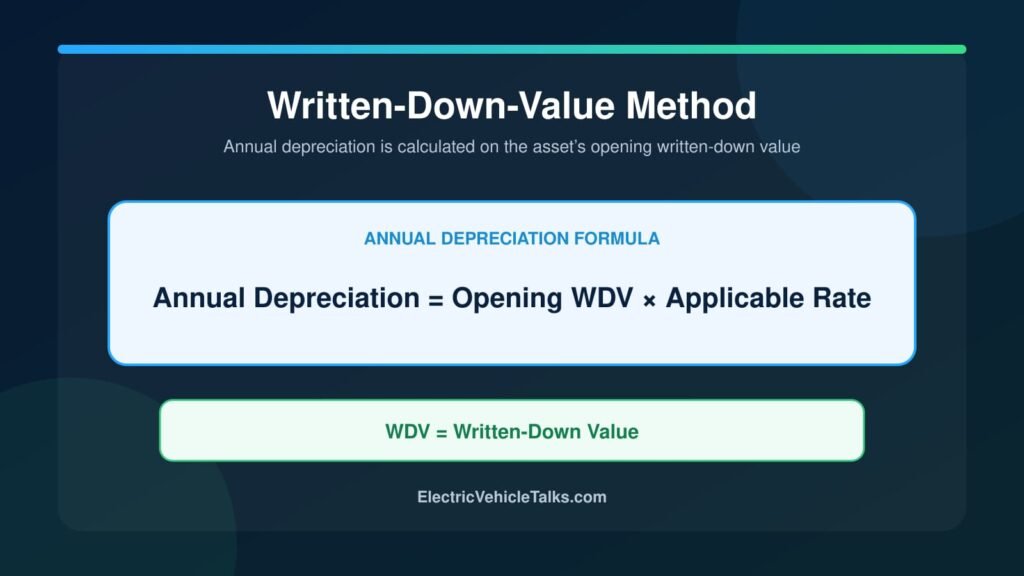
The deduction becomes smaller each year because it is applied to the reduced balance.
3. Straight-line method
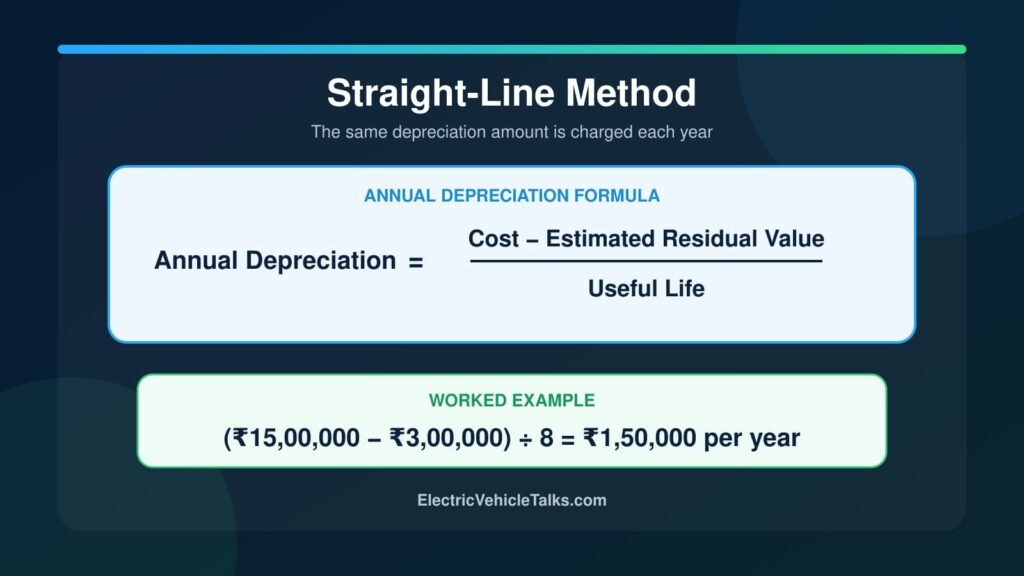
This may be useful for internal planning, but it does not predict the resale market.
4. Practical EV resale calculator
A meaningful EV depreciation calculator for 2026 should consider:
- Current new price of the same or nearest equivalent model
- Vehicle age
- Kilometres driven
- Battery SoH and real-world range
- Remaining vehicle and battery warranty
- Accident, flood, and repair history
- Charging hardware included
- Service and software records
- Local demand and charging accessibility
- Dealer margin and ownership-transfer costs
Avoid calculators that apply one generic percentage to every electric car or scooter.
Insurance Depreciation Is Not Market Depreciation
Motor insurers use IDV as the vehicle’s insured value for total-loss and theft claims. Standard age-based schedules can help set IDV, while depreciation on parts may affect repair settlements.
Zero-depreciation cover generally reduces eligible part-depreciation deductions in covered repairs. It does not:
- Freeze the EV’s market value
- Guarantee the original purchase price
- Eliminate battery ageing
- Prevent the insurer from applying policy exclusions
- Guarantee that a dealer will offer the IDV at resale
For older vehicles or unusual models, the insurer and policyholder may agree on an IDV based on valuation rather than relying only on a standard schedule.
Resale Value of EV Cars in India in 2026
There is no credible universal percentage that represents the resale value of all EV cars in India. A three-year-old mainstream EV may retain value well if demand is high and the warranty remains active. Another vehicle of the same age may suffer heavily after a new-model price cut or discontinuation.
Factors that usually support resale value
| Positive signal | Why buyers value it |
|---|---|
| OEM battery-health report | Reduces uncertainty about usable capacity |
| Transferable battery warranty | Limits the second owner’s risk |
| Established service network | Improves repair and parts confidence |
| Consistent real-world range | Demonstrates continued usability |
| Complete service history | Provides evidence of responsible ownership |
| Popular model and body style | Creates a larger pool of buyers |
| Fast-charging capability | Improves intercity usability |
| Original charger and accessories | Avoids additional setup expenditure |
| Clean accident and flood history | Reduces high-voltage-system concerns |
Battery condition should be considered alongside age and kilometres. Low mileage alone does not guarantee a strong resale price; even a lightly driven EV can be unattractive if it has spent extended periods fully charged in extreme heat, has unresolved battery warnings or lacks service records.
How to Enhance Your Electric Vehicle’s Resale Value
- Obtain evidence of battery health: Ask an authorized service centre whether it can provide a diagnostic report, usable-capacity result, or battery-health certificate. Keep dated copies.
- Follow sensible charging habits: Use the manufacturer’s recommended daily charging limit. Avoid leaving the battery at 100% for long periods unless the owner’s manual advises otherwise. Do not routinely run it to near-zero. DC fast charging is useful and designed into compatible EVs, but home or workplace AC charging is generally gentler and cheaper for everyday use.
- Preserve warranty eligibility: Complete required inspections and software campaigns on time. Save invoices even when the visit is free.
- Keep the original equipment: Retain portable chargers, charging cables, adapters, spare keys, manuals, and invoices. Missing equipment creates an immediate bargaining point for the buyer.
- Fix warning lights and software issues: Do not sell an EV with unresolved charging errors or battery alerts. Buyers may assume the worst when no diagnosis is available.
- Protect the battery enclosure: Have significant underbody impacts inspected. Avoid unqualified repairs to the high-voltage system, battery casing, or cooling circuit.
- Time the sale intelligently: Before listing, check the current ex-showroom price, discounts, and specifications of the equivalent new vehicle. Your original invoice is not the market’s current reference point.
Expert Insight from Electric Vehicle Talks
The Indian used-EV market’s biggest constraint is not necessarily battery failure—it is battery uncertainty.
Petrol-car buyers can obtain a compression test, mechanical inspection, and service-history review. Used-EV buyers need an equally understandable diagnostic system covering usable capacity, cell balance, thermal events, charging faults, and remaining warranty. Until OEM-backed battery-health certificates become widely available and comparable, buyers will continue discounting vehicles to compensate for uncertainty.
That also creates an opportunity. Owners who can demonstrate battery condition, warranty coverage, clean repairs, and reliable real-world range should increasingly separate their vehicles from poorly documented listings.
Over the next several years, residual values are likely to become more model-specific and less dependent on the simple label “EV.” Brand support, battery durability, charging speed, price stability, and access to replacement modules will distinguish strong used-EV performers from weak ones.
The strongest purchase strategy is therefore not simply to choose the longest range. Buyers should select a vehicle with sufficient real-world range, a credible warranty, established service support, stable pricing, and transparent battery diagnostics.
People Also Ask
What is EV depreciation in India?
It is the loss in an EV’s value caused by age, usage, battery condition, market demand, technology changes, and new-vehicle pricing. Tax and insurance depreciation are separate calculations.
What is the depreciation rate for electric cars?
There is no fixed Indian resale rate. For qualifying business assets, electrically operated vehicles may fall under the 40% WDV income-tax category, subject to eligibility and use conditions.
Do electric cars depreciate faster than petrol cars?
Some do, particularly older, premium, discontinued, or slow-charging models. Popular EVs with healthy batteries, transferable warranties, and dependable service support may perform much better.
How is EV depreciation calculated?
For market depreciation, subtract today’s resale value from the original price. Divide that loss by the original price and multiply by 100.
Does fast charging reduce EV resale value?
Occasional fast charging does not automatically damage resale value. Frequent high-power charging combined with heat, repeated overheating, or poor battery health may raise buyer concerns.
Does battery replacement reset depreciation?
A new OEM battery can improve confidence and usability, but it does not make the rest of the vehicle new. Age, condition, model demand, and warranty coverage still affect its price.
Is the 40% EV depreciation rate available to individuals?
Only where the EV qualifies as a depreciable business or professional asset, and the legal conditions are satisfied. A vehicle used exclusively for personal purposes does not qualify for business depreciation.
EV Depreciation in India FAQs
What is a good battery state of health for a used EV?
A result above 90% is reassuring, while 85–90% may still be healthy depending on the vehicle’s age and usage. Always confirm how the manufacturer calculated the result.
Does an eight-year battery warranty guarantee eight years of full range?
No. A warranty normally covers specified defects and may include a capacity threshold. It does not promise zero degradation or unchanged driving range.
Should I value a used EV against its original invoice?
Use the current price and specification of the nearest new alternative first. Large discounts or improved batteries can make the historic invoice irrelevant.
Does low mileage guarantee a higher EV resale price?
No. Battery age, temperature exposure, charging history, accident damage, warranty, and current market demand may outweigh a low odometer reading.
Can I claim depreciation on a personally owned electric scooter?
Not merely because it is electric. Income-tax depreciation normally requires that the scooter be an eligible asset used for business or professional purposes.
Is zero-depreciation insurance useful for an EV?
It can reduce eligible depreciation deductions on replaced parts during covered repairs. Check whether battery, motor, charger, and consumable exclusions apply.
How can a used-EV buyer avoid a bad purchase?
Obtain an OEM diagnostic report, test the vehicle at different charge levels, inspect the underbody, verify warranty transfer, examine service records, and compare real-world range with similar vehicles.
Final Verdict
EV Depreciation in India cannot be reduced to one percentage. The resale market, income-tax rules, and insurance policies measure different things, and confusing them can lead to poor buying, selling, or tax decisions.
For private owners, battery health, warranty, model demand, and current new-EV prices are the decisive variables. For businesses, the official depreciation schedule may provide a substantial deduction, but only when the vehicle and its use satisfy the applicable conditions.
As India’s used-EV ecosystem matures, transparent battery certification and stronger secondary-market support should reduce uncertainty. Until then, documentation is one of the best tools owners have for protecting value.
Explore more EV news, buying guides, charging resources, technology updates, and ownership advice at Electric Vehicle Talks.

Related Articles: