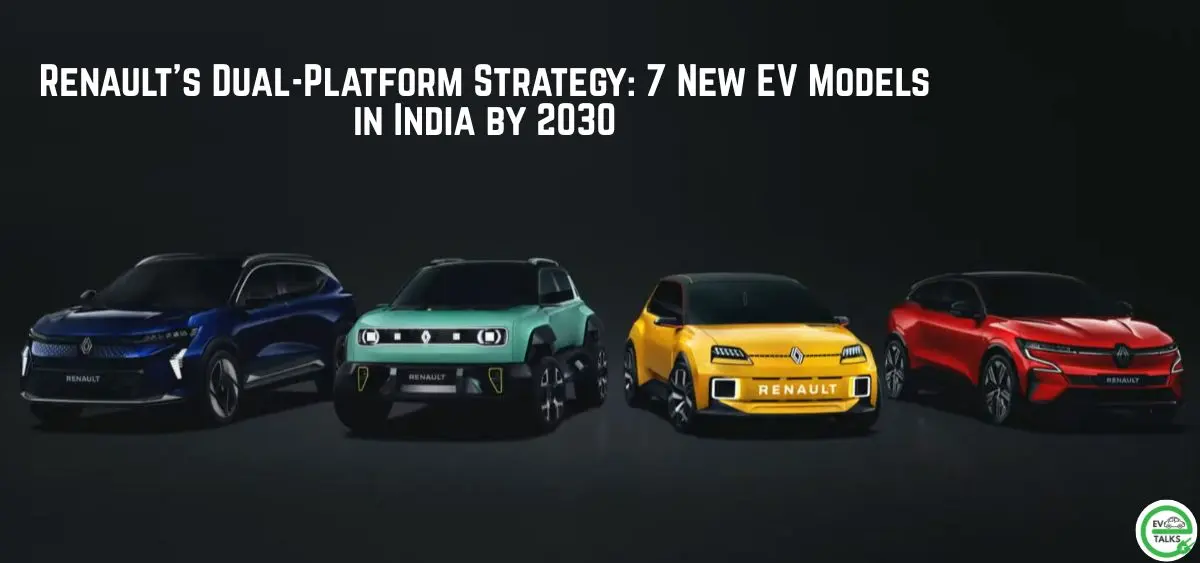

French automaker Renault has unveiled an ambitious roadmap for India under its “futuREady India” strategy, aiming to significantly expand its presence and capture a 5% market share by 2030. Central to this vision is Renault’s dual-platform strategy, which will support the launch of seven new models across internal combustion engine (ICE), hybrid, and electric vehicle (EV) segments.
Dual-Platform Approach to Drive Growth
At the core of this transformation is Renault’s dual-platform strategy, designed to balance affordability with advanced technology.
The first architecture, Renault Group Entry Platform (RGEP), is an evolution of the earlier CMF-A platform. It will cater to the highly competitive sub-₹10 lakh segment. This platform is engineered to meet evolving customer demands, including factory-fitted CNG options, updated powertrains, and next-generation digital and electronic systems. Upcoming upgraded versions of popular models like Renault Kiger and Renault Triber will be based on RGEP.

The second architecture, Renault Group Modular Platform (RGMP), is a more advanced and flexible platform aimed at vehicles longer than 4 metres. It supports a “multi-energy” approach, enabling ICE, hybrid, and fully electric powertrains, including advanced features like electric all-wheel-drive systems. This reinforces how Renault plans a dual-platform strategy to cater to both budget-conscious buyers and premium segments.
Expanding Product Portfolio
As part of its aggressive expansion, Renault will introduce seven models by 2030. The recently launched next-generation Renault Duster marks the beginning of this new phase.
The upcoming lineup is expected to include:
- A Duster-based 7-seater SUV (Bigster) by 2027
- A new sub-4-metre compact SUV, likely named “Bridger,” by late 2027
- The Bridger EV, anticipated in early 2028 as Renault’s first mass-market electric car in India
- Updated versions of Kiger and Triber on the RGEP platform
This diverse pipeline highlights how Renault plans a dual-platform strategy to strengthen its presence across multiple segments.
India as a Strategic Hub
Renault is also positioning India as a global manufacturing and engineering hub. Its Chennai facility will serve as a “center of Excellence,” supporting both domestic and international operations.
The company is targeting up to 90% localization to remain cost-competitive against rivals like Tata Motors and Mahindra & Mahindra. Additionally, Renault aims to achieve annual exports worth €2 billion (around ₹18,000 crore) by 2030.
The Chennai technical centre, with over 6,000 engineers, will play a crucial role in software development and global vehicle programs.
Future Outlook
With a clear focus on innovation, localisation, and electrification, Renault plans a dual-platform strategy to redefine its India journey. By combining affordability with advanced mobility solutions, the company is positioning itself as a strong contender in India’s rapidly evolving automotive landscape.

Related Articles: