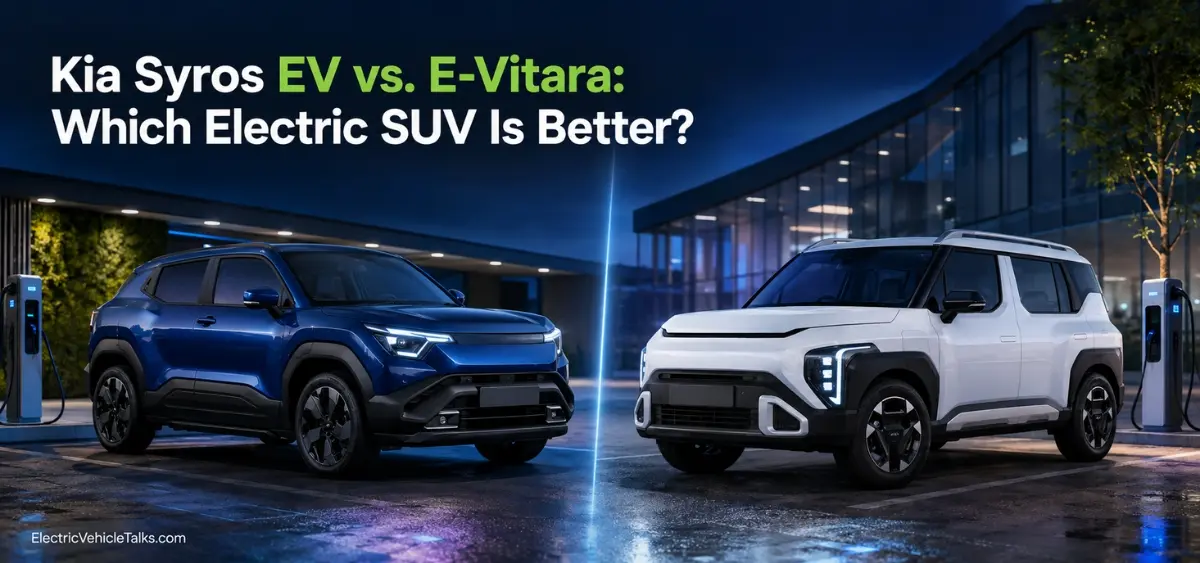

The Syros EV vs. E-Vitara battle is much closer—and more surprising—than their specifications initially suggest. At around ₹20 lakh, one delivers quicker acceleration, stronger torque, and faster charging, while the other counters with a larger battery, longer wheelbase, and Maruti Suzuki’s trusted service network.
The differences become even more interesting inside. The smaller electric SUV offers wider rear seating and several premium features, while the longer model promises stronger road presence and greater luggage practicality. Even their expected real-world ranges are closer than their battery capacities suggest.
So, which electric SUV actually offers better value to Indian families? We compared their prices, dimensions, space, performance, range, charging capabilities, features, and warranties. The final scorecard produced a winner that may genuinely surprise you.
Syros EV vs. E-Vitara: Quick Verdict
| Buyer priority | Better choice | Why? |
|---|---|---|
| City driving | Kia Syros EV | Shorter body, smaller turning circle and higher ground clearance |
| Highway touring | Maruti Suzuki e-Vitara | Bigger battery, higher top speed and longer wheelbase |
| Rear-seat comfort | Kia Syros EV | Wider measured rear seat, ventilation and boxy roofline |
| Luggage capacity | E-Vitara* | Longer boot floor in the supplied physical measurements |
| Premium features | Kia Syros EV | Triple-screen layout, i-Pedal, dashcam and rear ventilation |
| Fast charging | Kia Syros EV | Up to 100 kW DC and 11 kW AC support |
| Service accessibility | E-Vitara | Maruti Suzuki’s broad service presence |
| Performance | Kia Syros EV | More torque and quicker claimed acceleration |
| Battery warranty | Kia Syros EV | Up to 15 years/unlimited kilometres for the first owner, subject to conditions |
| Overall winner | Kia Syros EV | Better all-round technology and everyday usability |

Syros EV vs. E-Vitara Price Comparison
The supplied price comparison places the selected variants remarkably close:
| Electric SUV | Approximate comparison price |
|---|---|
| Kia Syros EV | ₹20 lakh |
| Maruti Suzuki e-Vitara | ₹20.21 lakh |
| Difference | ₹21,000 |
At this level, the ₹21,000 difference should not decide the purchase. Battery size, charger installation, insurance, warranty conditions, and the features available in the chosen variant matter far more.
Both manufacturers also offer Battery-as-a-Service arrangements on selected versions. Kia advertises a BaaS entry price from ₹7.99 lakh with battery payments beginning at ₹3.30 per kilometer, while Maruti introduced the eVitara BaaS plan from ₹10.99 lakh plus ₹3.99 per kilometer for the battery. These are finance products—not conventional full-vehicle prices—and conditions apply.
Syros EV vs. E-Vitara on-road price
The final on-road price will vary according to the following:
- Variant and battery pack
- State road-tax policy
- Insurance premium
- Extended warranty
- Home-charger equipment and installation
- Accessories and dealer packages
- BaaS or conventional financing
- Registration and local statutory charges
EV road-tax exemptions are state-specific and can change. Buyers should obtain written quotations showing the full vehicle price, battery ownership terms, insurance, charger installation, and any per-kilometer obligation.
Price winner: Tie
Syros EV vs. E-Vitara Dimensions
The E-Vitara is 280 mm longer and has a 150 mm longer wheelbase. The Syros EV is slightly wider, 30 mm taller, and offers 22 mm more ground clearance.
| Dimension | Kia Syros EV | E-Vitara | Advantage |
|---|---|---|---|
| Length | 3,995 mm | 4,275 mm | E-Vitara |
| Width | 1,805 mm | 1,800 mm | Syros EV |
| Height | 1,670 mm | 1,640 mm | Syros EV |
| Ground clearance | 207 mm | 185 mm | Syros EV |
| Wheelbase | 2,550 mm | 2,700 mm | E-Vitara |
| Turning radius | 5.1 metres | 5.2 metres | Syros EV |
| Wheels | 17-inch alloys | 18-inch alloys | E-Vitara for appearance |
| Rear-seat width | 1,320 mm | 1,270 mm | Syros EV |
| Rear seat-to-roof measurement | 914 mm | 914 mm | Tie |
Kia’s official specification page confirms the Syros EV’s 3,995 mm length, 1,805 mm width, 1,670 mm height and 2,550 mm wheelbase. Kia Syros EV specifications
What do these dimensions mean in real life?
The e-Vitara’s longer wheelbase should help it feel more settled at highway speeds and can improve longitudinal cabin space. Its longer body also creates stronger SUV presence.
The Syros EV fights back with a boxier design. In congested cities such as Bengaluru, Delhi, or Mumbai, its shorter footprint and 5.1-meter turning radius should make parking and U-turns easier.
Its 207 mm ground clearance is also useful on broken roads, tall speed breakers, and partially paved rural routes. Ground clearance under load can differ, so buyers should still inspect the lowest battery-protection point.
Dimensions winner: E-Vitara for size; Syros EV for urban usability
Which EV Offers More Cabin and Boot Space?
The supplied measurements reveal an interesting result. Despite being shorter, the Syros EV has a 50 mm wider rear seating area. Both vehicles record 914 mm from the rear seat to the roof.
That makes the Kia especially attractive to families carrying three passengers in the second row.
Boot measurements
| Measurement | Kia Syros EV | E-Vitara |
|---|---|---|
| Boot depth | 787/584 mm | 940 mm |
| Boot width | 1,066 mm | 990 mm |
| Boot height | 533 mm | 533 mm |
| Supplied usable/geometric volume | 310 litres | Approx. 500 litres |
| Frunk | 16 litres | Not available in supplied data |
The Kia’s two depth figures reflect its sliding rear seat. Pushing the seat forward increases luggage room; pulling it back improves passenger legroom.
Kia officially quotes 390 litres in a standard configuration and up to 465 litres with the second-row seat moved to its foremost position. This explains why a physical measurement may produce a smaller usable figure.
The e-Vitara’s stated 500 litres should not automatically be compared with Kia’s official VDA figure. Multiplying maximum length, width and height measures the outer cuboid, including space that may not be practically usable around wheel arches or beneath the parcel shelf.
Rear-seat winner: Kia Syros EV
Measured luggage-floor winner: E-Vitara
Battery, Range and Performance Comparison
| Specification | Kia Syros EV | E-Vitara |
|---|---|---|
| Battery | 51.4 kWh NMC | 61 kWh LFP |
| Motor output | 126 kW | 128 kW |
| Torque | 255 Nm | 193 Nm |
| 0–100 km/h | 8.1 seconds | 8.7 seconds |
| Top speed | 120 km/h | 160 km/h |
| Expected practical range | Around 400 km | Around 400 km |
| Manufacturer-certified range | Up to 526 km | Up to 543 km |
Kia officially claims up to 526 km of MIDC range and 171 PS, while Maruti advertises up to 543 km for the 61 kWh e-Vitara. Laboratory range is useful for comparison, but it should never be treated as a guaranteed road figure.
Which one feels quicker?
Although the outputs are nearly identical, the Syros EV produces 62 Nm more torque and reaches 100 km/h approximately 0.6 seconds sooner in the supplied dataset.
That stronger low-speed response should be noticeable while overtaking or joining fast-moving traffic. The e-Vitara’s higher 160 km/h top-speed figure matters less in India than sustained acceleration, thermal control, and efficiency at 80–110 km/h.
Can the Syros EV deliver more than 450 km?
It may be possible in favorable conditions, but it should not be promised without a controlled test. Speed, air-conditioning, passenger load, tyre pressure, elevation, and temperature can change real-world range considerably.
A reasonable ownership expectation for both vehicles is approximately 350–430 km, depending on the route and driving style. A dedicated back-to-back range test would establish which model is more efficient under identical conditions.
Performance winner: Kia Syros EV
Certified-range winner: E-Vitara
NMC vs LFP: Which Battery Is Better?
The Syros EV’s 51.4 kWh NMC battery prioritizes energy density. NMC technology can store more energy for a given weight and size, helping manufacturers create compact EVs without an excessively heavy pack.
The e-Vitara’s 61 kWh LFP battery prioritizes thermal stability, long cycle life, and frequent-use durability. LFP generally tolerates regular high-state-of-charge use better, although battery-management software and thermal conditioning remain equally important.
Neither chemistry is automatically superior:
- Choose NMC if compact packaging, lower weight, and energy density matter.
- Choose LFP if long-term cycling, thermal stability, and frequent charging to 100% matter more.
- Always follow the manufacturer’s recommended charging limit.
- Avoid leaving either battery at 100% for long periods in extreme heat.
- Confirm whether the warranty measures capacity degradation and what threshold applies.
Battery longevity advantage: E-Vitara
Battery packaging advantage: Kia Syros EV
Which EV Charges Faster?
| Charging support | Kia Syros EV | E-Vitara |
|---|---|---|
| Maximum DC charging | 100 kW | 70 kW |
| AC charging | 3, 7 and 11 kW | 3 and 7 kW |
| Kia 10–80% claim | About 39 minutes | — |
| Best home-charging advantage | 11 kW three-phase | 7 kW |
Kia has a clear hardware advantage. Its 100 kW DC capability can reduce waiting time during intercity travel, provided the charger is operating correctly and the battery is at the right temperature.
Kia claims approximately 39 minutes for a 10–80% charge using a 100 kW charger under test conditions. Actual speed tapers as the battery fills and can be affected by temperature and charger sharing. Kia charging disclaimer
The 11 kW AC option is valuable for owners with three-phase electricity. However, many Indian homes cannot support 11 kW without a sanctioned-load upgrade.
A charging application such as Pick My EV can help estimate charging duration for both models, but owners should verify connector compatibility, live charger status, and tariff through the relevant operator’s application.
Charging winner: Kia Syros EV
Estimated Home-Charging Cost
Assuming an electricity tariff of ₹8 per kWh and approximately 10% charging loss:
| Vehicle | Battery | Approximate energy drawn | Estimated 0–100% cost |
|---|---|---|---|
| Kia Syros EV | 51.4 kWh | 56.5 kWh | ₹452 |
| E-Vitara | 61 kWh | 67.1 kWh | ₹537 |
If either vehicle delivers 400 km, the theoretical home energy cost would be approximately:
- Syros EV: ₹1.13 per kilometre
- E-Vitara: ₹1.34 per kilometre
These figures exclude battery subscription payments, parking charges, public-charger premiums, and maintenance.
Features: Where the Kia Syros EV Pulls Ahead
The Syros EV’s feature list is one of its biggest strengths:
- Connected dual screens with better visual coverage
- Premium interior materials
- Automatic regenerative braking
- i-Pedal single-pedal driving
- Automatic flush door handles
- Puddle lamps
- Tall, boxy cabin for improved headroom
- Ventilated rear seats
- Nine exterior colour options
- Charging-speed display in the instrument console
- 11 kW AC and 100 kW DC charging
- 100-watt USB-C charging port
- Retractable cupholders and generous storage
- Smart dual-camera dashcam
- Battery-heating system
- Side/front parking sensors, depending on variant
- Rear sunshades
- Openable dual-pane panoramic sunroof
- Vehicle-to-load capability
Kia also offers its 30-inch “Trinity” panoramic display, connected services, and over-the-air software updates on applicable variants.
E-Vitara’s key advantages
- Ten-way powered driver adjustment
- Flexible 40:20:40 rear-seat split
- Ten-step rear-seat recline
- Greater length and visual presence
- Maruti Suzuki service confidence
- 18-inch alloy wheels
- Snow mode
- Standard seven airbags
- Level 2 ADAS
- Five-star Bharat NCAP rating
Maruti also says the e Vitara is supported by more than 1,500 EV-ready service centres. That network could be especially valuable for buyers outside major metropolitan areas.
Features winner: Kia Syros EV
Safety and service confidence: E-Vitara
Warranty and Long-Term Ownership
| Coverage | Kia Syros EV | E-Vitara |
|---|---|---|
| High-voltage battery | 15 years/unlimited km, conditional | 8 years/1.6 lakh km |
| Eligibility note | First owner; terms apply | Whichever occurs earlier |
| Motor/vehicle | 3 years/unlimited km in supplied data | 3 years/1 lakh km |
| Extended coverage | Confirm at dealership | Paid extension available |
Kia describes its battery cover as having a lifetime warranty of 15 years with unlimited kilometres for the first owner, subject to conditions. Buyers must read exclusions involving commercial use, accidental damage, unauthorized repair, and required service intervals. Kia Syros EV warranty statement
The eVitara receives an eight-year/160,000 km battery warranty. Its standard vehicle warranty is three years/100,000 km, with paid extension options. Maruti Suzuki warranty details
Warranty winner: Kia Syros EV, provided the owner qualifies for all conditions.
India’s EV Policy and Charging Context
Private electric cars should not be assumed to receive a central purchase subsidy under PM E-DRIVE. The scheme primarily supports electric two-wheelers, three-wheelers, buses, trucks, ambulances, and charging infrastructure.
Central policy still benefits electric cars through a 5% GST rate. State governments may separately offer road-tax or registration benefits.
India had 52,718 public charging stations by July 2026, including 16,561 fast-charging stations, according to government information. PM E-DRIVE has allocated ₹2,000 crore for public charging infrastructure, with approvals covering thousands of additional chargers.
Infrastructure is improving, but apartment residents and rural users should confirm reliable charging before purchasing either EV.
Common Mistakes Buyers Should Avoid
- Comparing only certified range instead of realistic highway range
- Treating BaaS price as the complete vehicle price
- Ignoring per-kilometre battery payments
- Installing a charger without checking sanctioned electrical load
- Comparing geometric boot volume with VDA-certified capacity
- Selecting large wheels without considering tyre cost and ride comfort
- Assuming every advertised feature is available on every variant
- Overlooking battery-warranty exclusions
- Depending on a single public charger during long journeys
- Buying without testing the rear seat with all regular passengers
Expert Insight from Electric Vehicle Talks
The Syros EV vs. E-Vitara contest illustrates where India’s electric-car market is heading. Buyers no longer accept range alone as the measure of a good EV. Charging speed, software, battery warranty, rear-seat comfort, and resale protection have become equally important.
Our recommendation is straightforward:
- Choose the Kia Syros EV if most journeys are urban, you value technology and rear-seat comfort, or you want faster AC and DC charging.
- Choose the e-Vitara if you regularly travel on highways, prefer a larger battery and longer wheelbase, or live where Maruti’s service accessibility provides greater confidence.
- If annual usage is low, calculate whether a BaaS plan actually saves money.
- If you live in an apartment, secure written charging permission before booking.
- Test both cars with your family, luggage, and usual driving route.
Final Scorecard: Who Is the Winner?
| Category | Syros EV | E-Vitara | Winner |
|---|---|---|---|
| Price and value | 1 | 1 | Tie |
| Exterior presence | 0 | 1 | E-Vitara |
| City-friendly dimensions | 1 | 0 | Syros EV |
| Rear-seat comfort | 1 | 0 | Syros EV |
| Luggage practicality | 0 | 1 | E-Vitara |
| Battery capacity/range | 0 | 1 | E-Vitara |
| Acceleration and torque | 1 | 0 | Syros EV |
| AC/DC charging | 1 | 0 | Syros EV |
| Features and technology | 1 | 0 | Syros EV |
| Safety/service reach | 0 | 1 | E-Vitara |
| Battery warranty | 1 | 0 | Syros EV |
| Highway ability | 0 | 1 | E-Vitara |
| Total | 7 | 5 | Kia Syros EV |
Overall winner: Kia Syros EV
The victory is not absolute. The Kia wins because it provides the more complete package for technology-focused Indian families. The eVitara remains an excellent alternative for buyers prioritizing highway composure, battery size, safety credentials, and service availability.
People Also Ask
Syros EV vs e-Vitara: Which is better?
The Kia Syros EV is better for city use, premium features, quicker acceleration, rear-seat comfort, and faster charging. The e-Vitara is better for highway travel, battery capacity, road presence, and Maruti’s service ecosystem.
Which has a longer range: Syros EV or e-Vitara?
The e-Vitara has the higher manufacturer-certified figure at up to 543 km, compared with up to 526 km for the Syros EV. Real-world range for both could be around 350–430 km depending on conditions.
Which electric SUV offers more rear-seat space?
The supplied physical measurement gives the Syros EV a 1,320 mm rear-seat width versus 1,270 mm in the e-Vitara. Both record 914 mm of rear headroom in the supplied data.
Which one charges faster?
The Syros EV wins with up to 100 kW DC and 11 kW AC charging support. The compared e-Vitara supports up to 70 kW DC and 7 kW AC.
Is the e-Vitara safer than the Syros EV?
The e Vitara has a five-star Bharat NCAP rating, seven standard airbags, and Level 2 ADAS. Buyers should compare the crash rating and safety equipment of the exact Syros EV variant before deciding.
Does the Syros EV have a better warranty?
Kia advertises a 15-year/unlimited-kilometer high-voltage battery warranty for the first owner, subject to conditions. Maruti provides eight years or 160,000 km of battery coverage.
Which EV is easier to drive in crowded cities?
The Syros EV is 280 mm shorter, has a slightly smaller turning radius, and offers 207 mm ground clearance. These characteristics make it easier to maneuver in congested urban areas.
Frequently Asked Questions
What is the approximate Syros EV vs. E-Vitara price difference?
In the supplied comparison, the Kia costs approximately ₹20 lakh and the e-Vitara ₹20.21 lakh—a difference of about ₹21,000. Actual variant and on-road prices may differ.
Does the Syros EV have a frunk?
Yes. The supplied data lists a 16-liter frunk, providing useful storage for charging cables and small items.
Can both EVs deliver 400 km in real-world conditions?
Approximately 400 km may be achievable with efficient driving and favorable weather. Sustained high speed, heavy air conditioner use, elevation, and payload can reduce range.
Which EV has better ground clearance?
The Syros EV has 207 mm of listed ground clearance, compared with 185 mm for the e-Vitara.
Which EV is better for long-distance travel?
The e-Vitara’s larger battery, longer wheelbase, and higher top speed make it the stronger highway-oriented option. The Kia’s faster DC charging can partially offset its smaller battery on routes with dependable 100 kW chargers.
The Syros EV feels more technology-focused through its connected displays, premium trim, ventilated rear seats, panoramic sunroof, smart dashcam, and extensive storage solutions.
Should I choose BaaS or purchase the battery?
BaaS can reduce the initial payment but creates a recurring per-kilometer cost. High-mileage buyers should compare total payments over five to eight years against conventional vehicle financing before choosing it.
Conclusion
The Maruti Suzuki e-Vitara vs Kia Syros EV comparison produces a deservedly close result. The e-Vitara delivers the more traditional SUV experience: a larger footprint, long wheelbase, substantial battery, and reassuring service ecosystem.
The Syros EV feels like the more imaginative electric product. It uses its compact dimensions intelligently, delivers stronger torque, provides faster charging, and surrounds passengers with technology that improves everyday ownership.
With a final score of 7–5, the Kia Syros EV is the overall winner. However, the right decision depends on where you drive, where you charge, and what your family genuinely needs—not merely which specification looks bigger.
For more independent EV comparisons, charging guides, ownership advice and sustainable-mobility analysis, explore Electric Vehicle Talks

Related Article:-