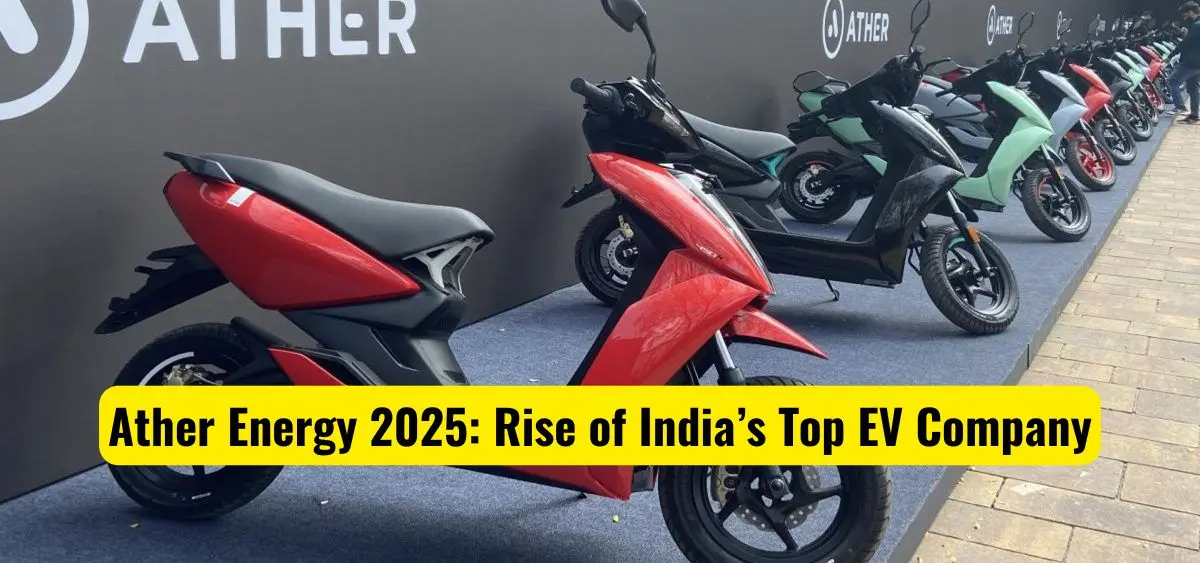

Ather Energy 2025: India’s electric vehicle (EV) industry is undergoing a massive transformation, and one of the brightest names leading this revolution is Ather Energy. Founded in 2013 by IIT Madras alumni Tarun Mehta and Swapnil Jain, the Bengaluru-based startup has grown from building prototypes in a research lab to becoming a publicly listed company with thousands of scooters on the road. By combining premium design, smart technology, and an expanding charging ecosystem, Ather has carved its place as one of India’s top EV companies.
From Vision to Reality
Ather’s journey began with a simple observation—India’s urban transport was dominated by poor-quality electric scooters that couldn’t compete with petrol-powered rivals. Determined to change this, the founders unveiled their prototype, the S340, in 2016. The real breakthrough came with the launch of the Ather 450 series, which redefined what an EV scooter could be—fast, connected, and reliable.
Over the years, Ather transitioned from niche premium scooters to mass-market adoption with the launch of the Ather Rizta in 2024. This family-oriented scooter, offering a 160 km range, affordable pricing, and spacious design, quickly became their bestseller, contributing to 60% of sales in FY25.
Scaling Up Manufacturing and Infrastructure
To meet rising demand, Ather set up a large-scale manufacturing facility in Hosur, Tamil Nadu, in 2021, capable of producing 110,000 scooters annually. Alongside this, Ather built its proprietary charging network, Ather Grid, now boasting over 3,500 fast-charging points across India. This infrastructure has played a critical role in reducing “range anxiety” for EV owners, giving Ather a unique competitive advantage.
IPO and Financial Growth
In 2024, Ather filed for an IPO worth ₹4,500 crore, and by May 2025, it was officially listed on NSE and BSE at a valuation of $2.5 billion. In FY25, the company’s total income grew 29% to ₹23,052 million, while margins improved significantly despite subsidy cuts. Early FY26 results also show momentum, with nearly 46,000 units sold in Q1 alone, proving that demand for EVs is accelerating.
Technology and Product Innovation
Ather’s strength lies in its technology-first approach. The AtherStack 7.0 software powers features like AI-based voice interactions, enhanced navigation, diagnostics, and OTA (over-the-air) updates. Their scooters, including the 450X, 450S, 450 Apex, and Rizta, are designed with smart connectivity and high performance in mind.
Additionally, the company has rolled out innovations like a 6 kW compact fast charger and the EL platform, which allows faster assembly and longer service intervals. Ather is also working on the Zenith platform, which will introduce electric motorcycles in the 125–300cc segment.
Challenges and Competition
Despite its progress, Ather operates in a highly competitive market. Ola Electric, TVS, and Bajaj Auto remain strong rivals with greater scale. Moreover, India’s price-sensitive customers and fluctuating government subsidies pose challenges to profitability.
The Road Ahead
Looking forward, Ather plans to expand its retail network to over 700 outlets by FY26, strengthen its northern and western India presence, and build a new manufacturing plant in Maharashtra with a 0.5 million-unit capacity. With strong brand loyalty, robust R&D, and a growing product line, Ather is well-positioned to capture 20% of India’s EV scooter market in the coming years.
Conclusion
Ather Energy’s rise is a remarkable story of Indian innovation and resilience. From a small startup to a listed EV powerhouse, the company has redefined urban mobility with technology-driven scooters and a supportive ecosystem. As EV adoption accelerates, Ather is not just keeping pace—it is charging ahead to shape the future of mobility in India and beyond. Ather Energy 2025
Related Articles:-