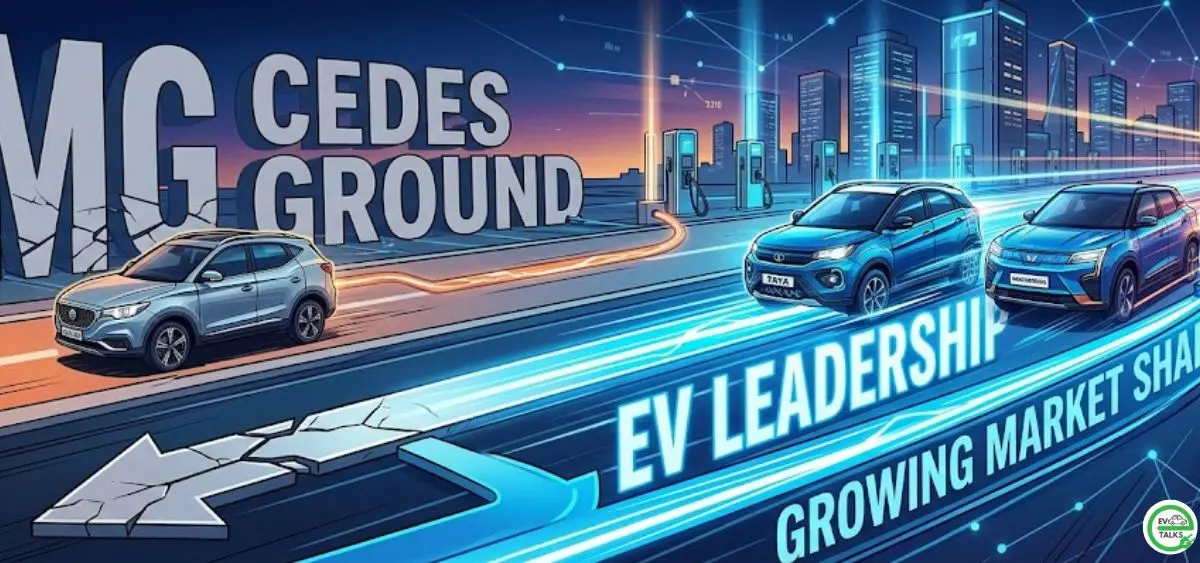

India’s electric passenger vehicle (PV) market is witnessing a major shift as established leaders face growing competition from rivals and new entrants. The latest vehicle registration data for May 2026 shows that MG cedes ground to Tata and Mahindra & Mahindra, despite recording higher sales volumes compared to last year.
The Indian EV market continues to expand at a remarkable pace, driven by rising consumer demand, wider model availability, and aggressive product launches. However, the rapid growth has intensified competition, making it increasingly difficult for early movers to maintain their market leadership.
Tata Motors Strengthens Leadership Position
Tata Motors retained its dominance in the electric passenger vehicle segment by increasing its market share to 38.9% in May 2026, up from 34.5% during the same month last year. The company registered 10,246 EVs, more than double the 5,073 units recorded a year earlier.
Industry experts attribute Tata’s success to its diversified EV lineup, which caters to multiple customer segments. Models such as the Tiago EV, Punch EV, Nexon EV, Curvv EV, and Harrier EV have helped the automaker maintain a strong presence across various price points.
Mahindra Emerges as the Second-Largest EV Player
Mahindra & Mahindra continued its strong momentum in the electric vehicle market. The company increased its market share to 23.3% in May 2026 from 21.4% a year ago, while registrations surged to 6,153 units from 3,148 units.
The growth has been largely fueled by the popularity of Mahindra’s next-generation electric SUVs, including the XEV 9e and BE 6. As a result, Mahindra overtook MG to become the second-largest electric passenger vehicle manufacturer in India during the month.
MG Faces Increasing Competitive Pressure
The latest data highlights how MG cedes ground to Tata and Mahindra in a rapidly evolving market. Although JSW MG Motor India increased its EV registrations to 4,950 units in May 2026 from 4,593 units a year earlier, its market share fell sharply to 18.8% from 31.2%.
The decline reflects the overall market’s exceptional growth. Electric passenger vehicle registrations rose 79% year-on-year to 26,373 units in May, compared to 14,699 units in the same period last year.
Analysts note that MG’s product portfolio remains relatively limited compared to its competitors. While the Windsor EV continues to generate strong sales, the company lacks a broader multi-segment lineup that could help it capture a wider customer base.
January–May 2026 Performance Highlights Market Shift
The trend becomes even clearer when examining cumulative registrations for the first five months of 2026. Tata Motors maintained its lead with a 38.3% market share, up from 34.5% a year earlier, supported by registrations of 44,579 units.
Mahindra’s market share climbed to 22% from 15.2%, with registrations jumping to 25,633 units. Meanwhile, MG cedes ground to Tata and Mahindra over the longer period as its market share declined to 21.9% from 32.8%, despite registrations increasing to 25,485 units from 22,158 units.
New Entrants Reshape India’s EV Landscape
Competition is intensifying not only among established manufacturers but also from new market entrants. Maruti Suzuki, which had almost no presence in the electric passenger vehicle segment a year ago, registered 1,580 units in May and secured a 6% market share.
Vietnamese automaker VinFast also made a strong debut with 1,230 registrations, capturing 4.7% of the market. Their arrival is adding further pressure on existing players and accelerating the evolution of India’s EV ecosystem.
Hyundai and BYD Lose Market Share
Other established automakers are also facing challenges. Hyundai’s EV registrations fell to 455 units from 719 units a year earlier, causing its market share to decline to 1.7% from 4.9%.
BYD recorded a modest increase in registrations to 684 units from 621 units. However, its market share slipped to 2.6% from 4.2% as overall industry growth outpaced the company’s expansion.
Outlook: A More Competitive EV Market Ahead
The latest market data confirms that MG cedes ground to Tata and Mahindra as India’s electric vehicle industry enters a new phase of competition. With manufacturers launching new models, expanding portfolios, and targeting multiple customer segments, market leadership is becoming increasingly difficult to defend.
As India’s EV market continues its rapid growth trajectory, success will depend on innovation, product diversity, pricing strategy, and the ability to respond quickly to evolving consumer preferences. The coming months are expected to witness even fiercer competition as both established players and new entrants battle for market share.

Related Articles: