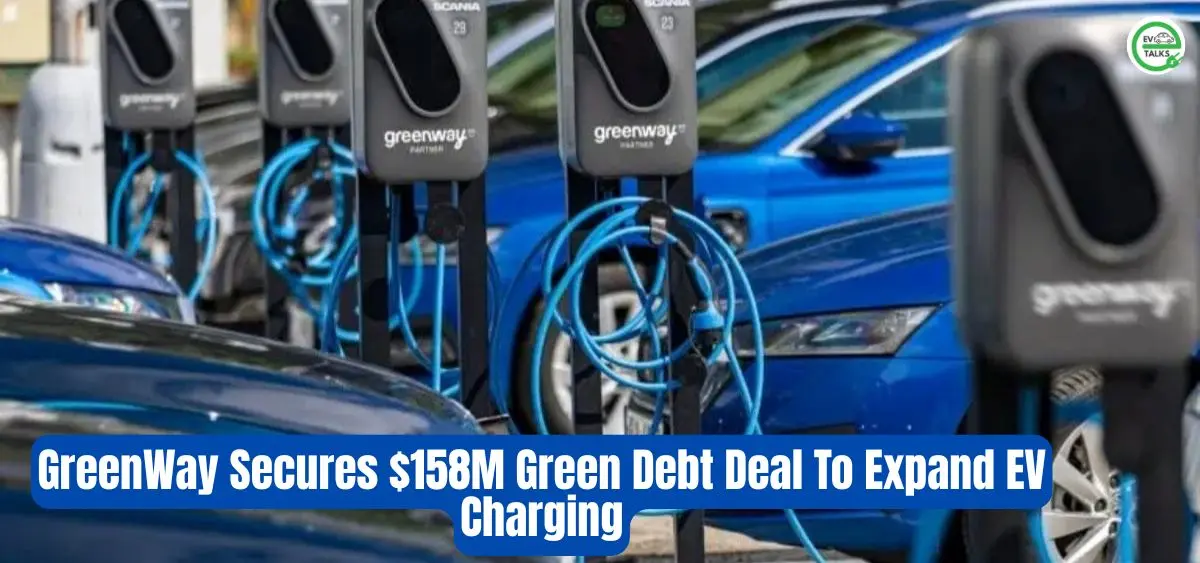

GreenWay Secures $158M Green Debt Deal in a landmark financing transaction that will significantly expand electric vehicle (EV) charging infrastructure across Central and Eastern Europe (CEE). The company has secured up to €138 million ($158 million) in green debt financing, marking one of the most important funding milestones for the region’s growing electromobility sector.
The financing package was arranged through a consortium of European lenders, including Crédit Mutuel Arkéa, the European Bank for Reconstruction and Development (EBRD), ING Bank Śląski, and mBank. The funding is supported by InvestEU, while mBank served as the agent, security agent, and green loan coordinator for the transaction.

Funding Package Designed for Growth
The new financing package includes a combination of refinancing, capital expenditure, and working capital facilities totaling €113 million. In addition, the agreement provides a €25 million uncommitted extension facility, offering GreenWay greater flexibility for future expansion projects.
According to the company, the transaction represents the first large-scale debt financing of its kind for a pure-play EV charging operator in Central and Eastern Europe. The funding will help GreenWay strengthen its market position in Poland while enhancing customer services and charging infrastructure in Slovakia, Croatia, and other regional markets.
Growing Investor Confidence in EV Charging Networks
The announcement that GreenWay Secures $158M Green Debt Deal reflects increasing confidence among investors and financial institutions in EV charging infrastructure as a long-term asset class. Charging network operators require substantial upfront investments to build extensive networks before achieving optimal utilization rates and profitability.
With this latest funding round, GreenWay has now secured up to €258 million for electromobility development across the CEE region. The company is backed by international infrastructure investors, including Generation Capital, Helios Energy Investments, and Mirova, alongside early-stage supporters Janom Investments and Neulogy Ventures.
Expanding One of the Region’s Largest Charging Networks
GreenWay currently operates more than 5,800 charging points across over 1,680 locations and claims to hold more than 90% market share among EV drivers in its core markets.
The company supports both public charging infrastructure and private charging solutions for businesses. Its customer portfolio includes major corporations such as InPost, Coca-Cola, IKEA, Holcim, and Westfield, helping accelerate fleet electrification across the region.
In 2025 alone, GreenWay added 361 high-power charging points across 62 new multi-charging hubs in Poland and Slovakia. The company is also investing in dedicated charging infrastructure for electric trucks, a critical step toward decarbonizing heavy-duty transport.
EV Growth and Energy Security Drive Demand
The fact that GreenWay Secures $158M Green Debt Deal comes at a time when Europe is rapidly increasing EV adoption while seeking to reduce dependence on imported fossil fuels. More than 90% of the oil consumed in Europe is imported, with nearly half used for road transportation.
European EV sales increased by 19% during January and February 2026. Poland’s battery electric vehicle fleet grew approximately 62% year-over-year to reach 147,000 vehicles, while Slovakia recorded a 68% increase, approaching 28,500 EVs.
A Milestone for Sustainable Transport Development
As GreenWay Secures $158M Green Debt Deal, the transaction highlights a broader shift in the EV industry from venture-capital-backed growth toward infrastructure-style financing. This evolution opens new opportunities for banks, institutional investors, and development finance organizations to support large-scale transportation decarbonization projects.
The deal further strengthens Central and Eastern Europe’s position within Europe’s clean mobility transition, demonstrating how private capital, climate goals, and energy security are becoming increasingly interconnected in the continent’s future transportation landscape.

Related Articles: