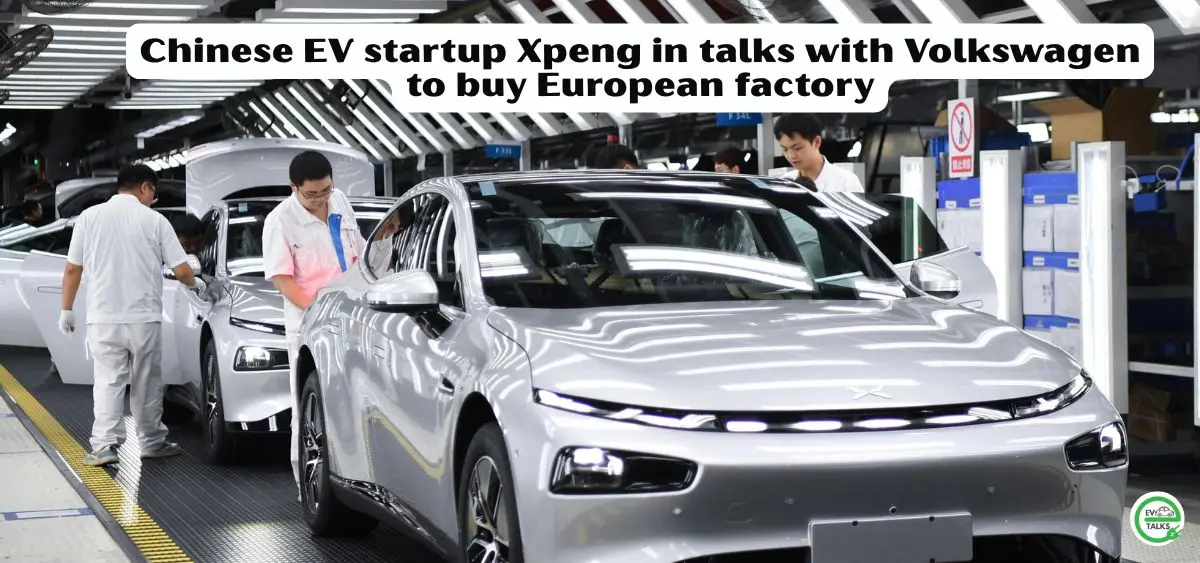

Chinese electric vehicle maker XPeng is reportedly exploring a major strategic move in Europe. According to recent developments, the EV startup Xpeng in talks with Volkswagen, is considering acquiring a manufacturing facility to strengthen its international presence and reduce reliance on exports from China.
Strategic Push into Europe
The EV startup Xpeng is in talks with Volkswagen, which comes at a time when the company is facing slowing growth in its domestic Chinese market. To offset this, XPeng is aggressively expanding overseas, with Europe emerging as a key focus region.

Elvis Cheng, XPeng’s managing director for northeastern Europe, revealed during a major automotive summit in London that discussions are ongoing to explore potential factory acquisition opportunities. The goal is to establish localized production, which would help the company scale its operations more efficiently across European markets.
Capacity Constraints and Export Growth
Currently, XPeng relies on contract manufacturing at the Magna Steyr plant in Graz, Austria, where models like the G6, G9, and P7+ are produced. However, rising demand and export volumes have pushed these facilities close to their limits.
By securing its own factory, XPeng aims to overcome these capacity constraints while ensuring better control over production. This is a crucial step as the EV startup Xpeng, in talks with Volkswagen, seeks to strengthen its footprint in Europe.
Avoiding Tariffs and Strengthening Independence
Another key driver behind the EV startup Xpeng being in talks with Volkswagen is the need to bypass high import tariffs imposed by the European Commission on Chinese-made EVs. Local production would allow XPeng to avoid these duties, making its vehicles more competitively priced.
Additionally, XPeng is looking to operate independently rather than entering traditional joint ventures, giving it greater control over manufacturing, branding, and distribution strategies in the region.
Volkswagen’s Strategic Position
Volkswagen Group already has an established relationship with XPeng, having invested $700 million for a 4.99% stake. The partnership focuses on co-developing vehicles for the Chinese market.
Meanwhile, Volkswagen is restructuring its European operations to cut excess capacity—estimated at around 750,000 vehicles by 2030. CEO Oliver Blume has indicated openness to sharing or selling underutilized facilities, creating a potential opportunity for XPeng.
Challenges and Uncertainties Ahead
Despite the promising outlook, several hurdles remain. XPeng has pointed out that many European factories, including those owned by Volkswagen, may be outdated and not fully compatible with the advanced manufacturing systems required for next-generation smart EVs.
Regulatory scrutiny is another major concern. European authorities are tightening foreign investment rules, especially in critical sectors like automotive manufacturing. Any deal between XPeng and Volkswagen would likely undergo thorough examination.
Alternative Plans in Motion
If negotiations do not result in a deal, XPeng is already exploring alternative options. These include identifying other available facilities across Europe or even building a brand-new factory from scratch.
As the EV startup Xpeng, in talks with Volkswagen, continues to evaluate its options, the outcome could significantly reshape its European strategy and influence the broader EV landscape in the region.

Related Articles: