
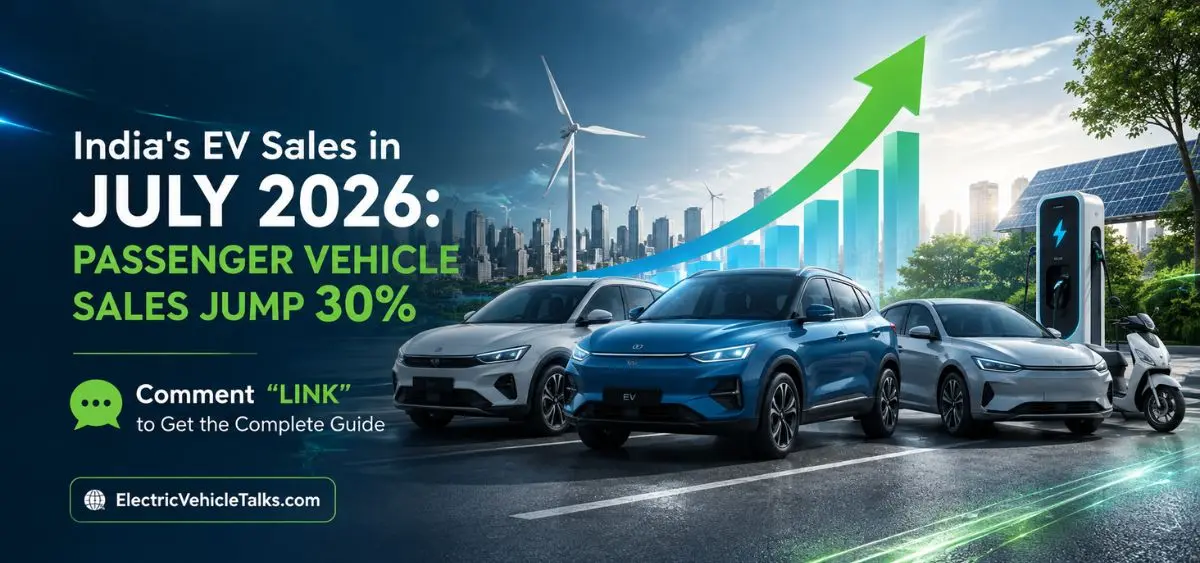

India’s EV sales in July 2026 are expected to reflect one of the strongest monthly performances for the country’s automotive industry. Preliminary estimates from leading market analysts indicate that passenger vehicle (PV) wholesale dispatches could rise by around 30% year-on-year (YoY), supported by robust consumer demand, expanding electric vehicle portfolios, and easing commodity costs. Despite higher vehicle prices and recent price revisions by some manufacturers, buyers continue to show strong interest in SUVs, compact vehicles, and electric mobility.

Electric Vehicles Drive Market Momentum
Electric mobility remains the biggest growth engine in India’s EV sales in July 2026. Electric two-wheelers are projected to record an impressive 82% YoY growth, while EV penetration in the two-wheeler segment is expected to cross 10.6%. Passenger EV penetration is also estimated to reach 7.8%, reflecting increasing acceptance among private buyers.
New launches, including the Tata Sierra EV, JSW MG Windsor, and Maruti Suzuki eVitara, are expanding consumer choices. Rising fuel prices and lower long-term ownership costs are also encouraging buyers to shift toward electric SUVs and hatchbacks.
Brand-Wise Sales Outlook
Among passenger vehicle manufacturers, Tata Motors is expected to post the strongest growth, with sales projected to jump 49% due to strong SUV demand and a favorable base effect. Maruti Suzuki could register 22% growth, while Mahindra & Mahindra is likely to grow 24%, supported by sustained SUV demand and plans to double EV production over the next five years. Hyundai is also expected to report an 11% increase.
In the two-wheeler market, TVS Motor is projected to maintain leadership with a 27.3% EV market share, while Bajaj Auto and Royal Enfield are expected to grow by around 32% and 36%, respectively. Hero MotoCorp is likely to report an 18% increase, whereas Ola Electric has slipped to the fifth position in the electric two-wheeler segment.
Commercial Vehicles and Growth Drivers
Beyond passenger vehicles, wholesale growth is estimated at 23% for two-wheelers, 29% for medium and heavy commercial vehicles (M&HCVs), and 20% for tractors. Analysts attribute this momentum to easing raw material costs, inventory replenishment, strong infrastructure activity, and supportive state policies, including Delhi’s EV Policy 2026. These factors continue to strengthen India’s EV sales in July 2026 and boost buyer confidence across urban and semi-urban markets.
Risks Remain Despite Positive Outlook
Although the outlook remains encouraging, analysts caution that below-normal monsoon rainfall, currently around 15% below average, could impact rural demand for tractors and entry-level vehicles later in the season. Public charging infrastructure also remains a challenge, with approximately one public charger available for every 135 electric vehicles.
Overall, India’s EV sales in July 2026 highlight a rapidly expanding automotive market, driven by electrification, strong consumer demand, and continuous product innovation, positioning the industry for sustained growth in the coming months.

Related Articles:









