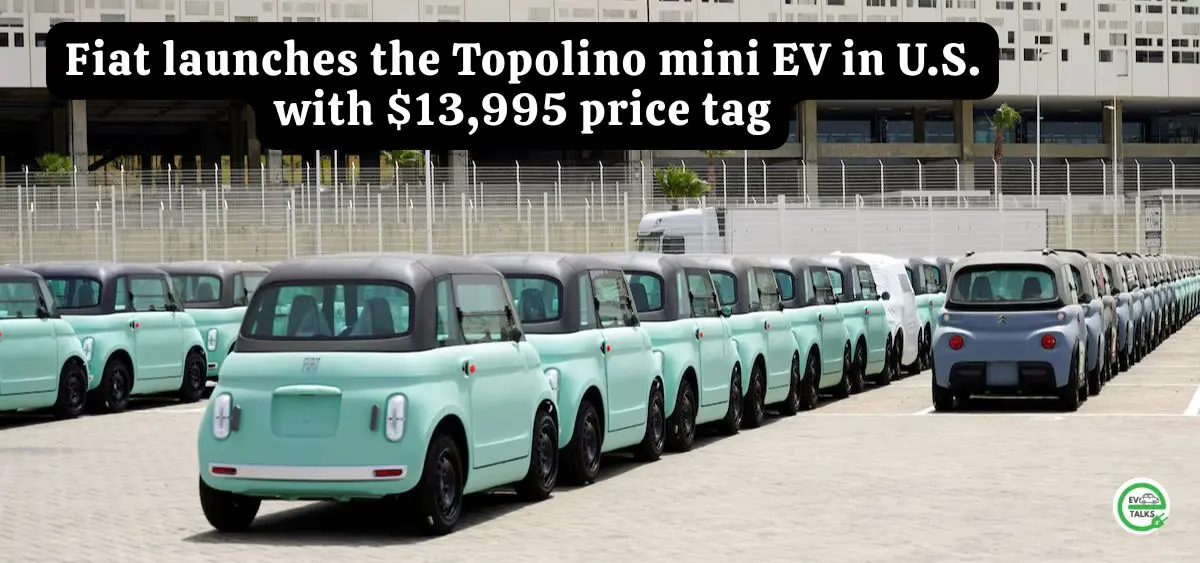

Fiat launches the Topolino mini EV in the United States, introducing a tiny two-seat electric vehicle designed for urban mobility, private communities, resorts, and recreational areas. Priced at $13,995, the ultra-compact EV combines Italian design heritage with modern electric technology while targeting customers looking for affordable and practical short-distance transportation.
Fiat Topolino EV Price and Key Specifications
The Fiat launches Topolino mini EV with an entry-level price of $13,995, making it one of the most affordable electric vehicles available in the U.S. market. The lightweight electric quadricycle is designed for efficient city and community travel rather than long-distance driving.
Key specifications of the Fiat Topolino include the following:
| Feature | Details |
|---|---|
| Starting Price | $13,995 |
| Vehicle Type | Two-seat compact electric vehicle |
| Driving Range | Up to 46 miles (74 km) |
| Battery Pack | 5.4 kWh lithium-ion battery |
| Charging Time | Around 5 hours |
| Weight | Just over 1,000 pounds |
| Length | Approximately 8 feet |
| Top Speed | 19 mph (standard version) |
The small footprint and low weight make the Topolino easy to maneuver in crowded areas, parking spaces, and private communities.

Designed for Private Communities and Short-Distance Mobility
Unlike traditional electric cars built for highways and long-distance travel, the Fiat Topolino is positioned as a neighborhood mobility solution. The vehicle will initially be available for use in private locations such as resorts, golf courses, residential communities, and similar environments.
The standard version comes with a limited top speed of 19 mph, allowing it to operate as a compact mobility vehicle rather than a conventional passenger car.
Fiat has also announced plans to offer an upgrade option that will expand the vehicle’s usability in the United States.
Upgrade Kit Will Enable Public Road Access
From late summer, Fiat Topolino owners will have the option to install a special upgrade kit that converts the vehicle into a federally regulated Low-Speed Vehicle (LSV).
After the upgrade, the EV will receive:
- Increased top speed of up to 25 mph
- Ability to operate on certain public roads
- Compliance with low-speed vehicle regulations
This upgrade could make the Topolino more practical for short urban trips, local commuting, and neighborhood transportation.
Italian Heritage Returns With Modern Electric Technology
Fiat launches the Topolino mini EV as a revival of one of the company’s most iconic names. The original Fiat Topolino was introduced in the 1930s and became one of Italy’s most recognizable small cars.
The name “Topolino,” which means “little mouse” in Italian, was inspired by the famous nickname associated with Walt Disney’s Mickey Mouse character. Fiat has brought back the historic badge to represent a new generation of compact electric mobility.
The modern Topolino shares its technical foundation with the Citroën Ami and follows Fiat’s strategy of focusing on small, efficient vehicles for changing urban transportation needs.
Expanding Fiat’s Electric Vehicle Lineup in North America
The arrival of the Topolino expands Fiat’s electric portfolio in North America beyond the Fiat 500e electric hatchback, offering customers a smaller and more affordable alternative.
According to Fiat CEO Olivier Francois, the company continues to differentiate itself by embracing its long-standing expertise in small cars while adapting to the growing demand for electric mobility solutions.
Fiat Topolino EV: A New Approach to Affordable Electric Mobility
The Fiat launches the Topolino mini EV at a time when consumers are increasingly searching for compact, efficient, and affordable electric transportation options. With its low operating costs, simple design, and city-friendly dimensions, the vehicle could appeal to customers seeking an alternative to traditional cars for short-distance journeys.
While the Topolino is not designed to replace full-size electric vehicles, it represents a growing trend toward micro EVs that focus on convenience, sustainability, and practical everyday mobility.

Related Articles: