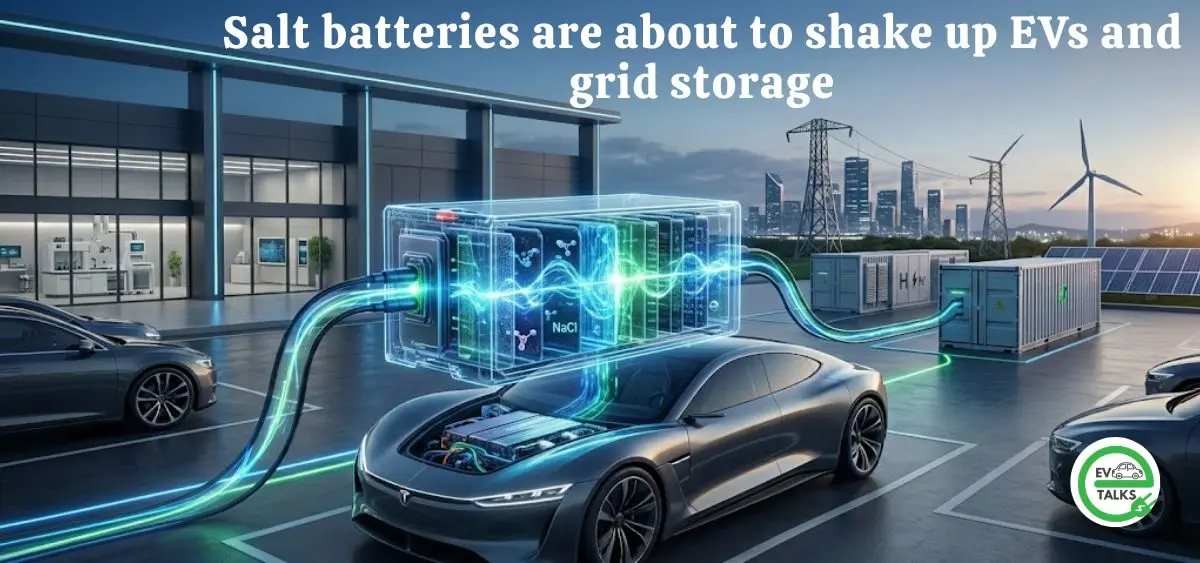

The global battery industry is entering a new era as Salt batteries move beyond research labs and enter large-scale commercial production. Sodium-ion battery technology is emerging as a serious challenger to lithium-ion batteries, which have dominated electric vehicles (EVs), electronics, and energy storage for decades.
While lithium batteries will continue to power premium electric cars requiring maximum range and compact designs, sodium-ion technology is rapidly becoming the preferred solution for affordable EVs, urban mobility, renewable energy storage, and extreme weather applications.
Sodium-Ion Batteries Challenge Lithium’s Long-Standing Dominance
Lithium-ion batteries have powered the EV revolution due to their high energy density and lightweight design. However, rising material costs, supply chain challenges, and safety concerns have pushed manufacturers to search for alternatives.
Salt batteries use sodium, an element that is significantly more abundant than lithium. Sodium can be extracted from common rock salt and seawater, making it cheaper, easier to source, and less vulnerable to geopolitical supply disruptions.
Sodium is around 1,000 times more abundant in the Earth’s crust compared to lithium, giving manufacturers a major advantage in creating affordable and sustainable energy storage solutions.
Affordable Electric Vehicles Could Get a Major Boost
One of the biggest advantages of sodium-ion technology is cost reduction. Sodium battery manufacturing reached cost parity with lithium iron phosphate (LFP) batteries in early 2026, and analysts expect sodium technology to become even cheaper by the end of 2027.
This cost advantage could significantly reduce the price of entry-level electric cars, electric two-wheelers, and commercial delivery vehicles. Automakers are increasingly exploring sodium-ion batteries to make EVs accessible to more consumers.
However, sodium batteries have one limitation — lower energy density. Modern sodium cells deliver around 175 Wh/kg, while advanced lithium batteries can exceed 250 Wh/kg. This means sodium-powered vehicles require larger and heavier battery packs to achieve similar driving ranges.
Because of this limitation, sodium technology is unlikely to replace lithium in luxury EVs and long-range electric vehicles.
Extreme Cold Weather Performance Gives Sodium an Edge
Cold temperatures have always been a major challenge for lithium-ion batteries. In freezing conditions, lithium electrolytes become less efficient, reducing charging speed and available battery capacity.
Sodium technology solves this problem with improved low-temperature performance. Companies such as CATL have developed sodium battery systems like Naxtra that can maintain nearly 90% capacity even at temperatures as low as -40°C.
This makes sodium-ion batteries particularly attractive for electric vehicles operating in colder regions where traditional lithium batteries experience performance losses.
Longer Battery Life Could Change EV Ownership
Battery durability is another area where sodium technology is making significant progress. Next-generation sodium battery packs are achieving more than 10,000 charge cycles before falling below 80% capacity.
For electric vehicles, this could translate into millions of kilometres of driving. In many cases, the battery pack may last longer than the vehicle itself, reducing replacement costs and improving long-term ownership value.
Grid Storage: Where Sodium Batteries Could Dominate
While battery weight is a major concern for vehicles, it is far less important for stationary energy storage systems. This makes grid storage one of the strongest opportunities for sodium technology.
Renewable energy sources such as solar and wind require large-scale storage systems to balance electricity supply and demand. Sodium batteries are ideal for these applications because they offer lower costs, improved safety, and long operational lifespans.
Unlike many lithium-based storage systems that require expensive cooling infrastructure, sodium batteries generate less heat and can operate without complex active cooling systems.
Safer Energy Storage With Lower Fire Risks
Safety is becoming a critical factor in battery deployment, especially for large energy storage projects.
Salt batteries have shown a significantly lower risk of thermal runaway compared with lithium-ion technology. Some demonstrations have shown sodium cells continuing to function even after severe physical damage without producing fire or smoke.
This improved safety profile can reduce maintenance expenses and make large-scale energy storage projects easier to deploy near communities and industrial areas.
Massive Commercial Expansion Begins
The sodium-ion battery market is rapidly scaling worldwide. Major manufacturers are investing heavily in production facilities and next-generation storage solutions.
CATL has introduced sodium-based energy storage platforms designed for utility applications. These systems offer long operational lifespans of 25 to 30 years and include advanced safety features that allow damaged cells to be isolated without shutting down the entire storage system.
China currently leads sodium battery development, with more than 42 active expansion projects. Meanwhile, global automakers and technology companies are supporting regional sodium battery manufacturing to reduce dependence on concentrated lithium supply chains.
Sodium Batteries Could Reshape Global Energy Supply Chains
The rise of sodium technology is not only a battery innovation story but also a shift in global resource strategy.
Lithium supply chains are concentrated in a few regions and affected by price volatility. Sodium provides a more stable alternative because it is widely available around the world.
Additionally, new sodium battery designs are reducing dependence on expensive and environmentally challenging materials such as cobalt and nickel. Many new designs use more affordable materials, including aluminum-based components.
Lithium vs Sodium Batteries: Key Differences
| Feature | Lithium-Ion Batteries | Sodium-Ion Batteries |
|---|---|---|
| Main Applications | Premium EVs, smartphones, long-range transport | Budget EVs, grid storage, extreme climates |
| Material Availability | Limited and affected by supply chains | Highly abundant from seawater and salt deposits |
| Energy Density | Higher than 250 Wh/kg in advanced cells | Moderate, around 175 Wh/kg |
| Safety | Higher thermal runaway risk | Around 60% lower thermal runaway risk |
| Cold Weather Performance | Reduced performance in freezing conditions | Maintains up to 90% capacity at -40°C |
| Cost Outlook | Higher costs linked to mineral prices | Expected cost advantage by 2027 |
The Future of Battery Technology Is Becoming More Diverse
The future energy market will likely not depend on a single battery chemistry. Lithium will remain important for applications where maximum range and compact size are priorities, but sodium technology is opening new opportunities in affordable transportation and renewable energy storage.
With lower costs, safer operation, longer lifespans, and abundant raw materials, Salt batteries are emerging as one of the most promising technologies capable of reshaping the future of EVs and global energy infrastructure. As production expands, sodium-ion batteries could become a key driver of a cleaner, more affordable, and more resilient energy ecosystem.

Related Articles: