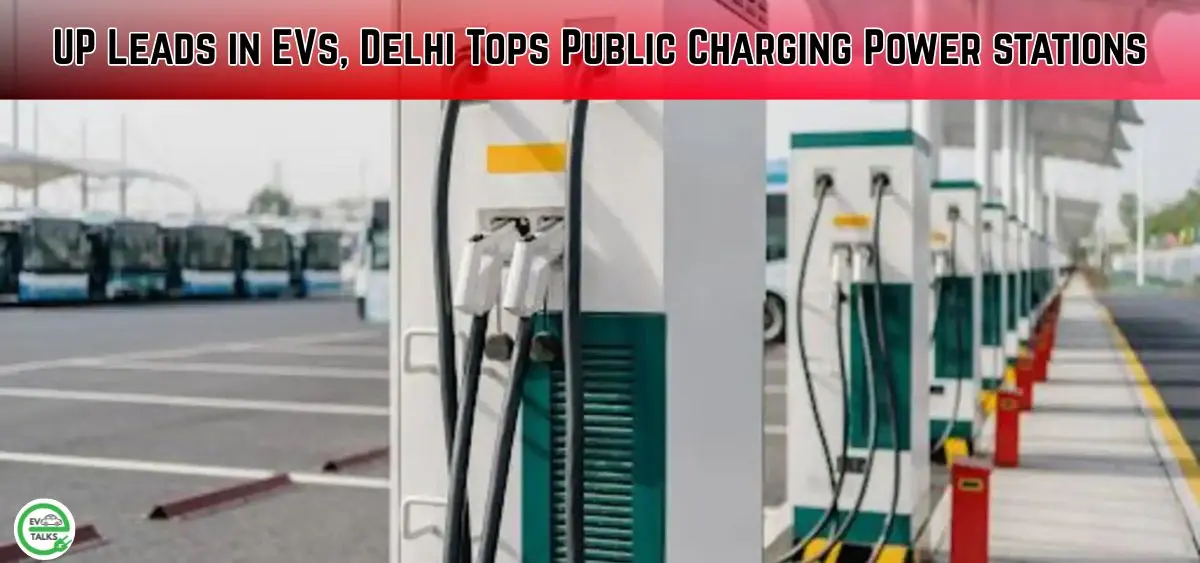

India’s electric mobility revolution is accelerating at an unprecedented pace. As per the transport ministry’s Vahan dashboard, nearly 80 lakh electric vehicles (pure EVs and battery-operated vehicles) are registered across the country. Of these, about 4.8 lakh—roughly 6 per cent—are registered in Delhi. Yet, an interesting paradox has emerged: while UP Leads in EVs by total registrations, Delhi dominates electricity consumption at public charging stations (PCS).
India’s Growing EV Market
In 2025 alone, total EV sales crossed 2.3 million units, accounting for nearly 8 per cent of all new vehicle registrations in India. This growth has been driven largely by strong demand in the two-wheeler, three-wheeler, and passenger vehicle segments. The surge aligns with the government’s push for cleaner mobility and its ambitious net-zero emissions target by 2070.

UP Leads in EVs by Volume
When it comes to sheer numbers, UP leads in EVs with approximately 15.2 lakh electric vehicles on the road. Maharashtra follows with 9.2 lakh EVs, while Karnataka has 7.2 lakh. Delhi, despite its aggressive EV policy, has a comparatively smaller base of 4.8 lakh EVs.
However, the story changes when we examine power consumption at public charging stations.
Delhi Tops Public Charging Power Consumption
Between April and November 2025, India’s public charging stations consumed 993 million units (MU) of electricity. Surprisingly, Delhi accounted for nearly 240 MU—about 24–25 per cent of the national total—making it the largest consumer of public charging power.
Other states trailed behind:
- Maharashtra: 227 MU (22.9%)
- Karnataka: 138 MU (13.9%)
- Uttar Pradesh: 131 MU (13.2%)
Despite the fact that UP Leads in EVs, its public charging consumption remains significantly lower than Delhi’s.
Understanding the Registration vs. Consumption Gap
The gap can be explained by vehicle type and usage patterns. In Uttar Pradesh, the EV base largely consists of two-wheelers and three-wheelers, many of which depend on home charging or informal “galli” charging setups that are not captured in public charging data.
Delhi, on the other hand, has a dense commercial fleet and is India’s EV bus leader, operating around 4,000 electric buses with a target of 7,500 by late 2026. These heavy-duty buses require substantially more electricity than small private vehicles, driving up PCS consumption.
Infrastructure and the Road Ahead
Delhi has built over 8,900 public charging points as of early 2026 and plans to add 7,000 more under EV Policy 2.0, aiming to exceed 16,000 points by year-end. This expansion is critical to tackling air pollution and meeting regulatory targets.
While UP leads in EVs by numbers, Delhi’s strategic focus on public transport electrification and charging infrastructure makes it the true powerhouse in public charging usage. Together, these trends reflect the evolving dynamics of India’s electric mobility ecosystem.
Related Articles:-