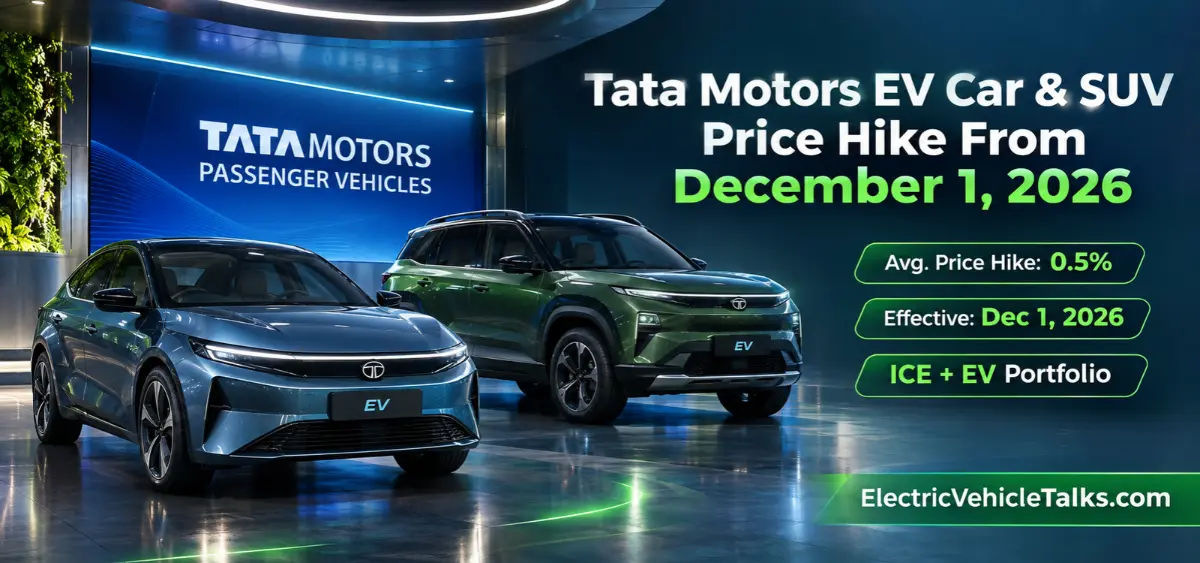

Electric car buyers planning to bring home a Tata EV may soon have to stretch their budgets. Tata Motors Passenger Vehicles Ltd. (TMPV) has officially announced an average price increase of 0.5% across its entire passenger vehicle portfolio, effective December 1, 2026. The latest Tata Motors EV Car & SUV Price Hike comes amid rising input costs and persistent manufacturing cost pressures.
Popular electric vehicles, including the Nexon EV, Punch EV, Tiago EV, Curvv EV, Sierra EV, and Harrier EV, will come under the revision. However, the actual price increase will vary depending on the model and variant selected by customers.
How Much Will Tata Electric Car Prices Increase?
Tata Motors Passenger Vehicles has announced an average price hike of 0.5% across its ICE and electric vehicle portfolio from December 1, 2026. Based on indicative ex-showroom prices, Tata electric cars and SUVs could become about ₹3,495 to ₹14,645 more if the average rate applies uniformly. However, the company has not announced model-wise or variant-wise revised prices.

Tata Motors Price Hike December 2026: Key Highlights
- Announcement date: November 24, 2026
- Effective date: December 1, 2026
- Average price increase: 0.5%
- Affected vehicles: All passenger car and SUV model ranges, including EVs
- Affected powertrains: Petrol, diesel, CNG, and electric
- Estimated EV price increase: ₹3,495 to ₹14,645
- Primary reason: Persistently elevated input costs
- Variant-wise revised prices: Yet to be announced
According to the official press release issued by Tata Motors Passenger Vehicles in Mumbai on November 24, 2026, the revision covers its entire passenger vehicle portfolio, with the extent of the increase varying across models and variants.
Why Is Tata Motors Increasing Electric Car and SUV Prices?
Tata Motors has attributed the upcoming price revision to persistently elevated input costs. The automaker has been absorbing a significant portion of these additional expenses to maintain competitive vehicle pricing. However, continued cost pressures have prompted the company to pass on part of the financial burden to customers.
Potential cost pressures affecting automobile manufacturers include:
- Rising raw material prices
- Increasing battery and electronic component costs
- Higher manufacturing expenses
- Supply chain and logistics costs
- Increasing vehicle technology and production expenses
The official announcement does not specify the individual contribution of these factors.
Instead of introducing a fixed price increase across every vehicle, Tata Motors has opted for a model-specific and variant-specific pricing strategy to maintain competitiveness across different market segments.
Tata Motors EV Car & SUV Price Hike: Which Models Will Be Affected?
The December 2026 price revision covers Tata Motors’ entire electric passenger vehicle portfolio, including affordable electric hatchbacks, compact electric SUVs, and premium electric SUVs.
| Electric Vehicle | Current Ex-Showroom Price | Estimated Price Hike |
|---|---|---|
| Tata Tiago EV | ₹6.99–10.09 lakh | ₹3,495–5,045 |
| Tata Punch EV | ₹9.79–12.99 lakh | ₹4,895–6,495 |
| Tata Nexon EV | ₹12.49–17.69 lakh | ₹6,245–8,845 |
| Tata Curvv EV | ₹17.19–19.39 lakh | ₹8,595–9,695 |
| Tata Sierra EV | ₹18.79–25.99 lakh | ₹9,395–12,995 |
| Tata Harrier EV | ₹21.79–29.29 lakh | ₹10,895–14,645 |
Note: These estimates are calculated by applying a uniform 0.5% increase to the supplied November 2026 ex-showroom prices. Actual revised prices may differ depending on the model, battery configuration, and variant. These are not officially announced prices.
How Much More Could Tata EV Buyers Pay?
Estimated maximum price increase by EV model
Based on a uniform 0.5% increase
Tiago EV → ₹5,045
Punch EV → ₹6,495
Nexon EV → ₹8,845
Curvv EV → ₹9,695
Sierra EV → ₹12,995
Harrier EV → ₹14,645
Indicative calculations, not official variant-wise price hikes.
Among Tata’s electric vehicles, the Tiago EV could witness the smallest increase in absolute terms, while premium electric SUVs such as the Sierra EV and Harrier EV could experience a comparatively higher increase under the same percentage-based calculation.
Tata Tiago EV and Punch EV
The Tiago EV and Punch EV remain attractive options for first-time electric vehicle buyers. Based on the average revision, their prices could increase by approximately ₹3,495 to ₹6,495.
Tata Nexon EV and Curvv EV
Customers planning to purchase a Nexon EV or Curvv EV could face an estimated additional expense of ₹6,245 to ₹9,695, depending on the selected variant.
Tata Sierra EV and Harrier EV
Buyers considering premium electric SUVs could see a higher increase in monetary terms. Depending on the selected Tata Sierra EV variants and Tata Harrier EV variants, these premium electric SUVs could become costlier by approximately ₹9,395 to ₹14,645 under the illustrative calculation.
Tata Petrol, Diesel and CNG Cars Will Also Become Costlier
The upcoming price revision is not limited to electric vehicles. Tata Motors has confirmed that its entire internal combustion engine portfolio will also be affected.
Here is the estimated impact on conventional Tata passenger vehicles.
| Model | Current Ex-Showroom Price | Estimated Price Hike |
|---|---|---|
| Tata Tiago | ₹4.76–8.62 lakh | ₹2,380–4,310 |
| Tata Punch | ₹5.75–10.77 lakh | ₹2,875–5,385 |
| Tata Altroz | ₹6.00–10.90 lakh | ₹3,000–5,450 |
| Tata Nexon | ₹7.40–14.22 lakh | ₹3,700–7,110 |
| Tata Curvv | ₹10.00–18.75 lakh | ₹5,000–9,375 |
| Tata Sierra | ₹11.49–21.29 lakh | ₹5,745–10,645 |
| Tata Harrier | ₹13.00–25.50 lakh | ₹6,500–12,750 |
| Tata Safari | ₹13.40–26.27 lakh | ₹6,700–13,135 |
These indicative figures suggest that the overall price increase could range from ₹2,380 for entry-level passenger cars to ₹14,645 for premium electric SUVs if the average revision is applied uniformly.
Will Every Tata Electric Vehicle Receive a 0.5% Price Hike?
No. Tata Motors has specifically clarified that 0.5% represents the average increase across its entire passenger vehicle portfolio.
The actual price revision may depend on several factors, including the vehicle model, selected variant, powertrain, battery pack configuration, and the company’s pricing strategy.
Some variants may receive a smaller increase, while others could experience a comparatively higher revision.
Customers should therefore wait for the official December 2026 price list before calculating their final purchase budget.
Automobile Price Hikes: Tata Motors Is Not Alone
Rising input costs continue to put pressure on the Indian automobile industry. According to the additional industry information supplied, Tata Motors’ December revision follows earlier price adjustments in July and September 2026.
Other automakers have reportedly introduced or announced similar pricing revisions.
| Automobile Manufacturer | Reported Price Increase | Effective Date |
|---|---|---|
| Maruti Suzuki | Average 0.31% | November 22, 2026 |
| Tata Motors | Average 0.5% | December 1, 2026 |
| Hyundai Motor India | Up to ₹8,000 on select variants | December 1, 2026 |
| Audi India | Up to 2% | January 1, 2027 |
These revisions reflect broader cost-related challenges across the automobile sector, rather than a pricing issue limited to electric vehicles.
The previous price hikes and competing manufacturers’ announcements are based on the supplied supplementary information and are not independently confirmed by Tata’s official press release.
How Will the Price Hike Affect Tata EV On-Road Prices?
Electric vehicle buyers should remember that the ex-showroom price is only one component of the final purchase cost.
An increase in the ex-showroom price may also affect other expenses, including:
- Motor insurance premiums
- Registration charges, where price-linked
- Applicable road taxes, depending on state EV policies
- Loan amounts and monthly EMI payments based on available EV car loan options.
Several Indian states offer road tax exemptions or concessions for electric vehicles. Consequently, the overall on-road price increase will vary depending on the registration location, insurance provider, and applicable incentives.
Should You Buy a Tata Electric Car Before December 1?
Budget-conscious buyers can also explore the Tata EV Battery-as-a-Service (BaaS) ownership model, which separates the battery cost from the upfront vehicle acquisition price.
However, simply booking an electric car before December 1 may not guarantee protection against the upcoming price hike.
Buyers should confirm the following with their authorized dealership:
- Current ex-showroom and on-road prices
- Price protection policies
- Vehicle stock availability
- Expected delivery and invoicing dates
- November discounts and exchange offers
- Applicable EV subsidies, government incentives, and financing benefits.
Completing the invoicing process by November 30, 2026, or securing written price protection from the dealership could help eligible customers avoid the upcoming revision.
About Tata Motors Passenger Vehicles Ltd.
Tata Motors Passenger Vehicles Ltd. (TMPV), formerly known as Tata Motors Limited, is part of the USD 180 billion Tata Group, according to the company’s November 24 press release.
The company offers a diverse portfolio of passenger cars and SUVs across multiple powertrain technologies, with a strong emphasis on safety, engineering, connected technologies and sustainable mobility.
Tata Motors has also played a significant role in accelerating electric vehicle adoption in India through its expanding portfolio of electric hatchbacks and SUVs.
The company’s name officially changed from Tata Motors Limited to Tata Motors Passenger Vehicles Limited on October 13, 2025, following a Composite Scheme of Arrangement sanctioned by the National Company Law Tribunal, Mumbai Bench.
Company stock exchange details:
| Exchange | Scrip Code |
|---|---|
| BSE | 500570 |
| NSE | TMPV |
Conclusion
The upcoming Tata Motors EV Car & SUV Price Hike marks another pricing adjustment in India’s evolving automobile market. While the average increase of 0.5% appears relatively modest, it could translate into several thousand rupees in additional purchase costs, particularly for premium electric SUVs.
Tata Motors maintains that the revision is necessary to partially offset rising input costs while continuing to offer competitive value to customers.
For prospective electric vehicle buyers, completing a planned purchase before December 1, 2026, could offer potential savings. However, the final impact will become clear once Tata Motors releases its updated model-wise and variant-wise price lists.
FAQs about Tata Motors EV Car & SUV Price
1. When will Tata Motors increase electric car prices in India?
Tata Motors will implement its revised passenger vehicle prices from December 1, 2026.
2. How much will Tata EV prices increase in December 2026?
Tata Motors has announced an average price increase of 0.5% across its ICE and EV portfolio. Individual model and variant increases may differ.
3. Will the Tata Nexon EV price increase in December 2026?
Yes, the Nexon EV falls under the announced portfolio-wide price revision. Based on a uniform 0.5% calculation, its price could increase by ₹6,245 to ₹8,845.
4. Why is Tata Motors increasing electric vehicle prices?
The company is revising prices to partially compensate for persistently elevated input costs while continuing to absorb a significant portion of the additional expenses.
5. Will booking a Tata EV before December 1 prevent the price hike?
Not necessarily. Price protection depends on the dealership’s terms, invoicing date, and applicable purchase conditions.
6. Is the price hike applicable to the Tata Harrier EV and Sierra EV?
Yes, both electric SUVs fall within the scope of the announced passenger vehicle portfolio revision. Their exact revised prices have not yet been announced.

Related Articles: