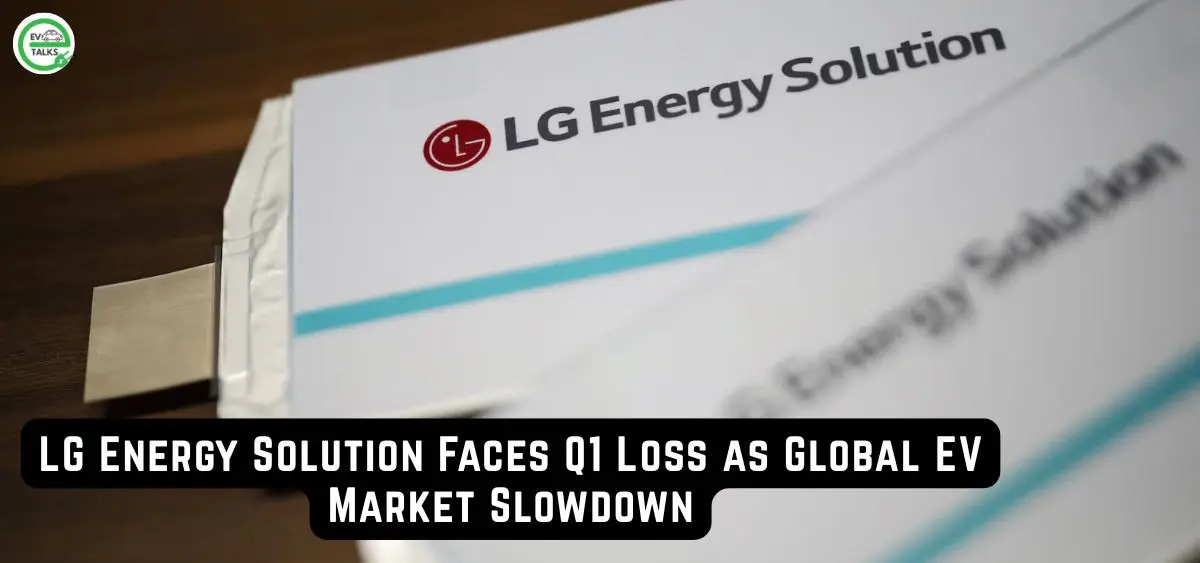

LG Energy Solution Faces Q1 Loss as the company reported a sharp downturn in its first-quarter 2026 financial performance, driven largely by weakening electric vehicle (EV) demand in North America and rising investment costs.
Q1 Financial Performance Highlights
In the January–March quarter, the company posted revenue of KRW 6.55 trillion, marking a 2.5% year-on-year decline. More notably, it swung to an operating loss of KRW 207.8 billion, a significant reversal from the KRW 375 billion profit recorded in the same period last year. The operating margin also dropped from a positive 5.6% to a negative 3.2%.
Net losses widened dramatically to KRW 944 billion, compared to a net profit of KRW 227 billion a year ago, highlighting mounting pressure on profitability. Although tax credits worth KRW 189.8 billion under the U.S. Inflation Reduction Act helped cushion the blow, the core operating loss would have been even steeper without these incentives.

Key Reasons Behind the Decline
The primary reason LG Energy Solution faces a Q1 Loss is the slowdown in EV demand, particularly in North America. Major clients like General Motors and Tesla have experienced sluggish sales, with some production adjustments, including temporary plant shutdowns.
Additionally, shipments of pouch-type batteries declined due to inventory corrections by customers, further impacting revenue. Lower production incentives in North America—falling from KRW 458 billion last year to KRW 190 billion this year—also contributed to the earnings drop.
Growth in ESS and Battery Segments
Despite the weak EV market, the company recorded growth in shipments of cylindrical batteries and Energy Storage Systems (ESS). ESS has emerged as a key growth driver, now contributing over 20% of total revenue.
As LG Energy Solution faces a Q1 Loss, it is increasingly pivoting towards ESS, aiming to triple its revenue from this segment in 2026. Rising demand from AI-driven data centers is expected to fuel this growth trajectory.
Strategic Investments and Future Outlook
The company continues to invest heavily in capacity expansion, with capital expenditure remaining high due to new production lines and ESS-focused facilities. It has also secured over 100 GWh of new orders for its advanced 46-series cylindrical batteries, bringing its total backlog to over 440 GWh.
While LG Energy Solution faces a Q1 Loss in the short term, analysts believe this may represent a cyclical bottom. A recovery is anticipated in the second half of 2026 as ESS operations stabilize and EV demand gradually improves.
Overall, LG Energy Solution’s Q1 Loss reflects broader challenges in the global EV market, but its strategic pivot and strong order pipeline indicate potential for a rebound ahead.

Related Articles: