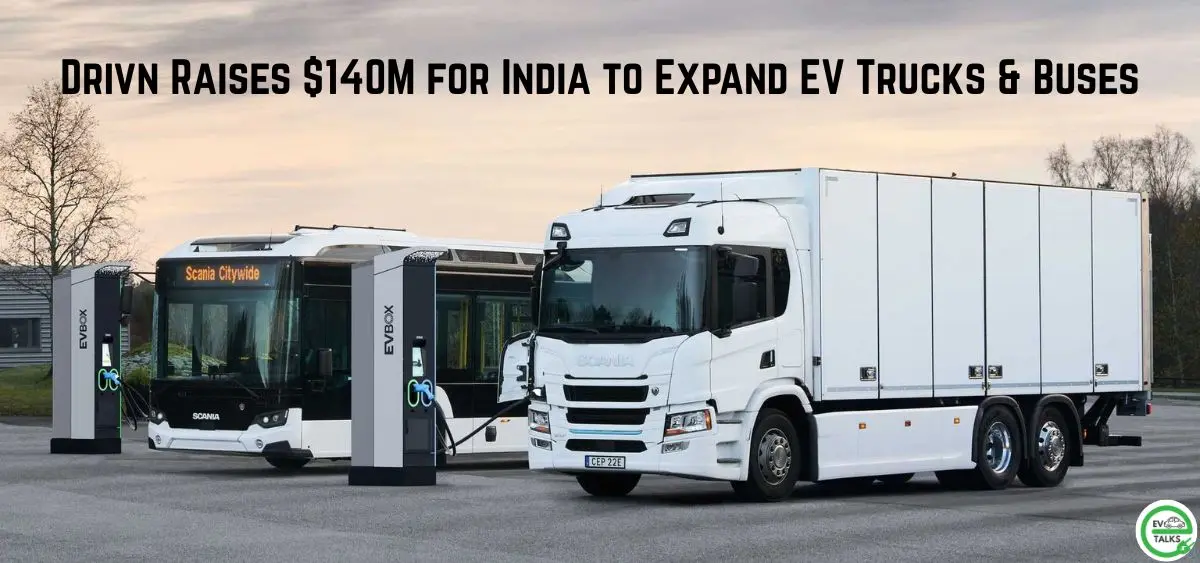

Electric mobility startup Drivn has raised $140 million to accelerate its expansion in India’s commercial EV space, with a strong focus on electric buses and trucks. The funding round includes an $80 million commitment from Japan’s Nomura, structured as a mix of debt and equity and scheduled to be deployed in phases. This development marks a significant milestone as Drivn raises $140M for India to tap into one of the most challenging yet promising EV segments.
Targeting the Toughest EV Segment
Unlike passenger EVs, heavy commercial vehicles such as buses and trucks remain largely dependent on diesel in India. High upfront costs and limited charging infrastructure have slowed adoption. However, Drivn raises $140M for India with a strategy that focuses not on selling vehicles but on solving financial and operational barriers that prevent fleet electrification.

Asset-Heavy Leasing Model Explained
Drivn operates on a capital-intensive leasing model designed to remove the burden of ownership for fleet operators. Its approach includes:
- Purchasing electric buses and trucks
- Leasing them through long-term contracts
- Building dedicated charging infrastructure at depots and freight corridors
This model directly addresses cost concerns. A 12-meter electric bus in India costs between ₹1.5 and 2.2 crore—around 2 to 2.5 times more than a diesel counterpart. By offering leasing solutions, Drivn raises $140M for India to eliminate this upfront barrier.
Cost Advantage Driving Adoption
Drivn estimates that electric vehicles can reduce operating costs to approximately ₹35 per km, compared to ₹50 per km for diesel vehicles. This difference can result in savings of up to ₹30 lakh per bus annually, depending on usage. These economics could play a crucial role in convincing fleet operators to transition toward EVs.
Competition Heats Up
The company enters a highly competitive market dominated by established players like Tata Motors, Ashok Leyland, Mahindra & Mahindra, and Eicher Motors. These companies already have strong manufacturing capabilities and growing EV portfolios.
To stand out, Drivn raises $140M for India with a neutral fleet aggregation strategy—sourcing vehicles from multiple OEMs instead of relying on a single manufacturer.
Infrastructure Challenges and Risks
Charging infrastructure remains a critical hurdle. Heavy-duty EVs require high-capacity, route-specific charging systems that are still limited across India. Drivn plans to mitigate this by developing its own charging network at strategic locations.
However, risks persist, including:
- Uncertain resale value of commercial EVs
- High capital and debt exposure
- Dependence on consistent fleet utilization
- Competition from OEM-backed fleet solutions
Policy Tailwinds and Growth Vision
Government initiatives like FAME II and PM E-DRIVE are supporting EV adoption through subsidies and infrastructure incentives. India’s target of 30% EV penetration by 2030 further strengthens the outlook.
Drivn plans to leverage this policy support over the next 5–7 years, aiming to build a fleet asset base exceeding ₹1,200 crore and achieve around ₹1,340 crore in assets under management by FY27.
As Drivn raises $140M for India, the company is positioning itself as a key player in transforming the country’s commercial transport ecosystem toward sustainable mobility.

Related Articles: