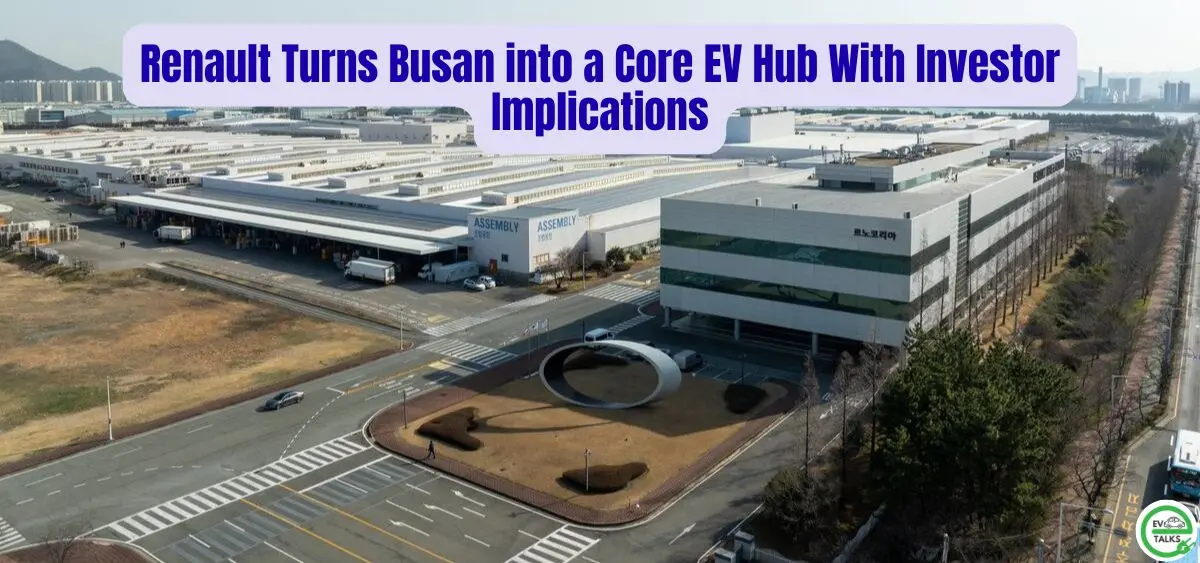

Renault Group has taken a decisive step in its electric vehicle journey by transforming its Busan facility in South Korea into a global production hub for next-generation EVs and flagship models. This move, central to its “Future-Ready” strategy, highlights how Renault turns Busan into a core EV Hub to strengthen its position in the rapidly evolving automotive landscape.
A Clear EV-Centric Production Roadmap
Under this strategy, Renault will begin in-house production of pure battery electric vehicles (BEVs) at the Busan plant starting in 2028. The company has also committed to launching one new electrified model annually through 2029, ensuring a consistent product pipeline.
A major highlight is the introduction of software-defined vehicles (SDVs), with the first AI-powered model expected in 2027. These vehicles aim to redefine mobility, functioning like “smartphones on wheels.” The Busan facility will also focus on producing larger D- and E-segment vehicles, positioning it as a specialized export base.

Additionally, the plant will begin contract manufacturing of the all-electric Polestar 4 from the second half of 2025, targeting both North American and domestic markets.
Building a Localized EV Ecosystem
A key pillar of the plan is local battery production. Renault is partnering with LG Energy Solution to establish a domestic battery supply chain, aligning production closer to advanced electronics and EV technology ecosystems in South Korea.
This strategic positioning reflects how Renault turns Busan into a core EV Hub not just for manufacturing but for integrating supply chains, improving efficiency, and accelerating innovation.
Operational Strength and Partnerships
The Busan plant already boasts advanced capabilities, including 881 robots and 400 AI-powered inspection systems. With an annual capacity of up to 300,000 units, the facility can produce internal combustion, hybrid, and electric vehicles simultaneously using its flexible “multi-energy” production line.
Renault’s collaboration with Geely Holding and partnerships with Polestar further strengthen its global footprint. The company aims to achieve a balanced sales mix of 50% hybrids and 50% EVs by 2030.
Investor Implications and Risk Factors
For investors, Renault Turns Busan Into Core EV Hub signals a strategic shift toward high-margin segments and localized production. The defined roadmap of annual launches provides better visibility into capital allocation and growth planning.
However, risks remain. Concentrating production in one region exposes Renault to currency fluctuations, geopolitical tensions, and labor challenges in South Korea. Building a domestic battery ecosystem also requires significant upfront investment.
Balancing Competition and Strategy
Unlike some competitors, Renault has chosen not to engage in aggressive EV price wars led by Chinese automakers. Instead, it emphasizes product strength and sustainable pricing.
Ultimately, Renault Turns Busan Into Core EV Hub represents a calculated move to enhance competitiveness, leverage advanced supply chains, and secure a stronger foothold in the global EV market.

Related Articles: